
Puck, 1877-05 · page 14 of 16
Puck — May 1877 — page 14: what you’re looking at
What you’re looking at
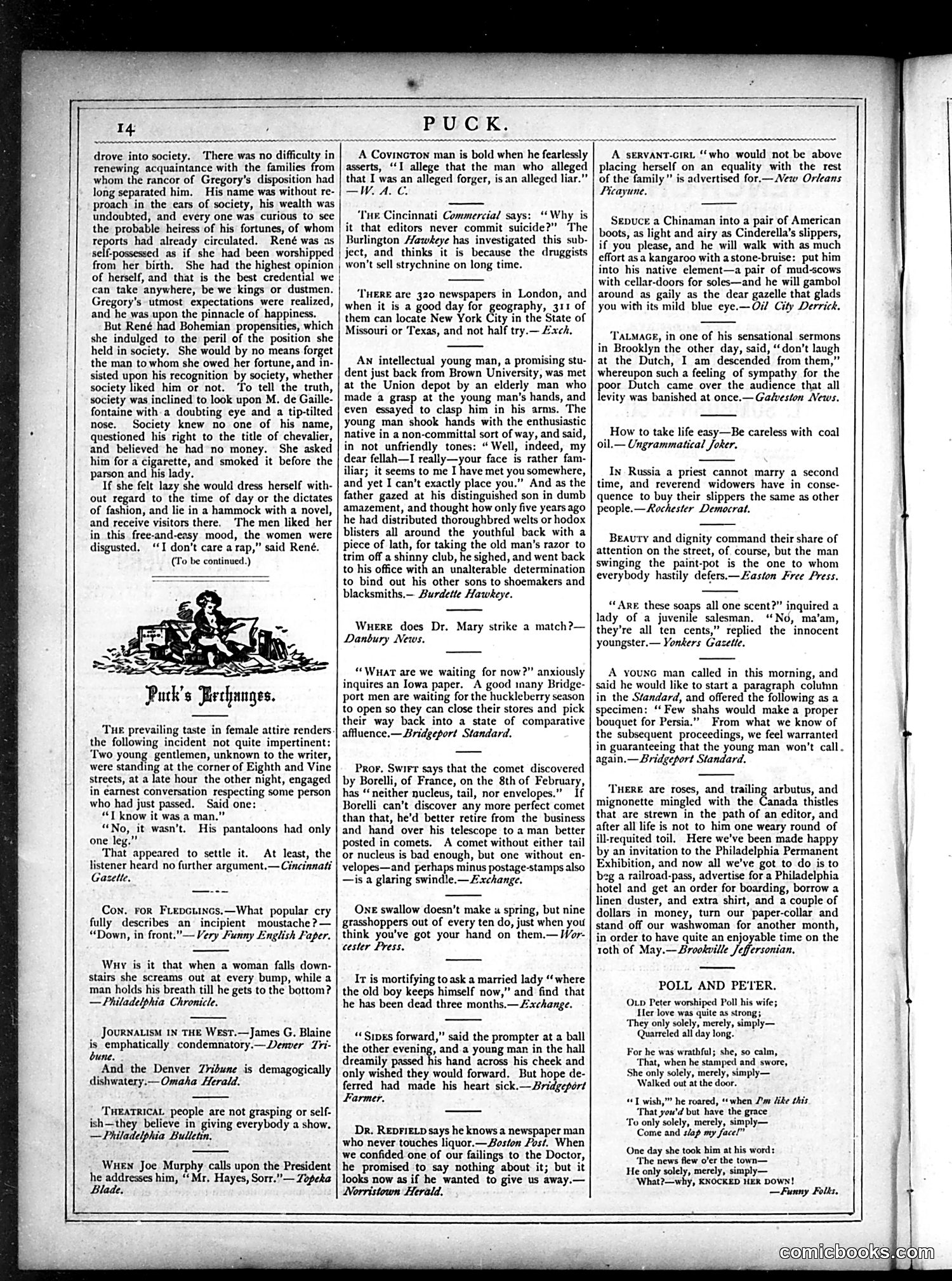
This page contains short humorous commentary items rather than traditional political cartoons. The section includes jokes and observations about contemporary American life, sourced from various newspapers. Topics include: a woman's impractical fashion choices; a Covington man allegedly forging a check; the prevalence of newspapers in New York; an encounter between a Brown University student and an elderly man at Union Depot; and various social absurdities. A small illustration at bottom-left shows what appears to be a domestic scene with figures in period dress. The items mock everyday follies—vanity, dishonesty, romantic misunderstandings, and social pretension—rather than targeting specific political figures. This reflects *Puck*'s satirical approach to American manners and behavior during this era.
📄 Transcribed text from this page (OCR, searchable)
Machine-transcribed from the original scan — historical spelling and the odd misread are preserved.
ore } drove into society. There was no difficulty in renewing acquaintance with the families from whom the rancor of Gregory’s disposition had long separated him. His name was without re- proach in the ears of society, his wealth was undoubted, and every one was curious to sce the probable heiress of his fortunes, of whom aeports had already circulated. René was as self-possessed as if she had been worshipped from her birth. She had the highest opinion of herself, and that is the best credential we can take anywhere, be we kings or dustmen. | Gregory’s utmost expectations were realized, || and he was upon the pinnacle of happiness. | But René had Bohemian propensities, which she indulged to the peril of the position she held in society. She would by no means forget the man to whom she owed her fortune, and in- sisted upon his recognition by society, whether society liked him or not. To tell the truth, society was inclined to look upon M. de Gaille- fontaine with a doubting eye and a tip-tilted nose. Society knew no one of his name, questioned his right to the title of chevalier, and believed he had no money. She asked him for a cigarette, and smoked it before the parson and his lady. If she felt lazy she would dress herself with- out regard to the time of day or the dictates of fashion, and lie in a hammock with a novel, and receive visitors there. ‘The men liked her in this free-and-eesy mood, the women were “T don't care a rap,” said René. (To be continued.) disgusted. Tue prevailing taste in female attire renders. the following incident not quite impertinent: ‘Two young gentlemen, unknown to the writer, were standing at the corner of Eighth and Vine streets, at a late hour the other night, engaged in earnest conversation respecting some person who had just passed. Said one: “T know it was a man.” “No, it wasn’t. His pantaloons had only one leg.” That appeared to settle it. At least, the listener heard no further argument.— Cincinnati Gazette, Con. ror FLepcincs.—What popular cry fully describes an incipient moustache? — “Down, in front.”—Very Funny English Faper, Why is it that when a woman falls down- stairs she screams out at every bump, while a man holds his breath till he gets to the bottom? —Philadelphia Chronicle. JOURNALISM IN THE WesT.—James G. Blaine is emphatically condemnatory.—Denver Zri- bune. And the Denver Zribune is demagogically dishwatery.— Omaha Herald. ‘THEATRICAL people are not grasping or self- ish—they believe in giving everybody a show. —Philadelphia Bulletin, Wie Joe Murphy calls upon the President pe adaisaees him, “Mr, Hayes, Sorr.”— Zopeka Blade. A Covincton man is bold when he fearlessly asserts, ‘I allege that the man who alleged that I was an alleged forger, is an alleged liar.” —W.ALC. ‘Tne Cincinnati Commercial says: “Why is it that editors never commit suicide?" The Burlington Hawkeye has investigated this sub- ject, and thinks it is because the druggists won't sell strychnine on long time. ‘THERE are 320 newspapers in London, and when it is a good day for geography, 311 of them can locate New York City in the State of Missouri or Texas, and not half try.— £xch. AN intellectual young man, a promising stu- dent just back from Brown University, was met at the Union depot by an elderly man who made a grasp at the young man’s hands, and even essayed to clasp him in his arms. The young man shook hands with the enthusiastic native in a non-committal sort of way, and said, in not unfriendly tones: “ Well, indeed, my dear fellah—I really—your face is rather fam- iliar; it seems to me I have met you somewhere, and yet I can't exactly place you.” And as the father gazed at his distinguished son in dumb amazement, and thought how only five years ago he had distributed thoroughbred welts or hodox blisters all around the youthful back with a piece of lath, for taking the old man’s razor to trim off a shinny club, he sighed, and went back to his office with an unalterable determination to bind out his other sons to shoemakers and blacksmiths, Burdette Hawkeye. Wuere does Dr. Mary strike a match?— Danbury News. “Wuat are we waiting for now?” anxiously inquires an Iowa paper. A good inany Bridge- port men are waiting for the huckleberry season to open so they can close their stores and pick their way back into a state of comparative affluence.— Bridgeport Standard. Pror. Swit says that the comet discovered by Borelli, of France, on the 8th of February, has ‘neither nucleus, tail, nor envelopes.” If Borelli can’t discover any more perfect comet than that, he’d better retire from the business and hand over his telescope to a man better posted in comets. A comet without either tail or nucleus is bad enough, but one without en- velopes—and perhaps minus postage-stamps also —is a glaring swindle.— Exchange. One swallow doesn’t make a spring, but nine grasshoppers out of every ten do, just when you think you've got your hand on them.— Wor- ester Press. Ir is mortifying to ask a married lady “where the old boy keeps himself now,” and find that he has been dead three months.— Exchange. ‘Sirs forward,” said the prompter at a ball the other evening, and a young man in the hall dreamily passed his hand across his cheek and only wished they would forward. But hope de- ferred had made his heart sick.— Bridgeport Farmer. Dr. RepFieip says he knows a newspaper man who never touches liquor.— Boston Post. When we confided one of our failings to the Doctor, he promised to say nothing about it; but it looks now as if he wanted to give us away.— Norristown Herald, — A seRVANT-cIRL ‘who would not be above placing herself on an equality with the rest of the family” is advertised for.— New Orleans Picayune. Sepuce a Chinaman into a pair of American boots, as light and airy as Cinderella’s slippers, if you please, and he will walk with as much effort as a kangaroo with astone-bruise: put him into his native element—a pair of mud-scows with cellar-doors for soles—and he will gambol around as gaily as the dear gazelle that glads you with its mild blue eye.—Oil City Derrick. ‘TALMAGE, in one of his sensational sermons in Brooklyn the other day, said, “don’t laugh at the Dutch, I am descended from them,” whereupon such a feeling of sympathy for the oor Dutch came over the audience that all levity was banished at once.— Galveston News. How to take life easy—Be careless with coal oil.— Ungrammatical Joker, In Russia a priest cannot marry a second time, and reverend widowers have in conse- quence to buy their slippers the same as other people.—Rochester Democrat. Beauty and dignity command their share of attention on the street, of course, but the man swinging the paint-pot is the one to whom everybody hastily defers.—Laston Free Press. “ARE these soaps all one scent?” inquired a lady of a juvenile salesman. “No, ma’am, they’re all ten cents,” replied the innocent youngster.— Yonkers Gazette. A younc man called in this morning, and said he would like to start a paragraph column in the Standard, and offered the following as a specimen: “Few shahs would make a proper Douquet for Persia.” From what we know of the subsequent proceedings, we feel warranted in guaranteeing that the young man won't call. again.— Bridgeport Standard. ‘THERE are roses, and trailing arbutus, and mignonette mingled with the Canada thistles that are strewn in the path of an editor, and after all life is not to him one weary round of ill-requited toil. Here we've been made happy by an invitation to the Philadelphia Permanent Exhibition, and now all we've got to do is to beg a railroad-pass, advertise for a Philadelphia hotel and get an order for boarding, borrow a linen duster, and extra shirt, and a couple of dollars in money, turn our paper-collar and stand off our washwoman for another month, in order to have quite an enjoyable time on the toth of May.—Brookville Jeffersonian, POLL AND PETER. Op Peter worshiped Poll his wife; Iler love was quite as strong; They only solely, merely, simply — Quarreled all day long. For he was wrathful; she, so calm, ‘That, when he stamped and swore, She only solely, merely, simply— ‘Walked out at the door. “wish,” he roared, “when Dm like this ‘That you'd but have the grace ‘To only solely, merely, simply— Come and slap my face!” ‘One day she took him at his word: ‘The news flew o’er the town— He only solely, merely, simply— ‘What?—why, KNOCKED HER DOWN! —Funny Folks. Elsa as comichooksxeom