
Puck, 1877-05 · page 11 of 16
Puck — May 1877 — page 11: what you’re looking at
What you’re looking at
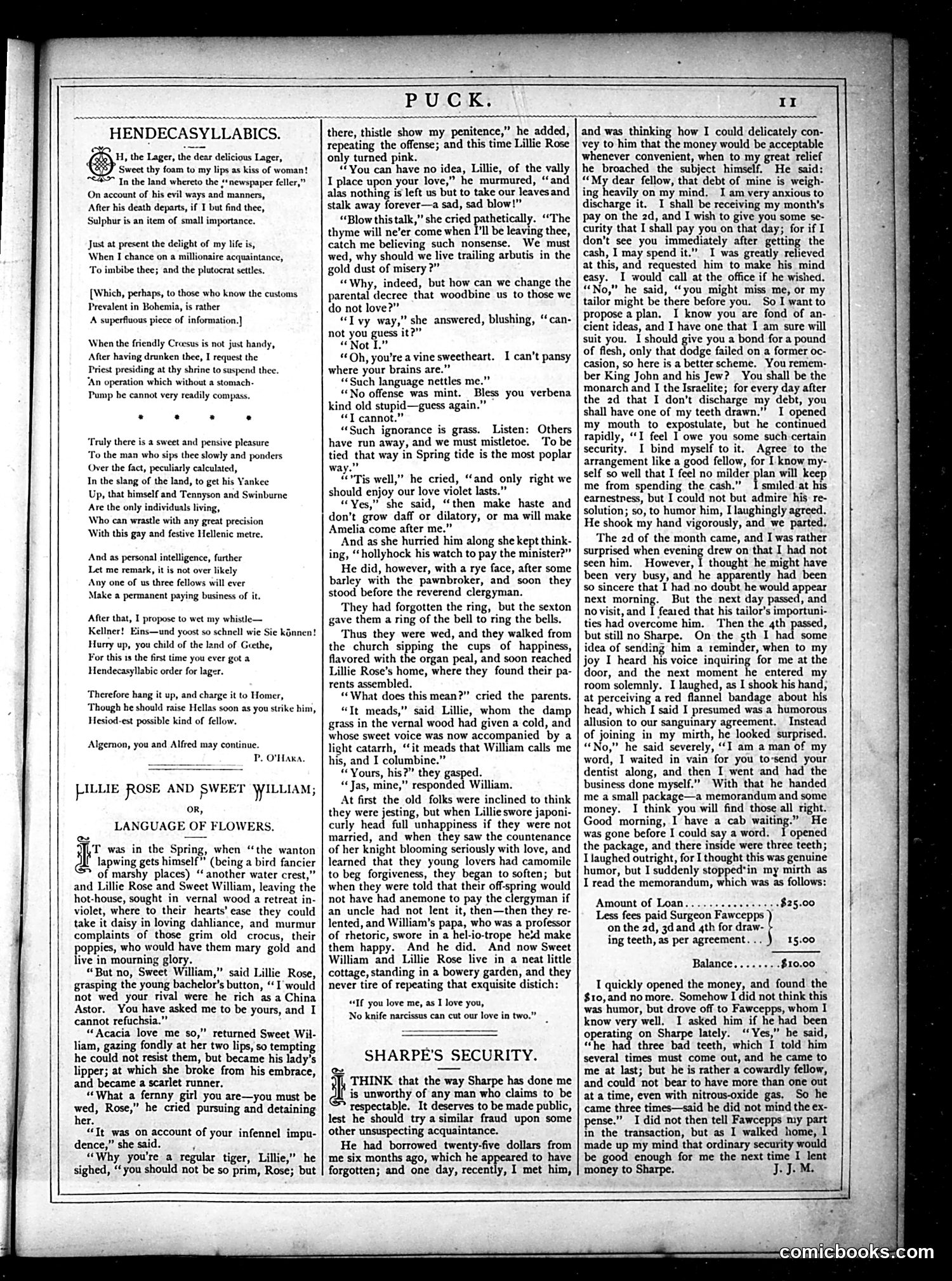
This page contains two distinct sections: a poem titled "Hendecasyllabics" (eleven-syllable verse) and two prose stories—"Lillie Rose and Sweet William: A Language of Flowers" and "Sharpe's Security." The content appears to be **fictional entertainment rather than political satire**. The stories involve romantic entanglements and financial matters among named characters (William, Lillie Rose, Sharpe). "Hendecasyllabics" is lyric poetry addressing themes of love and loss. **No clear political figures or satirical targets are visible**. This represents Puck's lighter literary content—the magazine balanced hard-hitting political cartoons with humorous fiction and verse for general entertainment. Without accompanying illustrations on this particular page, the satirical intent (if any) remains unclear.
📄 Transcribed text from this page (OCR, searchable)
Machine-transcribed from the original scan — historical spelling and the odd misread are preserved.
HENDECASYLLABICS. H, the Lager, the dear delicious Lager, ‘ Sweet thy foam to my lips as kiss of woman! In the land whereto the “newspaper feller,” On account of his evil ways and manners, After his death departs, if I but find thee, Sulphur is an item of small importance. Just at present the delight of my life is, When I chance on a millionaire acquaintance, To imbibe thee; and the plutocrat settles. [Which, perhaps, to those who know the customs Prevalent in Bohemia, is rather A superfluous piece of information.} When the friendly Croesus is not just handy, After having drunken thee, I request the Priest presiding at thy shrine to suspend thee. ‘An operation which without a stomach- Pump he cannot very readily compass. . * . . ‘Truly there is a sweet and pensive pleasure ‘To the man who sips thee slowly and ponders Over the fact, peculiarly calculated, In the slang of the land, to get his Yankee Up, that himself and Tennyson and Swinburne Are the only individuals living, Who can wrastle with any great precision With this gay and festive Hellenic metre. And as personal intelligence, further Let me remark, it is not over likely Any one of us three fellows will ever Make a permanent paying business of it. After that, I propose to wet my whistle— Kellner! Eins—und yoost so schnell wie Sie kinnen! Hurry up, you child of the land of Geethe, For this 18 the first time you ever got a Hendecasyllabie order for lager. ‘Therefore hang it up, and charge it to Homer, ‘Though he should raise Hellas soon as you strike him, Hesiod-est possible kind of fellow. Algemon, you and Alfred may continue. P. O'Haka. PILLIE ROSE AND SWE oR, LANGUAGE OF FLOWERS. WILLIAM; es sitet a", was in the Spring, when “the wanton lapwing gets himself” (being a bird fancier of marshy places) “another water crest,” and Lillie Rose and Sweet William, leaving the hot-house, sought in vernal wood a retreat in- violet, where to their hearts’ ease they could take it daisy in loving dahliance, and murmur complaints of those grim old’ crocus, their poppies, who would have them mary gold and live in mourning glory. “But no, Sweet William,” said Lillie Rose, grasping the young bachelor’s button, “I would not wed your rival were he rich as a China Astor. You have asked me to be yours, and I cannot refuchsia.”” “Acacia love me so,” returned Sweet Wil- liam, gazing fondly at her two lips, so tempting he could not resist them, but became his lady’s lipper; at which she broke from his embrace, and became a scarlet runner. “What a fernny girl you are—you must be red Rose,” he cried pursuing and detaining er. “Tt was on account of your infennel impu- dence,” she said. 3 “Why you're a regular tiger, Lillie,” he sighed, “you should not be so prim, Rose; but PUCK. there, thistle show my penitence,” he added, repeating the offense; and this time Lillie Rose only turned pink. “You can have no idea, Lillie, of the vally I place upon your love,” he murmured, “and alas nothing is left us but to take our leavesand stalk away forever—a sad, sad blow!” “Blow this talk,” she cried pathetically. “The thyme will ne’er come when I'll be leaving thee, catch me believing such nonsense. We must wed, why should we live trailing arbutis in the gold dust of misery ?” “Why, indeed, but how can we change the parental decree that woodbine us to those we do not love?” ; “Ivy way,” she answered, blushing, ‘“can- not you guess it?” “Not 1.” “Oh, you're a vine sweetheart. I can’t pansy where your brains are.” “Such language nettles me.” “No offense was mint. Bless you verbena kind old stupid—guess again.” “T cannot.” “Such ignorance is grass. Listen: Others have run away, and we must mistletoe. To be tied that way in Spring tide is the most poplar way.” “ ’Tis well,” he cried, “and only right we should enjoy our love violet lasts.” “Yes,” she said, “then make haste and don’t grow daff or dilatory, or ma will make Amelia come after me.” And as she hurried him along she kept think- ing, ‘“‘hollyhock his watch to pay the minister?” He did, however, with a rye face, after some barley with the pawnbroker, and soon they stood before the reverend clergyman. They had forgotten the ring, but the sexton gave them a ring of the bell to ring the bells. Thus they were wed, and they walked from the church sipping the cups of happiness, flavored with the organ peal, and soon reached Lillie Rose’s home, where they found their pa- rents assembled. ‘What does this mean?” cried the parents. “Tt meads,” said Lillie, whom the damp grass in the vernal wood had given a cold, and whose sweet voice was now accompanied by a light catarrh, ‘it meads that William calls me his, and I columbine.”” “Yours, his?” they gasped. “Jas, mine,” responded William. At first the old folks were inclined to think they were jesting, but when Lillie swore japoni- curly head full unhappiness if they were not married, and when they saw the countenance of her knight blooming seriously with love, and learned that they young lovers had camomile to beg forgiveness, they began to soften; but when they were told that their off-spring would not have had anemone to pay the clergyman if an uncle had not lent it, then—then they re- lented, and William's papa, who was a professor of rhetoric, swore in a hel-io-trope heid make them happy. And he did. And now Sweet William and Lillie Rose live in a neat little cottage, standing in a bowery garden, and they never tire of repeating that exquisite distich: “If you love me, as I love you, No knife narcissus can cut our love in two.” SHARPE'S SECURITY. THINK that the way Sharpe has done me is unworthy of any man who claims to be respectable. It deserves to be made public, lest he should try a similar fraud upon some other unsuspecting acquaintance. He had borrowed twenty-five dollars from and was thinking how I could delicately con- vey to him that the money would be acceptable whenever convenient, when to my great relief he broached the subject himself. He said: “My dear fellow, that debt of mine is weigh- ing heavily on my mind. I am very anxious to discharge it. I shall be receiving my month’s pay on the 2d, and I wish to give you some se- curity that I shall pay you on that day; for if I don’t see you immediately after getting the cash, I may spend it.” I was greatly relieved at this, and requested him to make his mind easy. I would call at the office if he wished. “No,” he said, “you might miss me, or my tailor might be there before you. So I want to propose a plan. I know you are fond of an- cient ideas, and I have one that I am sure will suit you. I should give you a bond for a pound of flesh, only that dodge failed on a former oc- casion, so here is a better scheme. You remem- ber King John and his Jew? You shall be the monarch and I the Israelite; for every day after the 2d that I don’t discharge my debt, you shall have one of my teeth drawn.” I opened my mouth to expostulate, but he continued rapidly, “I feel T owe you some such certain security. I bind myself to it. Agree to the arrangement like a good fellow, for I know my- self so well that I feel no milder plan will kee me from spending the cash.” I smiled -at his earnestness, but I could not but admire his re- solution; so, to humor him, I laughingly agreed. He shook my hand vigorously, and we parted. The 2d of the month came, and I was rather surprised when evening drew on that I had not seen him. However, I thought he might have been very busy, and he apparently had been so sincere that I had no doubt he would appear next morning. But the next day passed, and no visit, and I feared that his tailor’s importuni- ties had overcome him. Then the 4th 5 but still no Sharpe. On the sth I had some idea of sending him a reminder, when to my joy I heard his voice anquiring for me at the door, and the next moment he entered m room solemnly. I laughed, as I shook his hand; at perceiving a red flannel bandage about his head, which I said I presumed was a humorous allusion to our sanguinary agreement. Instead of joining in my mirth, he looked surprised. “No,” he said severely, “I am a man of my word, I waited in vain for you to-send your dentist along, and then I went and had the business done myself.” With that he handed me a small package—a memorandum and some money. I think you will find those all right. Good morning, I have a cab waiting.” He was gone before I could say a word. J opened the package, and there inside were three teeth; I laughed outright, for I thought this was genuine humor, but I suddenly stopped'in my mirth as I read the memorandum, which was as follows: Amount of Loan...... Ansan $25.00 Less fees paid Surgeon Fawcepps on the ad, 3d and 4th for draw- ing teeth, as per agreement. .. 15.00 Balance,.......$10.00 I quickly opened the money, and found the $10, and no more. Somehow I did not think this was humor, but drove off to Fawcepps, whom I know very well. I asked him if he had been operating on Sharpe lately. ‘ Yes,” he said, “he had three bad teeth, which I told him several times must come out, and he came to me at last; but he is rather a cowardly fellow, and could not bear to have more than one out at a time, even with nitrous-oxide gas. So he came three See he did not mind the ex- nse.” I did not then tell Fawcepps my part si the transaction, but as I walked, home, 1 made up my mind that ordinary security would me six months ago, which he appeared to have forgotten; and one day, recently, I met him, be good enough for me the next time I lent money to Sharpe. |. J. Me