
Penny Dreadfuls, 1900 · page 306 of 399
The Mysteries of the Court of London — page 306: what you’re looking at
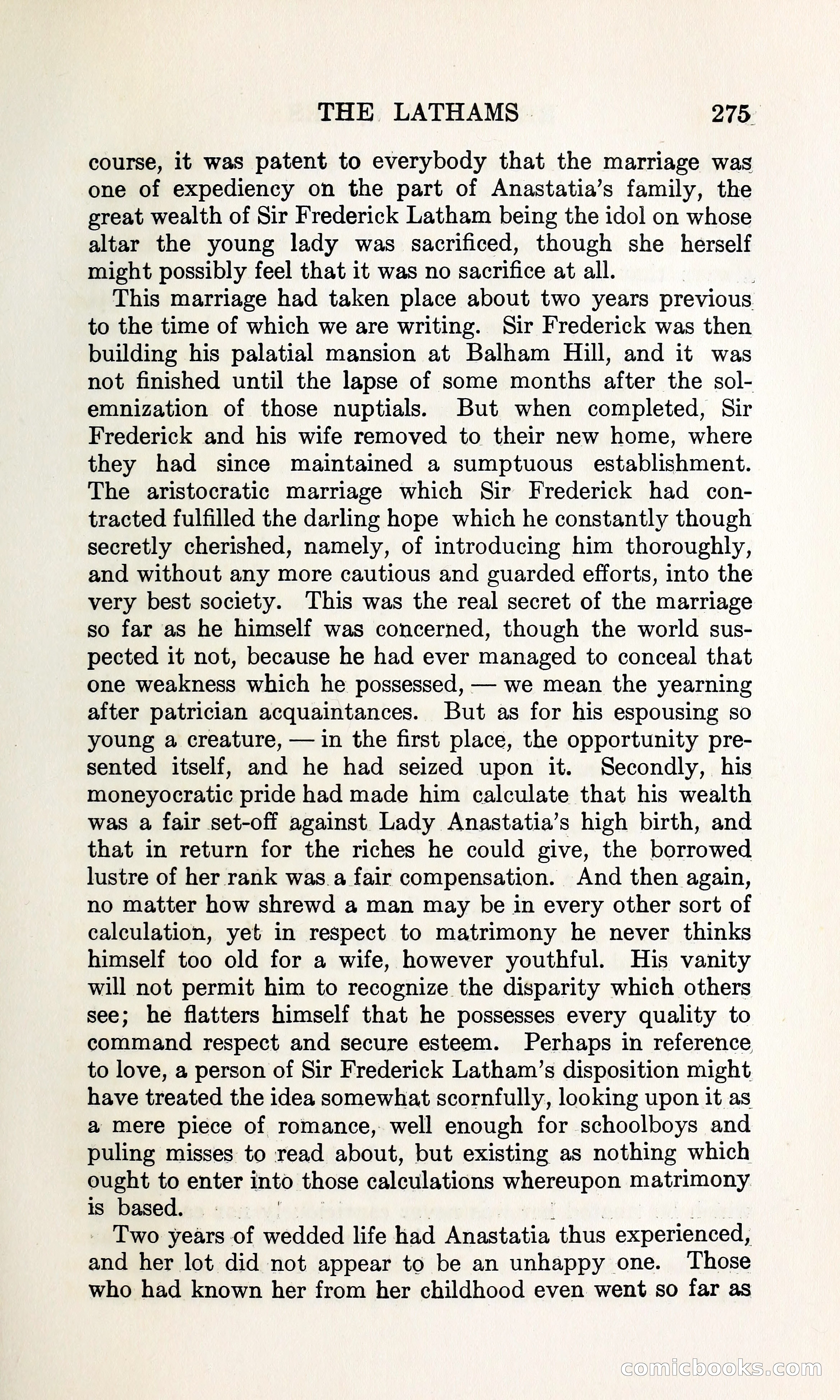
A restored page from Penny Dreadfuls, 1900. Page through the whole issue in the reader above.
📄 Transcribed text from this page (OCR, searchable)
Machine-transcribed from the original scan — historical spelling and the odd misread are preserved.
THE LATHAMS . 275_ course, it was patent to everybody that the marriage was one of expediency on the part of Anastatia’s family, the great wealth of Sir Frederick Latham being the idol on whose altar the young lady was sacrificed, though she herself might possibly feel that it was no sacrifice at all. This marriage had taken place about two years previous to the time of which we are writing. Sir Frederick was then building his palatial mansion at Balham Hill, and it was not finished until the lapse of some months after the sol- emnization of those nuptials. But when completed, Sir Frederick and his wife removed to their new home, where they had since maintained a sumptuous establishment. The aristocratic marriage which Sir Frederick had con- tracted fulfilled the darling hope which he constantly though secretly cherished, namely, of introducing him thoroughly, and without any more cautious and guarded efforts, into the very best society. This was the real secret of the marriage so far as he himself was concerned, though the world sus- pected it not, because he had ever managed to conceal that one weakness which he possessed, — we mean the yearning after patrician acquaintances. But as for his espousing so young a creature, — in the first place, the opportunity pre- sented itself, and he had seized upon it. Secondly, his moneyocratic pride had made him calculate that his wealth was a fair set-off against Lady Anastatia’s high birth, and that in return for the riches he could give, the borrowed lustre of her rank was.a fair compensation. And then again, no matter how shrewd a man may be in every other sort of calculation, yet in respect to matrimony he never thinks himself too old for a wife, however youthful. His vanity will not permit him to recognize the disparity which others see; he flatters himself that he possesses every quality to command respect and secure esteem. Perhaps in reference to love, a person of Sir Frederick Latham’s disposition might have treated the idea somewhat scornfully, looking upon it as a mere piece of romance, well enough for schoolboys and puling misses to read about, but existing as nothing which ought to enter into those calculations whereupon matnmony is based. 7 Two years: of wedded life had de tiation thus experienced, in her lot did not appear to be an unhappy one. Those who had known her from her childhood even went so far as ECORNICLOOOKS (CO)