
Penny Dreadfuls, 1900 · page 307 of 399
The Mysteries of the Court of London — page 307: what you’re looking at
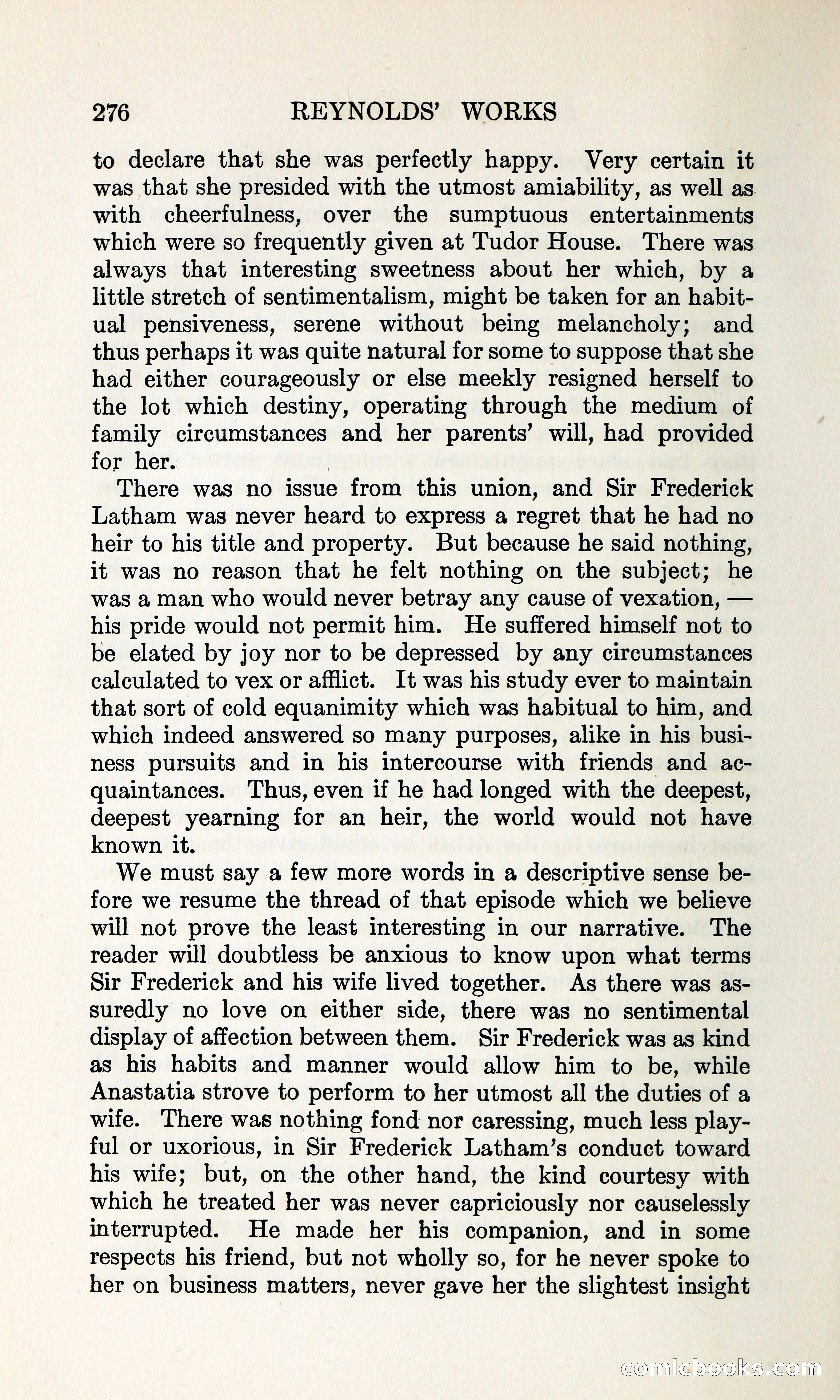
A restored page from Penny Dreadfuls, 1900. Page through the whole issue in the reader above.
📄 Transcribed text from this page (OCR, searchable)
Machine-transcribed from the original scan — historical spelling and the odd misread are preserved.
276 REYNOLDS’ WORKS to declare that she was perfectly happy. Very certain it was that she presided with the utmost amiability, as well as with cheerfulness, over the sumptuous entertainments which were so frequently given at Tudor House. There was always that interesting sweetness about her which, by a little stretch of sentimentalism, might be taken for an habit- ual pensiveness, serene without being melancholy; and thus perhaps it was quite natural for some to suppose that she had either courageously or else meekly resigned herself to the lot which destiny, operating through the medium of family circumstances and her parents’ will, had provided for her. | There was no issue from this union, and Sir Frederick Latham was never heard to express a regret that he had no heir to his title and property. But because he said nothing, it was no reason that he felt nothing on the subject; he was a man who would never betray any cause of vexation, — his pride would nct permit him. He suffered himself not to be elated by joy nor to be depressed by any circumstances calculated to vex or afflict. It was his study ever to maintain that sort of cold equanimity which was habitual to him, and which indeed answered so many purposes, alike in his busi- ness pursuits and in his intercourse with friends and ac- quaintances. Thus, even if he had longed with the deepest, deepest yearning for an heir, the world would not have known it. | We must say a few more words in a descriptive sense be- fore we resume the thread of that episode which we believe will not prove the least interesting in our narrative. The reader will doubtless be anxious to know upon what terms Sir Frederick and his wife lived together. As there was as- suredly no love on either side, there was no sentimental display of affection between them. Sir Frederick was as kind as his habits and manner would allow him to be, while Anastatia strove to perform to her utmost all the duties of a wife. There was nothing fond nor caressing, much less play- ful or uxorious, in Sir Frederick Latham’s conduct toward his wife; but, on the other hand, the kind courtesy with which he treated her was never capriciously nor causelessly interrupted. He made her his companion, and in some respects his friend, but not wholly so, for he never spoke to her on business matters, never gave her the slightest insight ECORNIGLOOKS (E(0)