
Penny Dreadfuls, 1897 · page 7 of 16
Captain Joe; or, The Days of the Mint — page 7: what you’re looking at
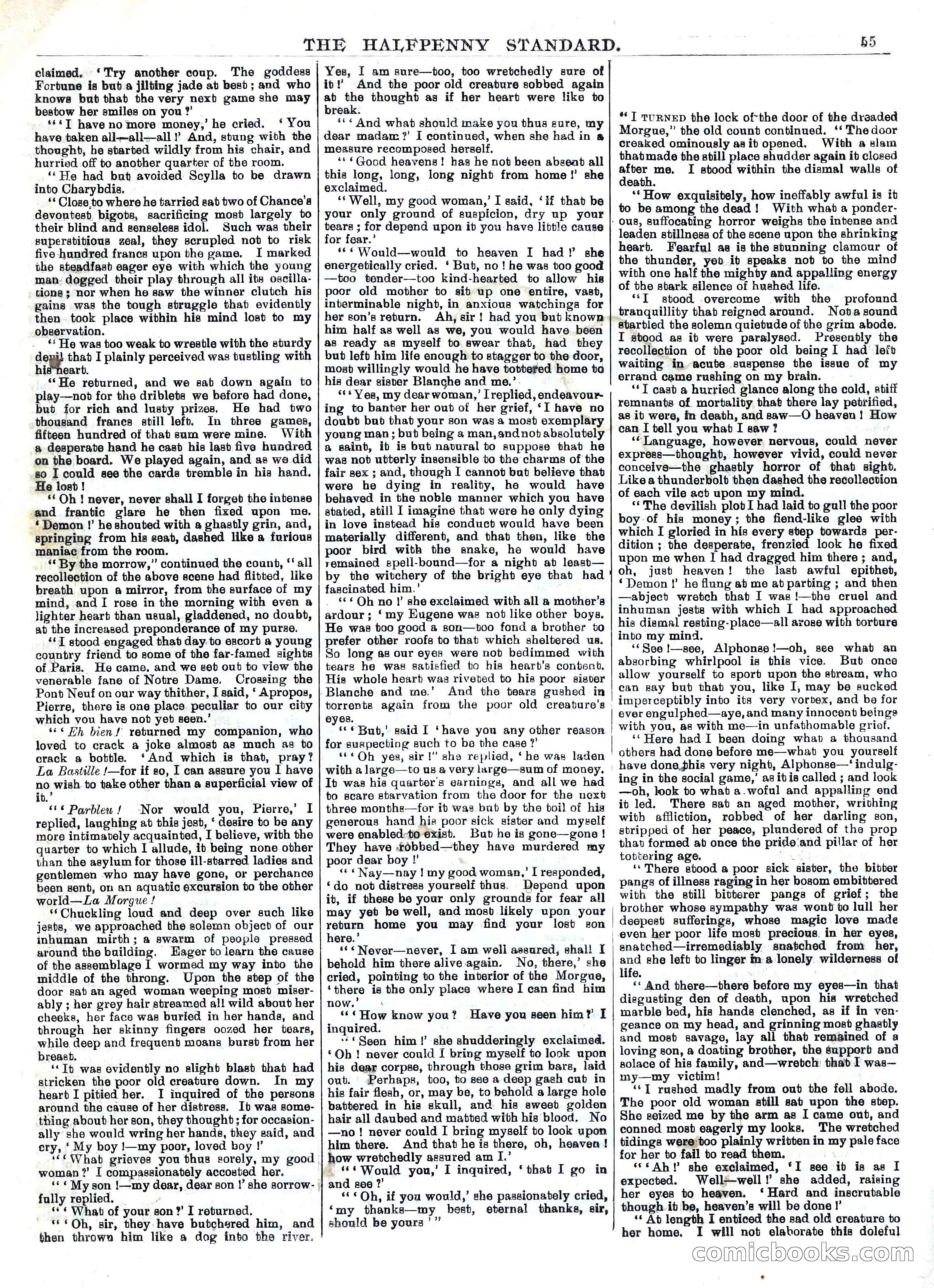
A restored page from Penny Dreadfuls, 1897. Page through the whole issue in the reader above.
📄 Transcribed text from this page (OCR, searchable)
Machine-transcribed from the original scan — historical spelling and the odd misread are preserved.
claimed. ‘Try another coup. The goddess Fortune is bubs jilting jade ab beat; and who knowa but that the very next game she may bestow her smiles on you ?’ *¢6T have no more money,’ he cried. ‘ You have taken all—all—all!’ And, stung with the thought, he started wildly from his chair, and hurrisd off to another quarter of the room. ‘He had but avoided Scylla to be drawn into Charybdis. ‘* Close, to where he tarried sab two of Chance’s Gevoutest, bigots, sacrificing mosb largely to their blind and senseless idol. Such was their superstitious zeal, they scrupled not to risk five hundred francs upon the game. I marked the steadfast eager eye with which the young man: dogged their play through all its oscilla- tions 3 nor when he saw the winner clutch his gains was the tough struggle that evidently then took place within his mind lost to my obeervation. ** He was too weak to wrestle with the sturdy doup that I plainly perceived was tustling with his*neart. “He returned, and we sab down again to play—nob for the dribleta we before had done, but for rich and lusty prizes, He had two thousand franes still left. In three games, fifteen hundred of that sum were mine. With a desperate hand he caat hia last five hundred on the board. We played again, and as we did so I could see the cards tremble in hia hand. He lost } ‘* Oh ! never, never shall I forget the intense and frantic glare he then fixed upon me. ‘Demon |’ he shouted with a ghastly grin, and, springing from his seat, dashed like a furious maniac from the room. ‘By the morrow,” continued the count, “all recollection of the above scene had flittbed, like breath upon a mirror, from the surface of my mind, and I rose in the morning with even a lighter heart than usual, gladdened, no doubt, ab the increased preponderance of my purse. ‘*T stood engaged that day. to escort a young country friend to some of the far-famed sights of Paria. He came, and we ged out to view the venerable fane of Notre Dame. Crosaing the Pont Neuf on our way thither, I said, ‘ Apropos, Pierre, there is one place peculiar to our city which you have not yet seen.’ “<< Th bien returned my companion, who loved to crack a joke almost as much as to crack a bottle. ‘And which is that, pray? La Bastille !—for if 80, I can assure you I have no wish to take other than a superficial view of ‘6 Parblew ! Nor would you, Pierre,’ I replied, laughing at this jest, ‘ desire to be any more intimately acquainted, I believe, with the quarter to which I allude, ib being none obher than the asylum for those ill-starred ladies and gentlemen who may have gone, or perchance been sent, on an aquatic excursion to the other world—La Morgue ! ‘Chuckling loud and deep over such like jests, we approached the solemn object of our inhuman mirth; a swarm of people preased around the building, Hager to learn the cauge of the assemblage I wormed my way into the middle of the throng. Upon the atep of the door sat an aged woman weeping most miser- ably ; her grey hair streamed all wild about her cheeks, her face was buried in her hands, and through her skinny fingers oozed her tears, while deep and frequent moans burab from her breaab, ‘Tp was evidently no slight blasb thab had stricken the poor old creature down. my heart I pitied her. I inquired of the persons around the cause of her distress. Ib was some- thing about her son, they thought ; for occasion- ally she would wring her hands, they zgaid, and ery, ‘My boy !—my poor, loved boy ! ‘“¢Whab grieves you thus sorely, my good woman ?’ [ compassionately accosted her. ‘© * My son !—my dear, dear son |’ she sorrow- fully replied, ‘+ ¢ What of your son?’ I returned. «Oh, sir, they have butchered him, and then thrown him like a dog into the river, Yes, I am sure—too, too wretchedly sure of it!’ And the poor old creature sobbed again ab the thought as if her heart were like to break. **“ And whabd should make you thua sure, my dear madam?’ I continued, when she had in & measure recomposed herself, ***Good heaveng! hag he not been absent all thia long, long, long night from home!’ she exclaimed. ** Well, my good woman,’ I said, ‘if that be your only ground of suapicion, dry up your tears ; for depend upon it you have little cause for fear.’ *©¢ Would—would to heaven I had!’ she energetically cried. ‘ Bub, no! he was too good —too tender—too kind-hearted to allow hig poor old mother to sitiup one entire, vast, interminable night, in anxious watchings for her son’s return. Ah, sir! had you but known him half as well as we, you would have been as ready as myself to. swear that, had they but left him life enough to stagger to the door, most willingly would he have tobtered home to his dear sister Blanche and me.’ *«s Yes, my dear woman,’ Ireplied, endeavour ing to banter her out of her grief, ‘I have no doubt bud that your son was a most exemplary young man; but being a man, and nob absolutely a saint, ib is but navural to suppoee that he was nod utterly insensible vo the charms of the fair sex 3 and, though I cannot but believe that were he dying in reality, he would have behaved in the noble manner which you have stated, still I imagine that were he only dying in love instead hia conduct would have been materially different, and that then, like the poor bird with the snake, he would have remained epell-bound—for a night ab least— by the witchery of the bright eye that had fascinated him.’ . Ohno? she exclaimed with all a mother’s ardour; ‘my Hugene was nob like other boys. He waa boo good a son—too fond a brother to prefer other roofs to that which sheltered us. So long as our eyes were nob bedimmed with teats he was satisfied bo hia hearb's content. His whole heart was riveted to his poor sister Blanche and me.’ And the tears gushed in torrents again from the poor old creature's eyes. Wied Bub,’ said I ‘have you any other reason for suspecting auch to be the case ?’ *©«Oh yes, air!” sha replied, ‘he was laden with a Jarge—to us a very large—sum of money. It was his qasrter'a earnings, and all we had to scare starvation from the door for the next three months—for ib was but by the boi! of his generous hand hia poor sick sister and myself were enabled-to exist. But he ia gone—gone ! They have itobbed—they have murdered my poor dear boy !’ “¢«“Nay—nay | my good woman,’ I responded, ‘do not distreaa yourself thus. Depend upon it, if these be your only grounds for fear all may yet be well, and most likely upon your return home you may find your lost son here.’ ‘¢¢Never—never, I am well assured, shal! I behold him there alive again. No, there,’ zhe cried, pointing to the interior of the Morgue, ‘there is the only placa where I can find him now.’ + ‘*« How know you? Have you seen him? I inquired. “** Seen him !’ she shudderingly exclaimed. ‘Oh! never could I bring myzelf to look upon his dear corpse, through those grim bara, laid oub. Perhaps, too, to sae a deep gash cub in his fair fleah, or, may be, to behold a large hole battered in his skull, and his sweet golden hair all daubed and matted with his blood. No —no ! never could I bring myself to look upon him there. And that he is there, oh, heaven! how wretchedly assured am I.’ **¢ Would you,’ I inquired, ‘that I go in and gee ?’ ‘©* Qh, if you would,’ she passionately cried, ‘my thanks—my best, eternal thanks, sir, should be yours ’” THE HALFPENNY STANDARD. — ** ] TURNED the lock ofthe door of the dreaded Morgue,” the old count continusd. ‘‘ The door creaked ominously asit opened. With a slam thatmade the still place shudder again it closed after me. I stood within the dismal walls of death. ‘*How exquisitely, how ineffably awful is tt to be among the dead! With what a ponder- - ous, suffocating horror weighs the intense and leaden stillness of the scene upon the shrinking heart. Fearful as is the stunning clamour of the thunder, yet it speaks not to the mind with one half the mighty and appalling energy of the stark silence of hushed life. *T stood overcome with the profound tranquillity that reigned around. Notasound Btarbled the solemn quiebtude of the grim abode. I stood as ib were paralysed. Presently the recollection of the poor old being I had left waiting in acute suspense the issue of my errand came rushing on my brain. ‘“*T cast a hurried glance along the cold, abitf remnants of mortality that there lay petrified, a8 it were, in death, and saw—O heaven! How can I tell you what I saw ? ‘*Language, however nervous, could never express—bthoughb, however vivid, could never conceive—the ghastly horror of that sight. Like a thunderbolt then dashed the recollection of each vile act upon wy mind. ** The devilish plot I had laid to gull the poor boy of his money ; the fiend-like glee with which I gloried in his every atep towards per- dition ; the desperate, frenzied look he fixed upon me when I had dragged him there ; and, oh, just heaven! the lasb awful epitheb, ‘Demon !’ he flung ab me at parting ; and then —abjech wretch that I was !—bhe cruel and inhuman jesta with which I had approached hia dismal resting-place—all arose with torture into my mind. ‘* See !—see, Alphonse !—oh, see whab an absorbing whirlpool is this vice. But once allow yourself to sport upon the stream, who can say but that you, like I, may be sucked imperceptibly into its very vortex, and be for ever engulphed—aye, and many innocent beings with you, as with me—in unfathomable griof. ** Here had I been doing whab a thousand otbera had done before me—what you yourself . have done,phis very night, Alphonse—‘ indulg- ing in the social game,’ as itis called ; and look —oh, look to what a.woful and appalling end ib led. Thore sat an aged mother, writhing with affliction, robbed of her darling son, stripped of her peace, plundered of the prop that formed ab once the pride'and pillar of her tottering age. a ‘There stood a poor sick sister, the bitbver pangs of illness raging in her bosom embittered with the still bitterer pangs of grief; the brother whose sympathy was wont to lull her deepest sufferings, whose magic love made even her poor life most precious, in her eyes, snatbched—irremediably anatched from her, and she left to linger ina lonely. wilderness of life. “« And there—there before my eyes—in that disgusting den of death, upon hia wretched marble bed, his hands clenched, as if in ven- geance on my head, and grinning most ghaatly and most savage, lay all that remained of a loving son, a doating brother, the support and solace of his family, and—wretch that I was— my—my victim! ‘¢T rushed madly from out the fell abode. The poor old woman atill sat upon the step. She seized me by the arm as I came out, and conned most eagerly my looks. The wretched tidings were‘too plainly written in my pale face for her to fail to read them. ‘*© Ah! she exclaimed, ‘I see ib is as I expected. Well—well!’ she added, raising her eyes to heaven. ‘Hard and inscrutable though ib'be, hesven’s will be done !’ “* Ab length I enticed the sad old creature to her home. I will not elaborate this doleful comliclooolkks.com