
Penny Dreadfuls, 1897 · page 6 of 16
Captain Joe; or, The Days of the Mint — page 6: what you’re looking at
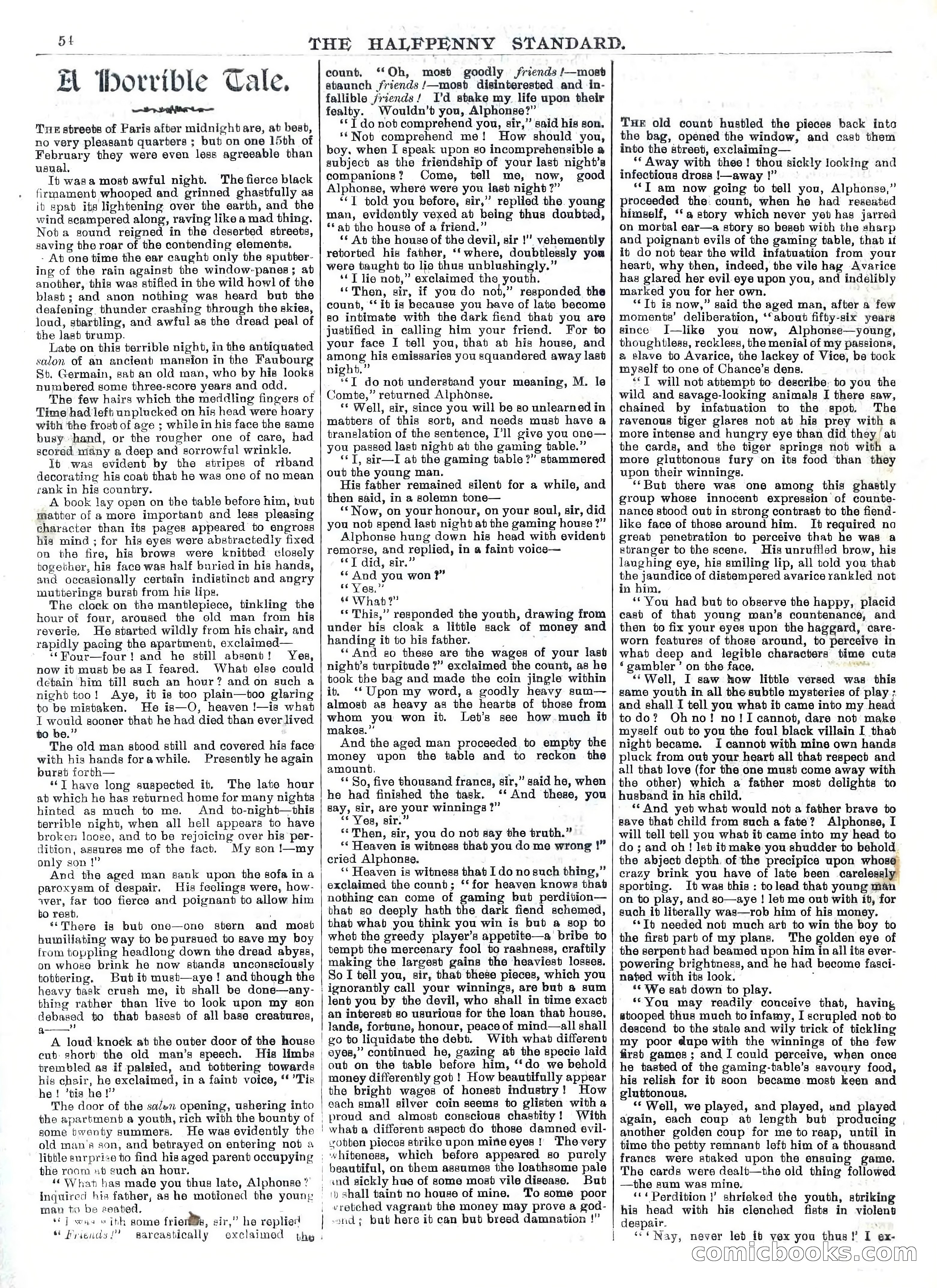
A restored page from Penny Dreadfuls, 1897. Page through the whole issue in the reader above.
📄 Transcribed text from this page (OCR, searchable)
Machine-transcribed from the original scan — historical spelling and the odd misread are preserved.
Ht ; a ‘horrible Tale. Yn abreebs of Paris after midnizht are, ab besb, no very pleasant quarters ; but on one 15th of February they were even less sgreeable than usual, It wasa most awful night. The fierce black firmament whooped and grinned ghasztfully as ip spab its lightening over the earth, and the wind acampered along, raving like a mad thing. Not a sound reigned in the deserted streets, saving the roar of the contending elements. - At one time the ear caught only bhe spubber- ing of the rain againsb the window~panes; ab another, this was stifled in the wild how] of the blast: and anon nothing was heard bub the deafening thunder crashing through the skies, loud, startling, and awful as the dread peal of the lasb brump. Late on this terrible night, in the antiquated salon of an ancient mansion in the Faubourg Sb. Germain, sab an old man, who by his looks numbered some thres-score years and odd. The few hairs which the meddling fingers of Time had left unplucked on his head were hoary wibh the frost of age ; while in his face the same busy ‘hand, or the rougher one of care, had scored widny e deep and sorrowful wrinkle, Ib was evident by the stripes of riband decorating his coat that he was one of no mean rank in his country. A book lay open on the table before him, but matter of a more important and leas pleasing character than ibs pages appeared to engross his mind; for his eyes were abstractedly fixed on vhe fire, his brows were knitted closely together, his face was half buried in his handa, and occasionally certain indiabinct and angry mutberings burat from hia lips, The clock on the mantlepiece, tinkling the hour of four, aroused the old man from hia reverie, He started wildly from his chair, and rapidly pacing the apartment, exclaimed— ‘““Wour—four! and he still absent! Yea, now it musb be as I feared. What else could detain ‘him till such an hour? and on such a nighd too! Aye, ib is too plain—too glaring bo be mistaken. He is—O, heaven !—is what I would sooner that he had died than ever lived bo be.” The old man sbood still and covered hia face with his hands forawhile. Presently he again burst forbh— *‘T have long suapected it, The late hour ab which he has returned home for many nighta hinted as much to me. And to-night—bthis terrible night, when all bell appears to have broken looze, and to be rejoicing over his per- dibion, assures me of the facbk. My son !—my only son !” And the aged man sank upon the sofa in a paroxysm of despair. His feelings were, how- aver, far too fierce and poignant to allow him bo rest, *Thore is bub one—one stern aad mosb humiliating way to be pursued to save my boy from toppling hesdloug down the dread abyss, on whoee brink he now stands unconaciously tobtering, Bub itp must—aye ! and though the heavy task crush me, it shall be done—any- thing rather than live to look upon my son debased ho thab basest of all base creabures, be A loud knoék at the outer door of the house cub short the old man’s apeech. His limba trembled as if palaied, and tottering towards is chair, he exclaimed, in a faind voice, ‘Tis he ! ‘tia he!” The door of the sa/en opening, ushering into the apartment a youth, rich with the bounty of gome bwenty summers. He was evidently the old man's son, and betrayed on entering nob a little eurprise bo find his aged parent occupying the roam 4 guch an honr. ‘(What has made you thus late, Alphonse ” inquired his father, as he motioned bhe youny man to be eeabed. “To was o ith some friertis, sir,” he replied “ Frigids!/? sareastically oxclaimed count. “Oh, most goodly friends ‘—mosrt staunch jriends /—mosb disinterested and in- fallible friends! I'd stake my life upon thelr fealty. Wouldn't you, Alphonse?” ‘© T do not comprehend you, sir,” said his son. ‘*Nob comprehend me! How should you, boy. when I speak upon so incomprehensible a subject as the friendship of your last night's companions? Come, tell me, now, good Alphonse, wheré were you last night?” “‘T bold you before, sir,” replied the. young man, evidently vexed ab being thua doubted, *© ab the house of a friend.” “* At the house of the devil, sir |" vehemently reborted his father, ‘‘ where, doubtlessly you were taught to lie thus unblushingly.” “T lie nob,” exclaimed the youth. ‘“Then, sir, if you do nob,” responded the count, “it ia because you have of late become 80 inbimate with the dark fiend that you are justified in calling him your friend. For to your face I tell you, that ab his house, and among his emissaries you squandered away last night,” ‘*T do not understand your meaning, M. le Comte,” returned Alphonse. ** Well, sir, since you wil! be so unlearned in mabbers of this sort, and needs must have a translation of the sentence, I’ll give you one— you passed last night at the gaming table.” “T, sir—I abt the gaming table?” stammered oub the young man. His father remained silent for a while, and then said, in a solemn tone— ‘© Now, on your honour, on your soul, sir, did you nob spend last night ab the gaming house ?” Alphonse hung down his head with evident remorse, and replied, in a faint voice— “JT did, sir.” “* And you won ?” ** Yes.” 4 What?” ‘« This,” responded the youth, drawing from under his cloak a little sack of money and handing it to hia father. ; ‘And so these are the wages of your last night’s turpitude ?” exclaimed the count, as he book the bag and made the coin jingle within it. ‘*Upon my word, a goodly heavy sum— almost as heavy as the hearts of those from whom you won it. Let’s see how.much ib makes.” And the aged man proceeded to empty the money upon the table and to reckon the amount. . ** So, five thousand franca, sir,” said he, when he had finished the task, ‘‘ And these, you say, Sir, are your winnings ?” ‘¢ Yea, sir.” . “Then, sir, you do not say the truth.” ** Heaven is witness that you do me wrong |” cried Alphonae. “ Heaven is witness that I do no guch thing,” exclaimed the count; ‘‘ for heaven knowa that nothing can come of gaming bub perdition— that so deeply hath the dark fiend achemed, that whab you think you win is bub a sop to whet the greedy player’s appetite—a bribe to tempt the mercenary fool to rashness, crafbily making the largest gains the heaviest losses. So I tell you, sir, that these pieces, which you ignorantly call your winnings, are but a sum lent you by the devil, who shall in time exact an interest so usurious for the loan that house, lande, fortune, honour, peace of mind—all shall | go to liquidate the debt. With whab different ayes,” continued he, gazing ab the specie laid out on the table before him, ‘‘do we behold money differently got | How beautifully appear the bright wages of honest industry! How each small silver coin seems to glizten witha proud and almost conscious chashity! With whab a different aspect do those damned evil- crobben pieces strike upon mife eyes ! The very . whipeneza, which before appeared so purely beautiful, on them assumes the loathsome pale _ and sickly hue of some moat vile disease. But |) shall taint no house of mine. To some poor | vretched vagrant the money may prove a god- | snd; but here it can but breed damnation !” the | THE HALFPENNY STANDARD. | THE old count hustled the pieces back inta the bag, opened the window, and cast them into the street, exclaiming— ‘* Away with thee! thou sickly locking and infectious dross !—away !” “‘T am now going to tell you, Alphonse,” Proceeded the. count, when he had resexted himself, ‘‘a story which never yet has jarred on mortal ear—a story so bessb with the aharp and poignant evils of the gaming table, that if ib do nob tear the wild infatuation from your heart, why then, indeed, the vile hag Avarice hag glared her evil eye upon you, and indelibly marked you for her own. ‘*Ib ia now,” said the aged man, after a few moments’ deliberation, “about fifty-six years since’ I—like you now, Alphonse—young, thoughtless, reckless, the menial of my passions, a slave to Avarice, the lackey of Vice, be tock myself to one of Chance’s dens. “IT will nob attempt to deecribe, to you the wild and savage-looking animals I there saw, chained by infatuation to the spot. The ravenous tiger glares not ab hia prey with a more intense and hungry eye than did they at the cards, and the tiger aprings not with a more glubtonous fury on its food than they upon their winnings. ‘Bub there was one among this ghastly group whose innocent expression of counte- nance stood out in strong contrast to the fiend- like face of those around him. Ib required no greab penebration to perceive that he was a stranger to the scene. His unrufiled brow, his laughing eye, hia smiling lip, all told you thab the jaundice of distempered avarice rankled not in him, **' You had but to observe the happy, placid cast of that young man’s countenance, and then to fix your eyes upon the haggard, care- worn features of those around, to perceive in what deep and legible characters time cuta ‘ gambler ’ on the face. = “Well, I saw how little versed wae this same youth in all the subtle mysteries of play : and shall I tell you what ib came into my head todo? Ohno! no!I cannot, dare nob’ make myself out to you the foul black villain I that night became. I cannot with mine own hands pluck from out your heart all that respect and all that love (for the one must come away with the other) which a father most delights to husband in his child. ** And yet what would not a father brave bo save bhat child from such a fate? Alphonse, I will tell tell you what ib came into my head to do ; and ob! leb it make you shudder to behold. the abject depth, of the precipice upon whose crazy brink you have of late been carelessly sporting. Ib was bhis : to lead that young man on to play, and so—aye ! let me out with it, for auch ib literally was—rob him of hia money. **Tt needed not much art to win the boy to the firat part of my plans. The golden eye of the serpent had beamed upon him in ail ita ever- powering brightnegs, and he had become fasci- nated with ita look. , ‘© We sat down to play. “You may readily conceive that, having gbooped thus much bo infamy, I scrupled nob-to descend bo the stale and wily trick of tickling my poor dupe with the winnings of the few firab games ; and I could perceive, when once he tasted of the gaming-table’s aavoury food, his relish for it soon became most keen sand gluttonous. ‘* Well, we played, and played, und played again, each coup at length but producing , another golden coup for me to reap, until in time the petty remnant left him of a thousand francs were staked upon the ensuing game. The carda were dealt—the old thing followed —the sum was mine. ‘«* Perdition |’ shrieked the youth, striking his head with his clenched fists in violent despair. : “* Nay, never led ib yex you thus!’ I ex- comicioooks.com