
Penny Dreadfuls, 1897 · page 8 of 16
Captain Joe; or, The Days of the Mint — page 8: what you’re looking at
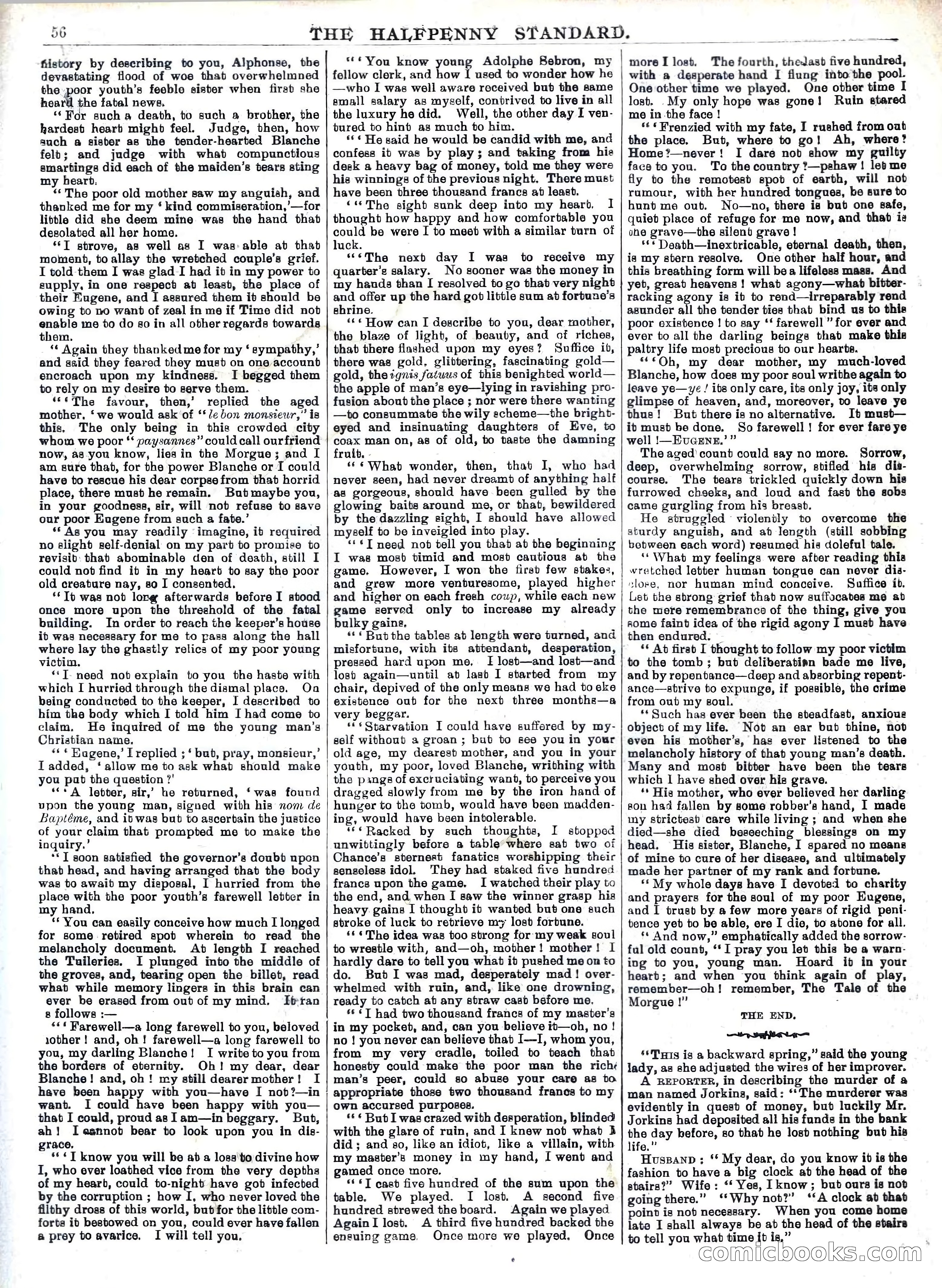
A restored page from Penny Dreadfuls, 1897. Page through the whole issue in the reader above.
📄 Transcribed text from this page (OCR, searchable)
Machine-transcribed from the original scan — historical spelling and the odd misread are preserved.
Jv THE HALFPENNY STANDARD. fiistory by describing to you, Alphonse, the devastating flood of woe that overwhelmned the poor youth’s feeble sister when firat she heard the fatal news, ‘“‘ For such a death, to such a brobher, the hardest heart might feel. Judge, then, how auch a sister as the tender-hearted Blanche fel); and judge with what compunctious amarbinge did each of the maiden’s tears sting my heart. “«The poor old mother saw my anguish, and thanked me for my ‘ kind commiseration,’—for little did she deem mine was the hand that desolated all her home. *‘T strove, as well as I was: able ab that moment, to allay the wretched couple’s grief. I told-them I wae glad I had it in my power to supply, in one reapect at least, the place of their Eugene, and I assured them it should be owing to no want of zeal in me if Time did not enable me to do ao in all other regards towards them. “‘ Again they thanked me for my ‘sympathy,’ and ssid they feared they must on one account encroach upon my kindness. I begged them to rely on my desire to serve them. ‘““¢The favour, then,’ replied the aged mother. ‘we would ask of ‘‘ Ze don monsieur,’ is this, The only being in this crowded city whom we poor ** paysannes” could call ourfriend now, a3-you know, lies in the Morgue; and I am sure that, for the power Blanche or I could have to rescue his dear corpse from that horrid place, there muat he remain. Butmaybe you, in your goodness, sir, will not refuse to save our poor Eugene from such a fate.’ ** As you may readily ‘imagine, ib required no slight self-denial on my part to promise to revisib: that abominable den of death, atill I could not find ib in my heart to say the poor old creature nay, 80 I consented, ** Ib was not lorg afterwards before I stoad once more upon the threshold of the fatal building. In order to reach the keeper’s house it was necessary for me to pass along the hall where lay the ghastly relics of my poor young victim. “T- need not explain to you the haste with which I hurried through the dismal place. Ona being conducted to the keeper, I described to him the body which I told him I had come to claim. He inquired of me the young man’s Chriatian name, «* * Kagene,’ I replied ;‘ bub, pray, monsieur,’ I added, ‘allow me to ask what should make you put the question ?' ‘““* A lebter, sir,’ he returned, ‘was found upon the young man, signed with his nom de Baptéme, and it was but bo ascertain the justice of your claim that prompted me to make the inquiry.’ **T soon satisfied the governor’se doubt npon that head, and having arranged that the body was to await my disposal, I hurried from the place with the poor youth’s farewell lebter in my hand, ‘* You can easily conceive how much I longed for some retired spot wherein to read the melancholy document. At length I reached the Tuileriez, I plunged imto the middle of the groves, and, tearing open the billet, read what while memory lingers in this brain can ever be erased from out of my mind. Iran 8 follows :— *«* Farewell—a long farewell to you, beloved 10bher ! and, oh! farewell—a long farewell to you, my darling Blanche! I write to you from the borders of eternity. Oh! my dear, dear Blanche! and, oh! my still dearer mother! I have been happy with you—have I nob?—in want. I could have been happy with you— that I could, proud as Iam—in beggary. But, ah! Iesnnot bear to look upon you in die- grace, **<]T know you will be ab a losa'to divine how I, who ever loathed vice from the very depbha of my hearb, could to-night have got infected by the corruption ; how I, who never loved the filthy dross of this world, but for the little com- forts it besbowed on you, could ever have fallen a prey to avarice. I will tell you. ‘** You know young Adolphe Sebron, my fellow clerk, and how [ used to wonder how he —who I was well aware received bub the same small aalary as myself, conbrived to live in all the luxury he did. Well, the other day I ven- tured to hint ag much to him. ‘© * He said he would be candid with me, and confeas it was by play; and taking from hie dezk a heavy bag of money, told ms they were hia winnings of the previous night, There must have been three thousand francs at least. ‘“The sight sunk deep into my heart. I thought how happy and how comfortable you could be were I to meet with a similar barn of luck. «The nexb day I waa to receive my quarter’s salary. No sooner was the money in my hands than I resolved to go that very night and offer up the hard got little sum ab fortune’s shrine. ‘©* How can I describe to you, dear mother, the blaze of light, of beauty, and of riches, that there flashed upon my eyes? Suffice ib, there was gold, glittering, fascinating gold— gold, thezgnis fatuus of this benighted world— the apple of man’s eye—lying in ravishing pro- fusion about the place ; nor were there wanting —to consummate the wily echeme—the bright- eyed and insinuating daughters of Eve, to coax man on, as of old, bo taste the damning frulb., - ‘©¢ What wonder, then, that I, who had never geen, had never dream? of anything half as gorgeous, should have been gulled by the glowing baits around me, or that, bewildered by the dazzling eight, I should have allowed myself to be inveigled into play. ‘*¢T need nob tell you thad at bhe beginning I wae mosb timid and most cautious ab tha game. However, I won the first few stakes, and grew more venburesome, played higher and higher on each fresh coup, while each new game served only to increase my already bulky gaing, ‘** But the tables at length were turned, and misfortune, with ita attendant, desperation, | presaed hard upon me, fF lost—and lost—and losb again—until ab last I started from my chair, depived of the only moana we had to eke existence out for the next three months—a very beggar. *** Starvation I could have suffered by my- self without a groan; but to zee youin your old age, my desresp mother, and you in your youth, my poor, loved Blanche, writhing with the pangs of excruciating want, to perceive you dragged slowly from me by the iron hand of hunger to the tomb, would have been madden- ing, would have been intolerable. ‘** Racked by such thoughts, I stopped unwittingly before a table where sab two of Chance’s sternest fanatics worshipping their sengeless idol. They had staked five hundred franca upon the game. I watched their play to the end, and when I saw the winner grasp his heavy. gains I thought ib wanted but one such stroke of luck to retrieve my lost forbune. ‘© © Tho idea waz too strong for my weak soul to wrestle with, and—oh, mother! mother! I hardly dare to tell you what it pushed me on to do. Bub I was mad, dezperately mad! over- whelmed with ruin, and, like one drowning, ready to catch at any straw caabd before me. 66 *T had two thousand francs of my master’s in my pocket, and, can you believe it—ob, no ! no ! you never can believe that I—I, whom you, from my very cradle, toiled to teach that honesty could make the poor man the rich; man’s peer, could so abuse your care as fo appropriate those two thousand francs to my own accursed purposes. «© ¢ But I was crazed with desperation, blinded with the glare of ruin, and I knew not what i did; and so, like an idiot, like a villain, with my master’s money in my hand, I went and gamed once more. “*T eaed five hundred of the sum upon the table. We played. I lost. A second five hundred strewed the board. Again we played AgainI lost. A third five hundred backed the ensuing game, Once more we played. Once U) 5 more I lost. The fourth, theJasd five hundred, with a desperate hand I flung into the pool. One other time we played. One other time I lost. .My only hope was gone! Ruin stared me in the face ! ‘¢ Frenzied with my fate, I rushed from oat the place. But, where to go! Ah, where? Home?—never! I dare nob show my guilty faca to you. To the country ?—pshaw ! leb me fly to the remoteat spot of earth, will mob rumour, with ber hundred tongues, be sure to hunt me oub. No—no, there ia bub one gafe, quiet place of refuge for me now, and that is vhe grave—bhe silent grave ! *** Deatbh—inexbricable, eternal death, then, ig my stern resolve. One other half hour, and this breathing form will bea lifeless mass. And yet, great heavens ! what agony—whab bitter- racking agony is ib to rend—irreparably rend asunder all the tender ties that bind us to this poor existence ! to say ‘‘ farewell ” for ever and ever to all the darling beings that make this paltry life most precious to our hearts. *€Oh, my dear mother, my much-loved Blanche, how does my poor soul writhe again to leave ye—ye / iba only care, its only joy, its only glimpse of heaven, and, moreover, to leave ye thue! But there ia no alternative. Ib must— it must be done. So farewell ! for ever fare ye well !—HuGENE,’” The aged count could say no more. Sorrow, deep, overwhelming sorrow, sbified hia dia- course. The tears trickled quickly down his furrowed chseka, and loud and fast the sobs came gurgling from his breast, He struggled violently to overcome the aturdy anguish, and at length (still sobbing between each word) resumed his doleful tale. “What my feelings were after reading thia wratched letter human tongue can never dia- close, nor human mind conceive. Suffice ib. Let the sbrong grief that now suffocates me ab the mere remembrance of the thing, give you rome faint idea of the rigid agony I must have then endured. _ *€ Ad firat I thought to follow my poor victim to the tomb; but deliberatian bade me live, and by repentance—deep and absorbing repent- ance—strive to expunge, if possible, the crime from oub my soul. **Such has ever been the steadfast, anxioue object of my life. Not an ear but thine, nod even his mother’s, has ever listened to the melancholy history of thab young man’s death. Many and most bitter have been the teare which I have shed over his grave. ‘* Hie mother, who ever believed her darling son had fallen by some robber’s hand, I made my strictest care while living ; and when she died—she died beseeching blessings on my head. His sister, Blanche, I spared no means of mine to cure of her disease, and ultimately made her partner of my rank and fortune. ‘* My whole days have I devoted to charity and prayers for the soul of my poor Eugene, and I trust by @ few more years of rigid peni- tence yeb to be able, ere I die, to atone for all. ** And now,” emphatically added the sorrow- ful old count, ‘*I pray you let this be a warn- ing to you, young man. Hoard it in your heard; and when you think again of play, remember—oh! remember, The Tale of the Morgue !” ° THE END, ity Safle ‘*T 1s is a backward spring,” said the young lady, as she adjusted the wires of her improver. A REPORTER, in describing the murder of a man named Jorkina, said: ‘‘The murderer waa evidently in quest of money, but luckily Mr. Jorkins had deposited all his fands in the bank the day before, so that he losb nothing bub his life.” Huspanp ; ‘* My dear, do you Know ib is the fashion to have a big clock at the head of the atairs?’ Wife: ‘* Yes, 1 know; but oura is not going there.” ‘‘Why not?” ‘A clock at that point is nob necessary. When you come home late I shall always be ab the head of the stairs to tell you what time it is,” comicbooks.con