
Penny Dreadfuls, 1890 · page 5 of 68
The Armourer's Apprentice — page 5: what you’re looking at
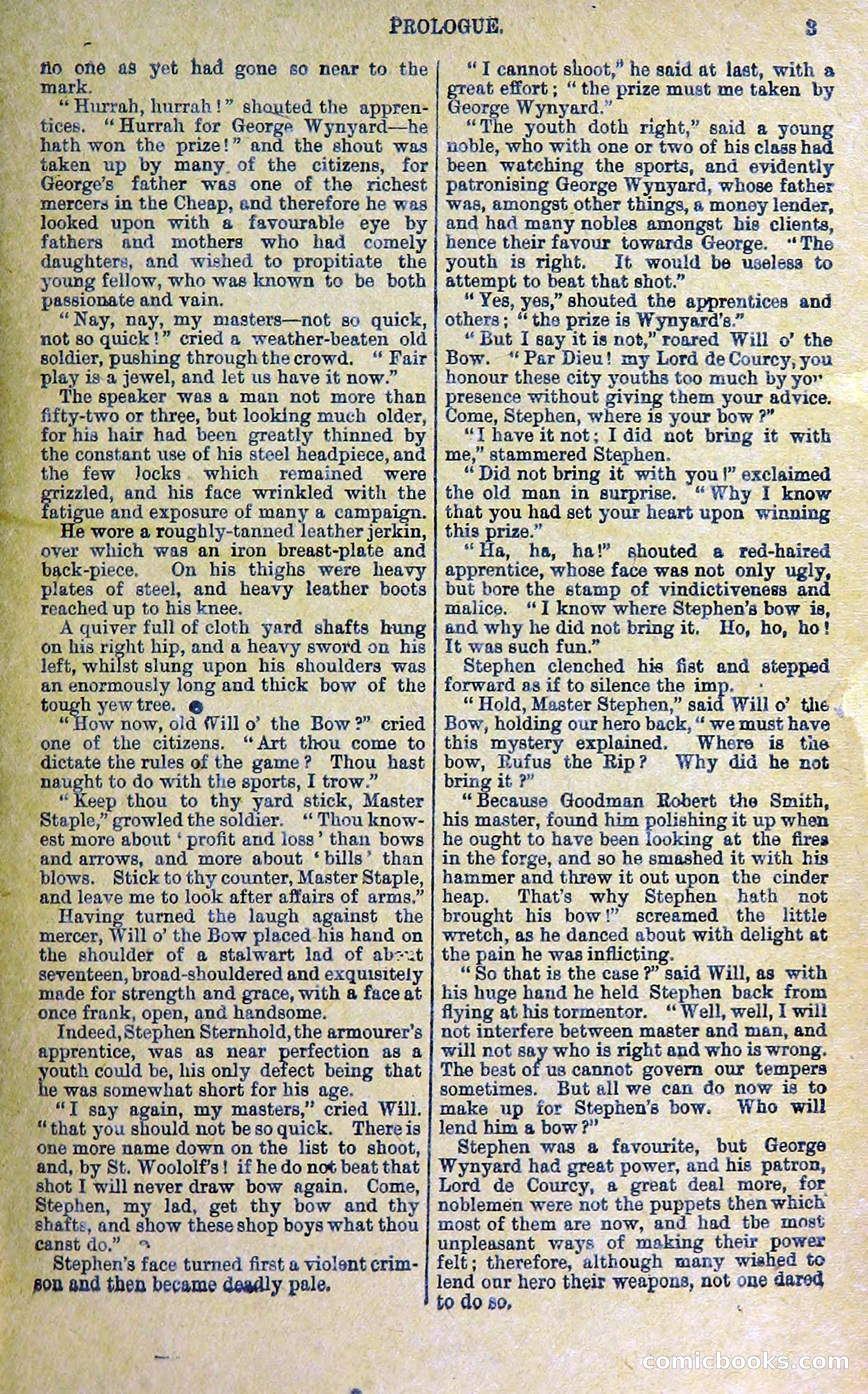
A restored page from Penny Dreadfuls, 1890. Page through the whole issue in the reader above.
📄 Transcribed text from this page (OCR, searchable)
Machine-transcribed from the original scan — historical spelling and the odd misread are preserved.
J y . . AS , 4 ef ‘ why r 4 «7 . - - ® AS . 4 % t 7 . w o‘ . 2 ‘ . = 4 -* : ; “= « ath thee 4) hd a Tac ¥ De NS, 5) oa ~ aed . : Ay . - * yy ‘= . ‘ , , im “4 ay 3 : “e ‘ ; . 1a , a — C - » ‘ | 4 a 7 : | ; % flo one as yet had gone so near to the Mt he eS urrah, hurrah!” shouted the appren- tices. hath won the prize!” and the shout was _ taken up by many. of the citizens, for _ George’s father was one of the richest _ -mercers in the Cheap, and therefore he was ' looked upon with a favourable eye by _ fathers snd mothers who had comely daughters, and wished to propitiate the passionate and vain. _ “Nay, nay, my masters—not so quick, play is-a jewel, and let us have it now.” _ The speaker was a man not more than _ fifty-two or three, but looking much older, ae th constant use of his steel headpiece, and grizzled, and his face wrinkled with the _ fatigue and exposure of many a campaign. He wore a roughly-tanned leather jerkin, ee which was an iron breast-plate and ‘back-piece. On his thighs were heavy _ plates of steel, and heavy leather boots _ reached up to his knee. | “st _ <A quiver full of cloth yard shafts hung ) a on his right hip, and a heavy sword on his left, whilst slung upon his shoulders was _ anenormously long and thick bow of the _- tough yew tree. @ | “flow now, old Vill o’ the Bow ?” cried -— one of the citizens. “Art thou come to dictate the rules of the game? Thou hast ‘ae + ne to do with the sports, I trow.” Keep thou to thy yard stick, Master _ Staple,” growled the soldier. “ Thou know- est more about ‘ profit and loss’ than bows and arrows, and more about ‘bills’ than plows. Stick to thy counter, Master Staple, ' and leave me to look after affairs of arms.” Having turned the laugh against the ‘mercer, Will o’ the Bow placed-his hand on _ the shoulder of a stalwart lad of abzut - seventeen, broad-shouldered and exquisitely made for strength and grace, with a face at _ once frank, open, and handsome. __ Indeed, Stephen Sternhold, the armourer’s _ fipprentice, was as near perfection as a _ youth could be, his only defect being that __ he was somewhat short for his age. | “Tsay again, my masters,” cried Will. _ “that you should not besoquick. Thereis _ one more name down on the list to shoot, ' and, by St. Woololf’s! if he do not beat that _ shot I will never draw bow again. Come, _ Stephen, my lad, get thy bow and thy P| if natts, and show these shop boys what thou fs 3 i we § ad f- “* E> } . / ae o’ 7, ~ A oe Ps O7: ul canst do,” % ___ Stephen’s face turned first a violent crim- _ fon and then became deadly pale. * a AT rate PAY ‘7 PRRs OM - ¥ Li } * i's idle ? ' Re i m4 A J — - (tb eae " eer A ' § ©) ys ' » “Hurrah for George Wynyard—he | _ young fellow, who was known to be both | Mi not so quick!” cried a weather-beaten old | - soldier, pushing throughthecrowd. “ Fair - for his hair had been greatly thinned by }. _ the few Jocks. which remained were) ’ - ." ' - . Sah oy A ? if r DST . . “ { - : : - e . 4 - a _* .% . b ° . “T cannot shoot,” he said at last, with a great effort; “the prize must me taken by George Wynyard.” — “The youth doth right,” said a young noble, who with one or two of his class had been watching the sports, and evidently patronising George Wynyard, whose father was, amongst other things, s money lender, and had many nobles amongst his clients, hence their favour towards George. ‘The youth is right. It would be useless to attempt to beat that shot.” 7 ‘Yes, yes,” shouted the apprentices and others; “the prize is Wynyard’s.” “But I say it is not,” roared Will o’ the Bow. “‘ Par Dieu! my Lord deCourcy, you honour these city youths too much by yor — presents without giving them your advice. ome, Stephen, where is your bow ?” “TY have it not; I did not bring it with me,’ stammered Stephen. “ Did not bring it with you!” exclaimed the old man in surprise. “Why I know > that you had set your heart upon winning this prize.” im “Ha, ha, ha!’ shouted a red-haired apprentice, whose face was not only ugly, but bore the stamp of vindictiveness and malice. ‘I know where Stephen’s bow is, and why he did not bring it. Ho, ho, ho! Tt was such fun.” | Stephen clenched his fist and stepped forward asif to silence the imp. - | “‘ Hold, Master Stephen,” said Will o’ the Bow, holding our hero back, “ we must have — this mystery explained. Where is tie bow, Rufus the Rip? Why did he not bring it ?” “Because Goodman Robert the Smith, his master, found him polishing it up when he ought to have been looking at the fires in the forge, and so he smashed it with his hammer and threw it out upon the cinder heap. That's why Stephen hath not | brought his bow!” screamed the little wretch, as he danced about with delight at the pain he was inflicting. — ‘So that is the case ?” said Will, as with his huge hand he held Stephen back from flying at histormentor. ‘ Well, well, I will not interfere between master and man, and will not say who is right and whoiswrong. | The best of us cannot govern our tempers sometimes. But all we can do now is to make up for Stephen’s bow. Who will lend him a bow ?” Stephen was a favourite, but George Wynyard had great power, and his patron, Lord de Courcy, s great deal more, for noblemen were not the puppets then which most of them are now, and had tbe most unpleasant ways of making their power felt; therefore, although many wished te lend our hero their weapons, not one dared OOO KS m a eoim