
Penny Dreadfuls, 1890 · page 4 of 68
The Armourer's Apprentice — page 4: what you’re looking at
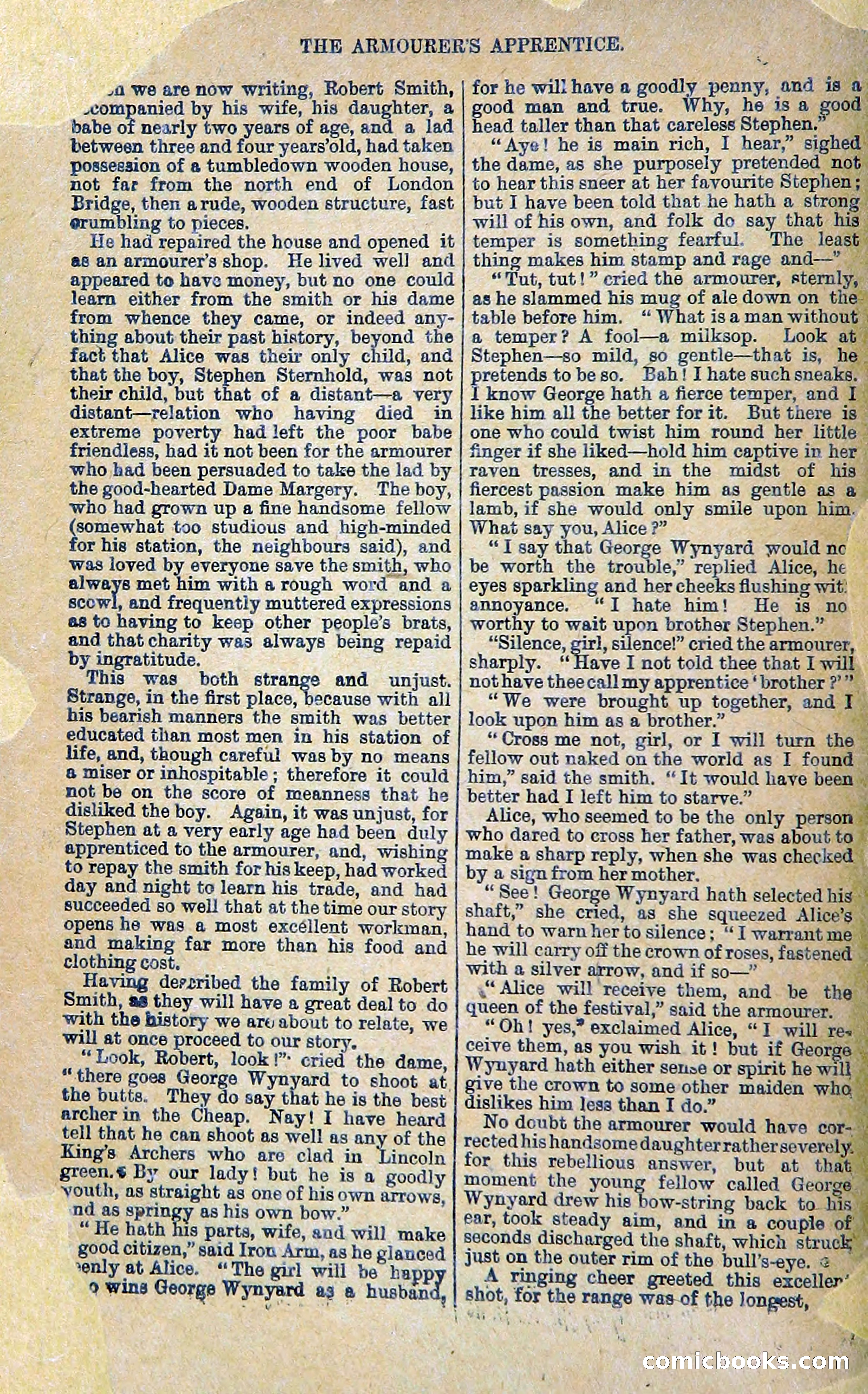
A restored page from Penny Dreadfuls, 1890. Page through the whole issue in the reader above.
📄 Transcribed text from this page (OCR, searchable)
Machine-transcribed from the original scan — historical spelling and the odd misread are preserved.
THE ARMOURER'S APPRENTICE. — 2 ee .a4 We are now writing, Robert Smith, _ #«ompanied by his wife, his daughter, a _ babe of nearly two years of age, and a lad between three and four years’old, had taken possession of a tumbledown wooden house, not far from the north end of London Bridge, then arude, wooden structure, fast erumbling to pieces. re He had repaired the house and opened it @&8 an armourers shop. He lived well and appeared to have money, but no one could learn either from the smith or his dame from whence they came, or indeed any- thing about their past history, beyond the fact that Alice was their only child, and that the boy, Stephen Sternhold, was not their child, but that cf a distant—a very distant—relation who having died in extreme poverty had left the poor babe _ friendless, had it not been for the armourer who had been persuaded to take the lad by the good-hearted Dame Margery. The boy, who had grown up a fine handsome fellow somewhat too studious and high-minded or his station, the neighbours said), and was loved by everyone save the smith, who always met him with a rough word and a Sette § and frequentiy muttered expressions as to having to keep other people’s brais, and that charity was always being repaid by ingratitude. This was both strange and unjust. Strange, in the first place, because with all his bearish manners the smith was better educated than most men in his station of _ life, and, though careful was by no means & miser or inhospitable ; therefore it could mot be on the score of meanness that he disliked the boy. Again, it was unjust, for _ Stephen at a very early age had been duly _ apprenticed to the armourer, and, wishing to repay the smith for his keep, had worked day and night te learn his trade, and had Succeeded so well that at the time our story opens he was a most excéllent workman, _ and making far more than his food and clothing cost. __ Having derzrribed the family of Robert ‘Smith, a8 they will have a great deal to do with the history we are about to relate, we will at once proceed to our story. “Look, Robert, look!” cried the dame, “there goes George Wynyard to shoot at the butts. They do say that he is the best archerin the Cheap. Nay! I have heard tell that he can shoot as well as any of the King’s Archers who are clad in aineala green. By our lady! but he is a goodly “youth, as straight as one of his own arrows, nd as springy as his own bow.” “ He hath his parts, wife, and will make good citizen,” said Iron Arm, as he glanced senly at Alice. “The girl will be happ 9 wins George Wynyard a3 & husband, | Shot, for the range was-of the longest, for he will have a goodly penny, and is a good man and true. Why, he 1s a good head taller than that carelessStephen.” “Ave! he is main rich, I hear,” sighed the dame, as she purposely pretended not to hear this sneer at her favourite Stephen but I have been told that he hath a strong will of his own, and folk do say that his temper is something fearful. The least thing makes him stamp and rage and—" ~ “Tut, tut!” eried the armourer, sternly, | as he slammed his mug of ale down on the table before him, “ What isa man withou 5 a temper? A fool—a milksop. Look at Stephen—so mild, so gentle—that is, he pretends to beso. Bah! I hate suchsneaks. I know George hath a fierce temper, and I like him all the better for it. But there 1s” one who could twist him round her little finger if she liked—hold him captive in her raven tresses, and in the midst of his fiercest passion make him as gentle as a lamb, if she would only smile upon him. What say you, Alice ?” OREM “IT say that George Wynyard would no be worth the trouble,” replied Alice, he — eyes sparkling and hercheeks flushing wit: — annoyance. “I hate him! He is no | worthy to wait upon brother Stephen.” “Silence, girl, silence!” cried the armourer, sharply. ‘ ave I not told thee that I will not have theecall my apprentice ‘brother ?’” “We were brought up together, and I~ look upon him as a brother.” he em “Cross me not, girl, or I will turn the fellow out naked on the world as I found — him,” said the smith. “It would have been — better had I left him to starve.” ‘>; Sa Alice, who seemed to be the only person | who dared to cross her father, was about to ~ make a sharp reply, when she was checked by a sign from her mother. a “See! George Wynyard hath selected shaft,” she cried, as she squeezed Alice’s © hand to warn her to silence; “I warrant me he will carry off the crown of roses, fastened — with a silver arrow, and if so—” > ~ Alice will receive them, and be the queen of the festival,” said the armourer. _ “Oh! yes,” exclaimed Alice, “I will res ceive them, as you wish it! but if George - Wynyard hath either sense or spirit he wil J maiden wh 0, A se t i * 4) a tty - uk # give the crown to some other dislikes him Jess than I do.” ae No doubt the armourer would have cor- rected his handsome daughterratherseverel y. for this rebellious answer, but at that moment the young fellow called George Wynyard drew his ow-string back to his ear, took steady aim, and in a couple of seconds discharged the shaft, which struck just on the outer rim of the bull’s-eye. So A ringing cheer greeted this exceller’ — as oKeKe) GOMICc ‘(S.com