
Penny Dreadfuls, 1890 · page 6 of 68
The Armourer's Apprentice — page 6: what you’re looking at
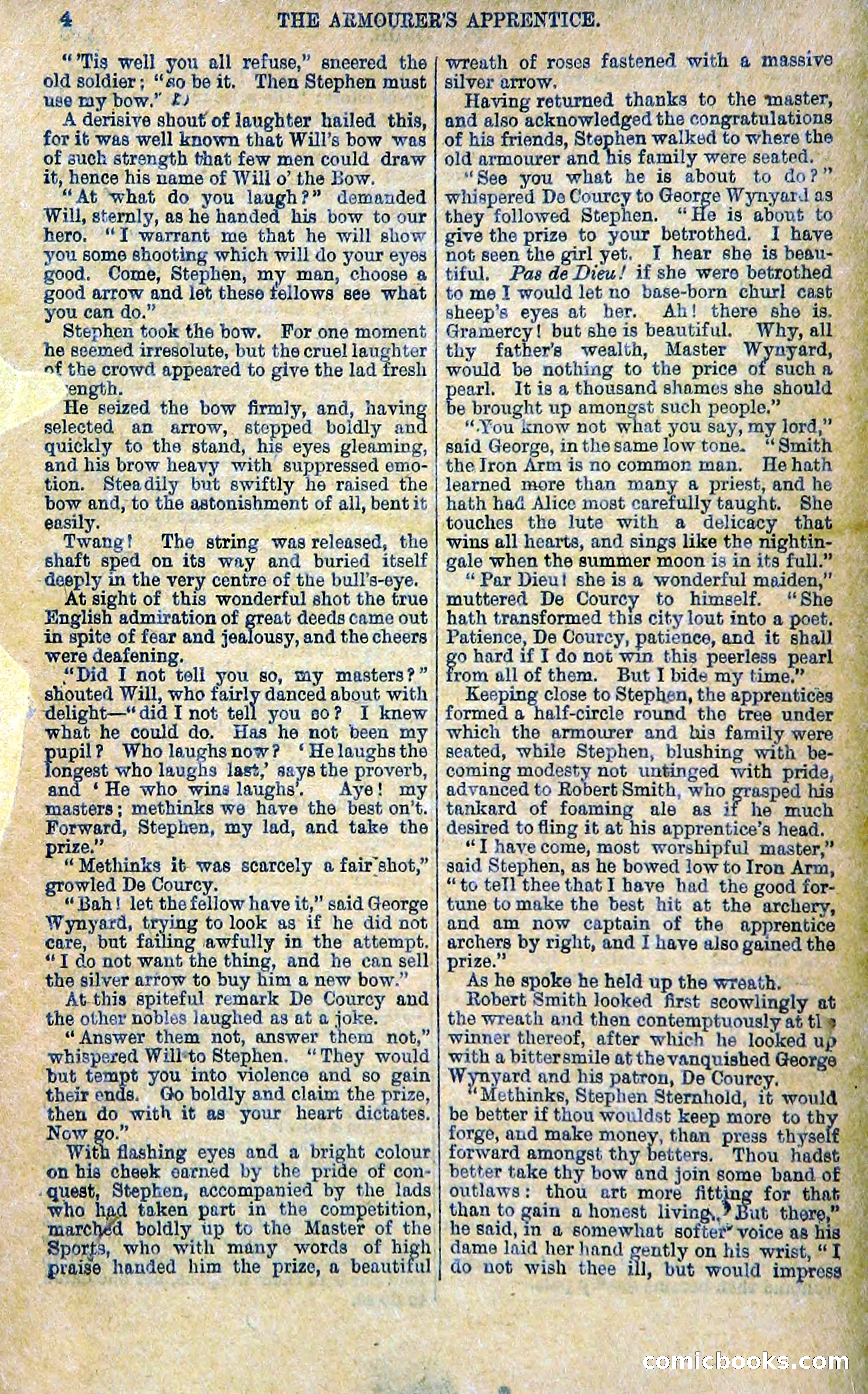
A restored page from Penny Dreadfuls, 1890. Page through the whole issue in the reader above.
📄 Transcribed text from this page (OCR, searchable)
Machine-transcribed from the original scan — historical spelling and the odd misread are preserved.
% ea * Boss: O) ae SI ARMOUR SoA PERGIN LOB "sel A/G ast L) ea “Tis well you all refuse,” sneered the old soldier; ‘so be it. Then Stephen must usetay bow.” fs ae i __ A deristye shout of laughter hailed this, for it was well known that Will’s bow was of such strength that few men could draw it, hence his name of Will o’ the Bow. “At what do you laugh?” demanded Will, sternly, as he handed his bow to our hero. “I warrant me that he will show you some shooting which will do your eyes good. Come, Stephen, my man, choose 4 good arrow and let these fellows see what you can do.” Stephen took the bow. For one moment he seemed irresolute, but the cruel lauchter of the aot appeared to give the lad fresh ength. He seized the bow firmly, and, havin selected an arrow, stepped boidly an quickly to the stand, his eyes gleaming, and his brow heavy with suppressed emo- tion. Steadily but swiftly he raised the bow and, to the astonishment of all, bent it easily. ar Twang! shaft sped on its way and buried itself _ -deeply in the very centre of the bull’s-eye. At sight of this wonderful shot the true _ English admiration of great deeds came out in spite of fear and jealousy, and the cheers . ‘were deafening. “Did I not teli you so, my masters?” shouted Will, who fairly danced about with -delight—* did I not tell you s0? I knew what he could do. Has he not been my purty Who laughsnow? ‘Helaughsthe ice who laughs last,’ says the proverb, and ‘He who wing laughs. Aye! my - masters; methinks we have the best on’t. cn _ Forward, Stephen, my lad, and take the * . « » — _ growled De Courcy. . “Bah! let the fellow have it,” said George . Wynyard, trying to look as if he did not ¢@are, but failing awfully in the attempt. _“T do not want the thing, and he can sell the silver arrow to buy him a new bow.” At-this spiteful remark De Courcy and the other nobles laughed as at a joke. “Answer them not, answer them not,” whispered Will*to Stephen. “They would ‘but tempt you into violence and so gain their ends. Go boldly snd claim the prize, then do with it as your heart dictates. . Now go.” With flashing eyes and a bright colour ‘on his cheek earned by the pride of con- . quest, Stephen, accompanied by the lads pay praise handed him the prize, a beautiful ’ : ‘. wy e te Pett c 4 ! ; } . R wreath of roses fastened with @ massive — of his friends, Stephen walked to where the — pee, _ | touches the lute with a delicacy that | The string was released, the desired to fling it at his apprentice’s head. “Methinks it was scarcely a fair shot ” | * | 4 to tell thee that I have had the good for id boldly up to the Master of the who nf taken part in the competition, ports, who with many words of high. Se 3 silver arrow, . | p Having returned thanks to the master, — and also acknowledged the congratulations — old armourer and his family were seated. “See you what he is about to do Bite whispered De Courcy to George Wynyarias they followed Stephen. “He is about to give the prize to your betrothed. I haye not seen the girl yet. I hear she is bepu- tiful, Pas de Dieu! if she were betrothed — to me I would let no base-born churl cast sheep's eyes at her, Ah! there sho is, © Gramercy! but she is beautiful. Why, all — thy father’s wealth, Master Wynyard, would be nothing to the price of sucha ~ earl. It is a thousand shames she should e brought up amongst such people.” ‘You Know not what you say, my lord,” said George, inthesamelow tone. “Smith — the Jron Arm is no common man. Hehath ~ learned more than many a priest,and he ~ hath had Alice most carefully taught. She ti . <i wins all hearts, and sings like the night ey gale when the summer moon is in its full.” “Par Dieu! she is a wonderful maiden,” muttered De Courcy to himself. “She hath transformed this city lout into a poet. — Patience, De Courcy, patience, and it shall ~ g° hard if I do not win this peerless pearl ~ rom allofthem. But I bide my time,” Keeping close to Stephen, the apprentices formed a half-circle round the tree under which the armourer and his family were ~ seated, while Stephen, blushing with be- coming modesty not untinged with pride, ~ advanced to Robert Smith, who grasped his — tankard of foaming ale as Tr he much “JT have come, most worshipful master,” said Stephen, as he bowed low to Iron Arm, tune to make the best hit at the archery, © and am now captain of the apprentice — archers by right, and I have alsogainedthe prize.” Ce" ae As he spoke he held up the wreath. Robert Smith looked first seowlingly at — the wreath and then contemptuously attls winner thereof, after which he looked up | _ with a bittersmile atthe vanquished George Wynyard and his patron, De Courey, = ‘Methinks, Stephen Sternhold, it would — be better if thou wouldst keep more to thy forge, and make aon than press thyself — forward amongst thy betters. Thou hadset — better take thy bow and join some band of — outlaws: thou art more fitting for that | than to gain a honest living, But there,” he said, in a somewhat softer’ voice ag his — dame laid her hand gently on his wrist, “I do not wish thee ill, but would impresg — ~f{ j w/e \% * ‘an com » Gomicboo: