
Penny Dreadfuls, 1854 · page 343 of 400
Rosa Lambert — page 343: what you’re looking at
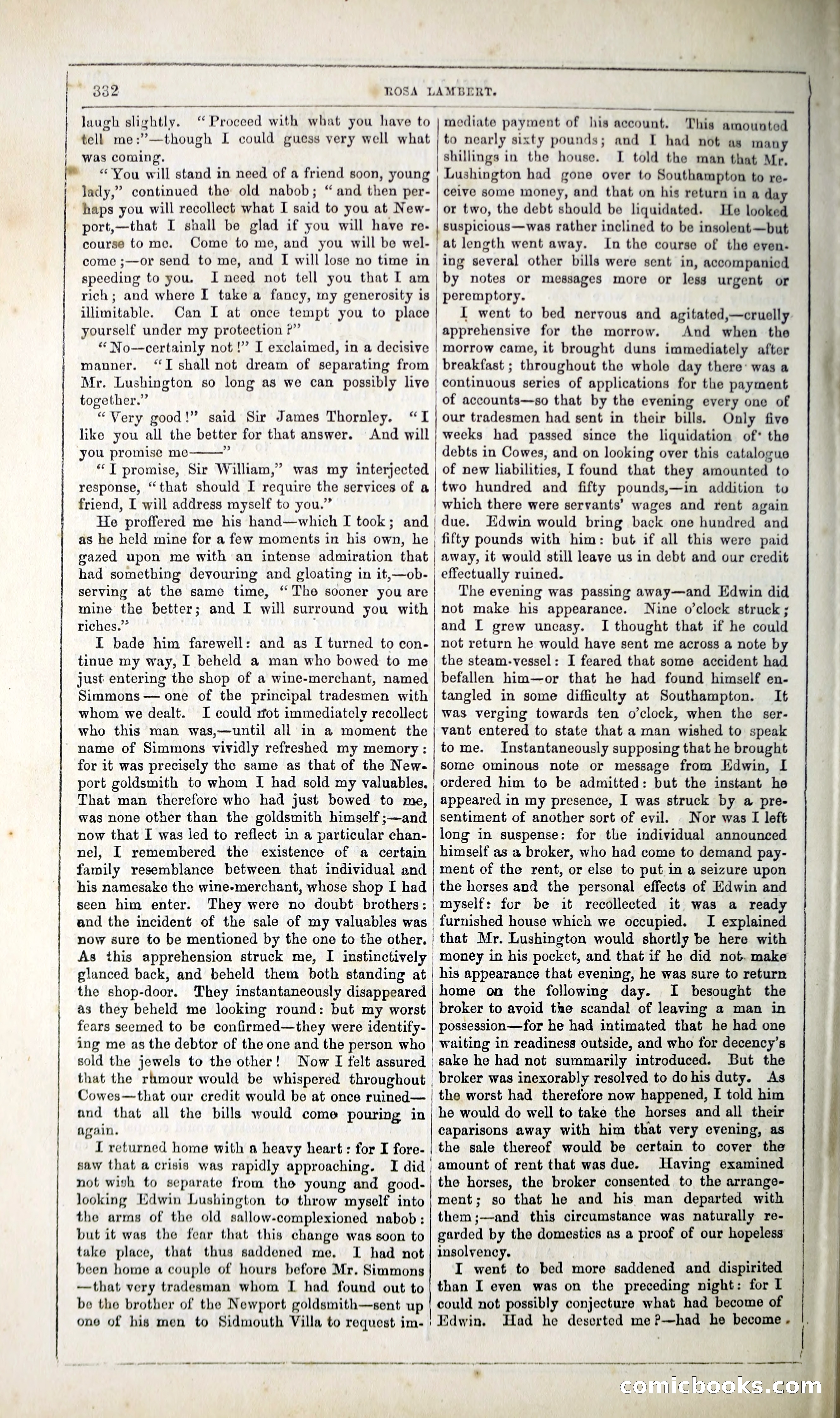
A restored page from Penny Dreadfuls, 1854. Page through the whole issue in the reader above.
📄 Transcribed text from this page (OCR, searchable)
Machine-transcribed from the original scan — historical spelling and the odd misread are preserved.
. ee ee ee ——- — laugh slightly. “ Proceed with what you have to | mediate payment of his accou aaa ate nee stsSs—~SsS ROSA LAMBERT. a — —_—— nt. This amounted tell me:’—though IL could guess very well what | to nearly sixty pounds; and I had not as many was coming. “You will stand in need of a friend soon, young lady,” continued the old nabob; “ and then per- haps you will recollect what I said to you at New- port,—that I shall be glad if you will have re. course to me. Come to me, and you will be wel- come ;—or send to me, and [I will lose no time in speeding to you. I need not tell you that I am rich; and where I take a fancy, my generosity is illimitable. Can I at once tempt you to place yourself under my protection ?”’ ** No—certainly not!” I exclaimed, in a decisive manner. “I shall not dream of separating from Mr. Lushington so long as we can possibly live together.” “Very good!” said Sir James Thornley. “I like you all the better for that answer. And will you promise me if “T promise, Sir William,” was my interjected response, “that should I require the services of a friend, I will address myself to you.” He proffered me his hand—which I took; and as he held mine for a few moments in his own, he gazed upon me with an intense admiration that had something devouring and gloating in it,—ob- serving at the same time, “The sooner you are mine the better; and I will surround you with riches.” I bade him farewell: and as I turned to con- tinue my way, I beheld a man who bowed to me just: entering the shop of a wine-merchant, named Simmons — one of the principal tradesmen with whom we dealt. I could rfot immediately recollect who this man was,—until all in a moment the name of Simmons vividly refreshed my memory : for it was precisely the same as that of the New- port goldsmith to whom I had sold my valuables. That man therefore who had just bowed to me, was none other than the goldsmith himself ;—and now that I was led to reflect in a particular chan- nel, I remembered the existence of a certain family resemblance between that individual and his namesake the wine-merchant, whose shop I had seen him enter. They were no doubt brothers: and the incident of the sale of my valuables was now sure to be mentioned by the one to the other. As this apprehension struck me, I instinctively glanced back, and beheld them both standing at the shop-door. They instantaneously disappeared as they beheld me looking round: but my worst fears seemed to be confirmed—they were identify- ing me as the debtor of the one and the person who sold the jewels to the other! Now I felt assured that the ramour would be whispered throughout Cowes—that our credit would be at once ruined— and that all the bills would come pouring in oprain. f returned home with a heavy heart: for I fore- saw that a crisis was rapidly approaching. I did not wish to separate from the young and good. looking Edwin Lushington to throw myself into the arms of the old sallow-complexioned nabob: but it was the fear that this change was soon to take place, that thus saddened me, I had not been home a couple of hours before Mr. Simmons —that very tradesman whom I had found out to be the brother of the Newport goldsmith—sent up one of his men to Sidmouth Villa to request im-' Edwin, Had he deserted me?—had he become - ee oom « ssl sess shillings in the house. I told the man that Mr. Lushington had gone over to Southampton to re- ceive some money, and that on his return in a day or two, the debt should be liquidated. He looked suspicious—was rather inclined to be insolent—but at length went away. In the course of the eyen- ing several other bills were sent in, accompanied by notes or messages more or less urgent or peremptory. I went to bed nervous and agitated,—cruelly apprehensive for the morrow. And when the morrow came, it brought duns immediately after breakfast ; throughout the whole day there’ was a continuous series of applications for the payment of accounts—so that by the evening every one of our tradesmen had sent in their bills. Only five wecks had passed since the liquidation of* the debts in Cowes, and on looking over this catalogue of new liabilities, I found that they amounted to two hundred and fifty pounds,—in addition to which there were servants’ wages and rent again due. Edwin would bring back one hundred and fifty pounds with him: but if all this were paid away, it would still leave us in debt and our credit effectually ruined. The evening was passing away—and Edwin did not make his appearance. Nine o’clock struck; and I grew uncasy. I thought that if he could not return he would have sent me across a note by the steam-vessel: I feared that some accident had befallen him—or that he had found himself en- tangled in some difficulty at Southampton. If was verging towards ten o’clock, when the ser- vant entered to state that a man wished to speak tome. Instantaneously supposing that he brought some ominous note or message from Edwin, I ordered him to be admitted: but the instant he appeared in my presence, I was struck by a pre- sentiment of another sort of evil. Nor was I left long in suspense: for the individual announced himself as a broker, who had come to demand pay- ) ment of the rent, or else to put in a seizure upon the horses and the personal effects of Edwin and myself: for be it recollected it was a ready | furnished house which we occupied. I explained that Mr. Lushington would shortly be here with money in his pocket, and that if he did not. make his appearance that evening, he was sure to return home on the following day. I besought the broker to avoid the scandal of leaving a man in possession—for he had intimated that he had one waiting in readiness outside, and who for decency’s sake he had not summarily introduced. But the broker was inexorably resolved to dohis duty. As the worst had therefore now happened, I told him he would do well to take the horses and all their caparisons away with him that very evening, as the sale thereof would be certain to cover the amount of rent that was due. Having examined the horses, the broker consented to the arrange- ment; so that he and his man departed with them ;—and this circumstance was naturally re- garded by the domestics as a proof of our hopeless insolvency, I went to bed more saddened and dispirited than I even was on the preceding night: for I could not possibly conjecture what had become of _ oe “a ange Ia P ‘4 com