
Penny Dreadfuls, 1854 · page 342 of 400
Rosa Lambert — page 342: what you’re looking at
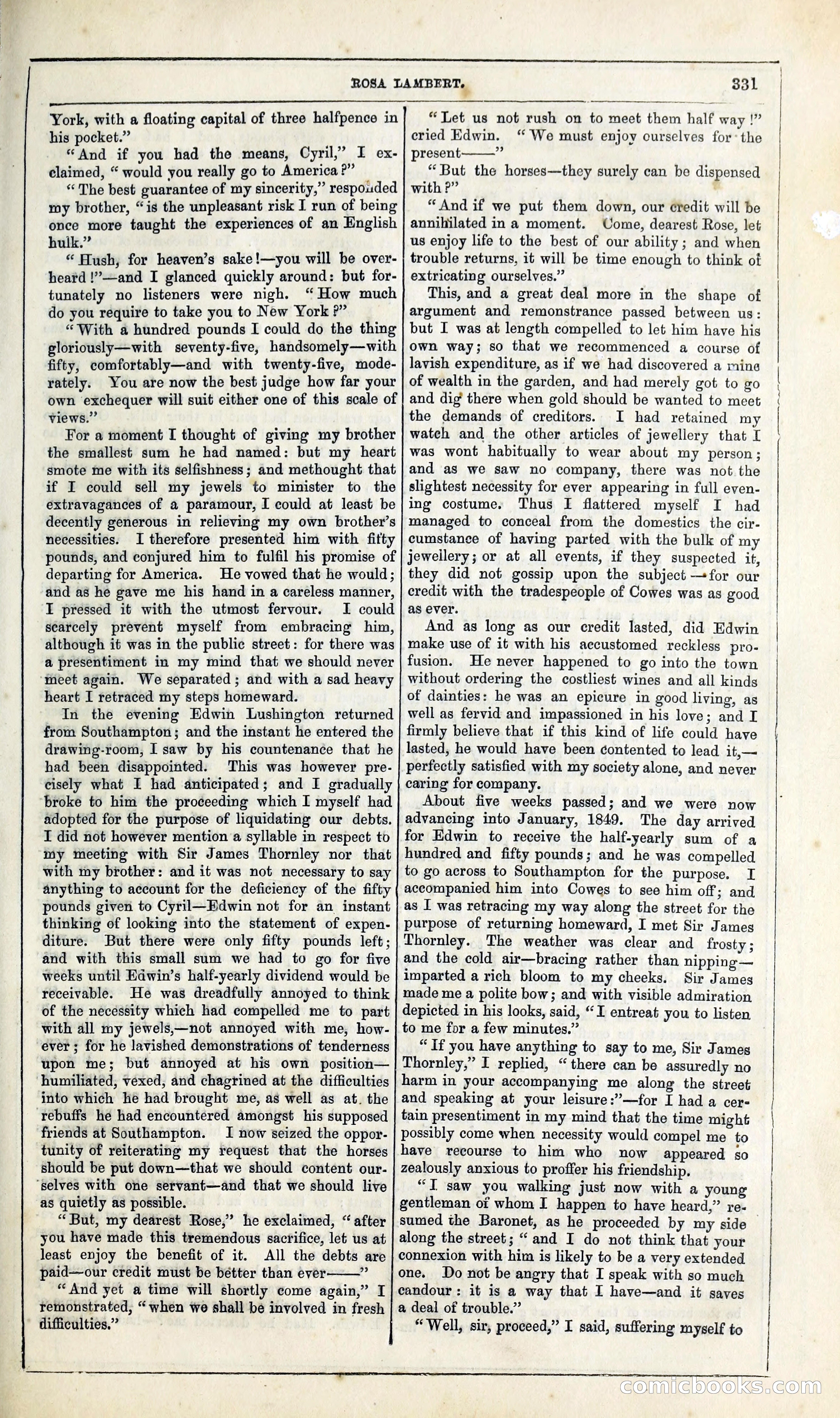
A restored page from Penny Dreadfuls, 1854. Page through the whole issue in the reader above.
📄 Transcribed text from this page (OCR, searchable)
Machine-transcribed from the original scan — historical spelling and the odd misread are preserved.
a a | ROSA LAMBERT, . 8 ee ee York, with a floating capital of three halfpence in his pocket.” “And if you had the means, Cyril,” I ex- claimed, “ would you really go to America ?” «The best guarantee of my sincerity,” respouded my brother, “is the unpleasant risk I run of being once more taught the experiences of an English hulk.” “ Hush, for heaven’s sake!—you will be over- | heard !”—and I glanced quickly around: but for- tunately no listeners were nigh. “ How much do you require to take you to New York ?” “With a hundred pounds I could do the thing gloriously—with seventy-five, handsomely—with fifty, comfortably—and with twenty-five, mode- rately. You are now the best judge how far your own exchequer will suit either one of this scale of views.” For a moment [I thought of giving my brother the smallest sum he had named: but my heart smote me with its selfishness; and methought that if I could sell my jewels to minister to the extravagances of a paramour, I could at least be decently generous in relieving my own brother’s necessities. I therefore presented him with fitty pounds, and conjured him to fulfil his promise of departing for America. He vowed that he would; and as he gave me his hand in a careless manner, I pressed it with the utmost fervour. I could searcely prevent myself from embracing him, although it was in the public street: for there was a presentiment in my mind that we should never ‘meet again. We separated; and with a sad heavy heart I retraced my steps homeward. In the evening Edwin Lushington returned from Southampton; and the instant he entered the drawing-room, I saw by his countenance that he had been disappointed. This was however pre- cisely what I had anticipated; and I gradually broke to him the proceeding which I myself had adopted for the purpose of liquidating our debts. I did not however mention a syllable in respect to my meeting with Sir James Thornley nor that with my brother: and it was not necessary to say anything to account for the deficiency of the fifty pounds given to Cyril—Edwin not for an instant thinking of looking into the statement of expen- diture. But there were only fifty pounds left; and with this small sum we had to go for five weeks until Edwin’s half-yearly dividend would be receivable. He was dreadfully annoyed to think of the necessity which had compelled me to part with all my jewels,—not annoyed with me, how- ever ; for he lavished demonstrations of tenderness upon me; but annoyed at his own position— humiliated, vexed, and chagrined at the difficulties into which he had brought me, as well as at. the rebuffs he had encountered amongst his supposed friends at Southampton. I now seized the oppor- tunity of reiterating my request that the horses should be put down—that we should content our- ‘selves with one servant—and that we should live as quietly as possible. “ But, my dearest Rose,’ he exclaimed, “ after you have made this tremendous sacrifice, let us at least enjoy the benefit of it. All the debts are paid—our credit must be better than ever 4 “And yet a time will shortly come again,” I remonstrated, “when we shall bé involved in fresh difficulties.” ; one. 331 “Let us not rush on to meet them half way !” cried Edwin. ‘ We must enjoy ourselves for: the present fe “But the horses—they surely can be dispensed with P” | “And if we put them down, our credit will be annihilated in a moment. Come, dearest Rose, let us enjoy life to the best of our ability ; and when trouble returns, it will be time enough to think of extricating ourselves.” This, and a great deal more in the shape of argument and remonstrance passed between us: but I was at length compelled to let him have his own way; so that we recommenced a course of lavish expenditure, as if we had discovered a mine of wealth in the garden, and had merely got to go and dig’ there when gold should be wanted to meet the demands of creditors. I had retained my watch and the other articles of jewellery that I was wont habitually to wear about my person; and aS we saw no company, there was not the slightest necessity for ever appearing in full even- ing costume. Thus I flattered myself I had managed to conceal from the domestics the cir- cumstance of having parted with the bulk of my jewellery; or at all events, if they suspected it, they did not gossip upon the subject —for our credit with the tradespeople of Cowes was as good as ever. And as long as our credit lasted, did Edwin make use of it with his accustomed reckless pro- fusion. He never happened to go into the town without ordering the costliest wines and all kinds of dainties: he was an epicure in good living, as well as fervid and impassioned in his love; and I firmly believe that if this kind of life could have lasted, he would have been contented to lead it,— perfectly satisfied with my society alone, and never caring for company. About five weeks passed; and we were now advancing into January, 1849. The day arrived for Edwin to receive the half-yearly sum of a hundred and fifty pounds; and he was compelled to go across to Southampton for the purpose. I accompanied him into Cowes to see him off; and as I was retracing my way along the street for the purpose of returning homeward, I met Sir James Thornley. The weather was clear and frosty ; and the cold air—bracing rather than nipping— imparted a rich bloom to my cheeks. Sir James made me a polite bow; and with visible admiration depicted in his looks, said, “‘ I entreat you to listen to me for a few minutes.” “If you have anything to say to me, Sir James Thornley,” I replied, “there can be assuredly no harm in your accompanying me along the street and speaking at your leisure:”—for I had a cer- tain presentiment in my mind that the time might possibly come when necessity would compel me to have recourse to him who now appeared so zealously anxious to proffer his friendship. “I saw you walking just now with a young gentleman of whom I happen to have heard,” re- sumed the Baronet, as he proceeded by my side along the street; “and I do not think that your connexion with him is likely to be a very extended Do not be angry that I speak with so much candour: it is a way that I have—and it saves a deal of trouble.” “Well, sir, proceed,” I said, suffering myself to Weom CIN OOKS) (EO)