
Penny Dreadfuls, 1854 · page 344 of 400
Rosa Lambert — page 344: what you’re looking at
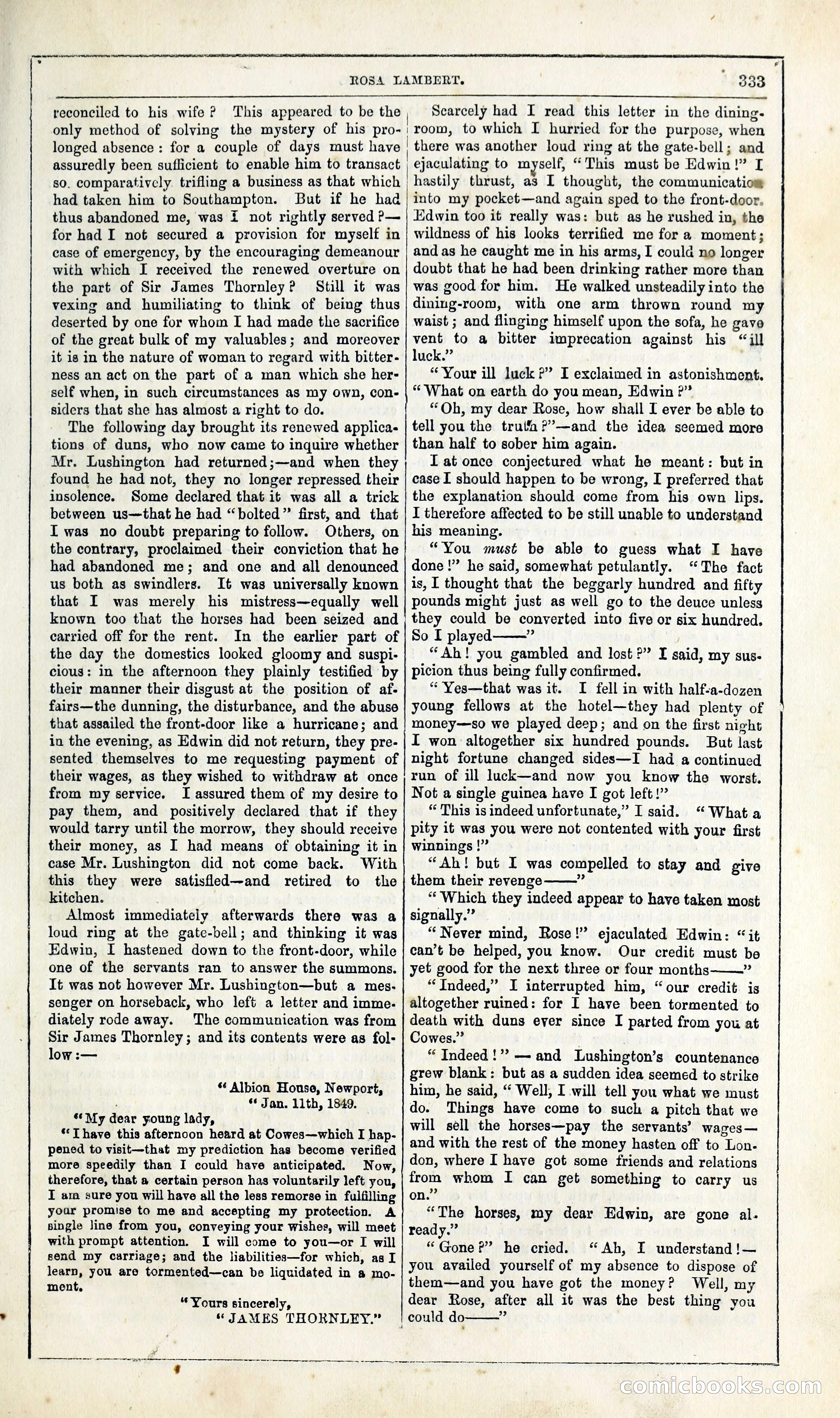
A restored page from Penny Dreadfuls, 1854. Page through the whole issue in the reader above.
📄 Transcribed text from this page (OCR, searchable)
Machine-transcribed from the original scan — historical spelling and the odd misread are preserved.
Pe EE eS Een ye ROSA LAMBERT. Doo reconciled to his wife? This appeared to be the | Scarcely had I read this letter in the dining- only method of solving the mystery of his pro-; room, to which I hurried for the purpose, when longed absence: for a couple of days must have | there was another loud ring at the gate-bell; and assuredly been sufficient to enable him to transact so. comparatively. trifling a business as that which had taken him to Southampton. But if he had thus abandoned me, was i not rightly served P— for had I not secured a provision for myself in case of emergency, by the encouraging demeanour with which I received the renewed overture on the part of Sir James Thornley? Still it was vexing and humiliating to think of being thus deserted by one for whom I had made the sacrifice of the great bulk of my valuables; and moreover it is in the nature of woman to regard with bitter- ness an act on the part of a man which she her- self when, in such circumstances as my own, con- siders that she has almost a right to do. The following day brought its renewed applica- tions of duns, who now came to inquire whether Mr. Lushington had returned;—and when they found he had not, they no longer repressed their insolence. Some declared that it was all a trick between us—that he had “bolted” first, and that I was no doubt preparing to follow. Others, on the contrary, proclaimed their conviction that he had abandoned me; and one and all denounced us both as swindlers. It was universally known that I was merely his mistress—equally well known too that the horses had been seized and carried off for the rent. In the earlier part of the day the domestics looked gloomy and suspi- cious: in the afternoon they plainly testified by their manner their disgust at the position of af- fairs—the dunning, the disturbance, and the abuse that assailed the front-door like a hurricane; and in the evening, as Edwin did not return, they pre- sented themselves to me requesting payment of their wages, as they wished to withdraw at once from my service. I assured them of my desire to pay them, and positively declared that if they would tarry until the morrow, they should receive their money, as I had means of obtaining it in case Mr. Lushington did not come back. With this they were satisfled—and retired to the kitchen. Almost immediately afterwards there was a loud ring at the gate-bell; and thinking it was Edwin, I hastened down to the front-door, while one of the servants ran to answer the summons. It was not however Mr. Lushington—but a mes- senger on horseback, who left a letter and imme- diately rode away. The communication was from Sir James Thornley; and its contents were as fol- low :— *¢ Albion House, Newport, ; ** Jan. 11th, 1849. **My dear young lady, **T have this afternoon heard at Cowes—which I hap- pened to visit—that my prediction has become verified more speedily than I could have anticipated. Now, therefore, that a certain person has voluntarily left you, I am sure you will have all the less remorse in fulfilling yoar promise to me and accepting my protection. A single Jine from you, conveying your wishes, will meet with prompt attention. I will come to you—or I will send my carriage; and the liabilities—for which, as I learn, you are tormented—can be liquidated in a mo- ment, ‘* Yours sincerely, “JAMES THORNLEY.” | | ] -—_—— - SO LE OR NT I rE oe ejaculating to myself, “This must be Edwin!” I hastily thrust, as I thought, the communicatiom into my pocket—and again sped to the front-door. Edwin too it really was: but as he rushed in, the wildness of his looks terrified me for a moment; and as he caught me in his arms, I could no longer doubt that he had been drinking rather more than was good for him. He walked unsteadily into the dining-room, with one arm thrown round my waist ; and flinging himself upon the sofa, he gave vent to a bitter imprecation against his “ill luck.” “Your ill luck P” I exclaimed in astonishment. “ What on earth do you mean, Edwin ?” “Oh, my dear Rose, how shall I ever be able to tell you the truta?’—and the idea seemed more than half to sober him again. I at once conjectured what he meant: but in case I should happen to be wrong, I preferred that the explanation should come from his own lips. I therefore affected to be still unable to understand his meaning. “You must be able to guess what I have done !”’ he said, somewhat petulantly. “The fact is, [ thought that the beggarly hundred and fifty pounds might just as well go to the deuce unless they could be converted into five or six hundred. So I played i “Ah! you gambled and lost?” I said, my sus- picion thus being fully confirmed. “ Yes—that was it. I fell in with half-a-dozen young fellows at the hotel—they had plenty of money—so we played deep; and on the first night I won altogether six hundred pounds. But last night fortune changed sides—I had a continued run of ill luck—and now you know the worst. Not a single guinea have I got left!” “This is indeed unfortunate,” I said. “Whata pity if was you were not contented with your first winnings !” “Ah! but I was compelled to stay and give them their revenge ty “Which they indeed appear to have taken most signally.” “ Never mind, Rose!” ejaculated Edwin: “it can’t be helped, you know. Our credit must be yet good for the next three or four months “ Indeed,” I interrupted him, “our credit is altogether ruined: for I have been tormented to death with duns eyer since I parted from you at Cowes.” | | “ Indeed !’? — and Lushington’s countenance grew blank: but as a sudden idea seemed to strike him, he said, “ Well, I will tell you what we must do. Things have come to such a pitch that we will sell the horses—pay the servants’ wages— and with the rest of the money hasten off to Lon- don, where [ have got some friends and relations from whom I can get something to carry us on.” “The horses, my dear Edwin, are gone al. ready.” “Gone?” he cried. “Ah, I understand !— you availed yourself of my absence to dispose of them—and you have got the money? Well, my dear Rose, after all it was the best thing you could do ry eee ted et E@RMICOOOKS (C(O)