
Penny Dreadfuls, 1800 · page 179 of 400
Pickwick Abroad: A Companion to the Pickwick Papers — page 179: what you’re looking at
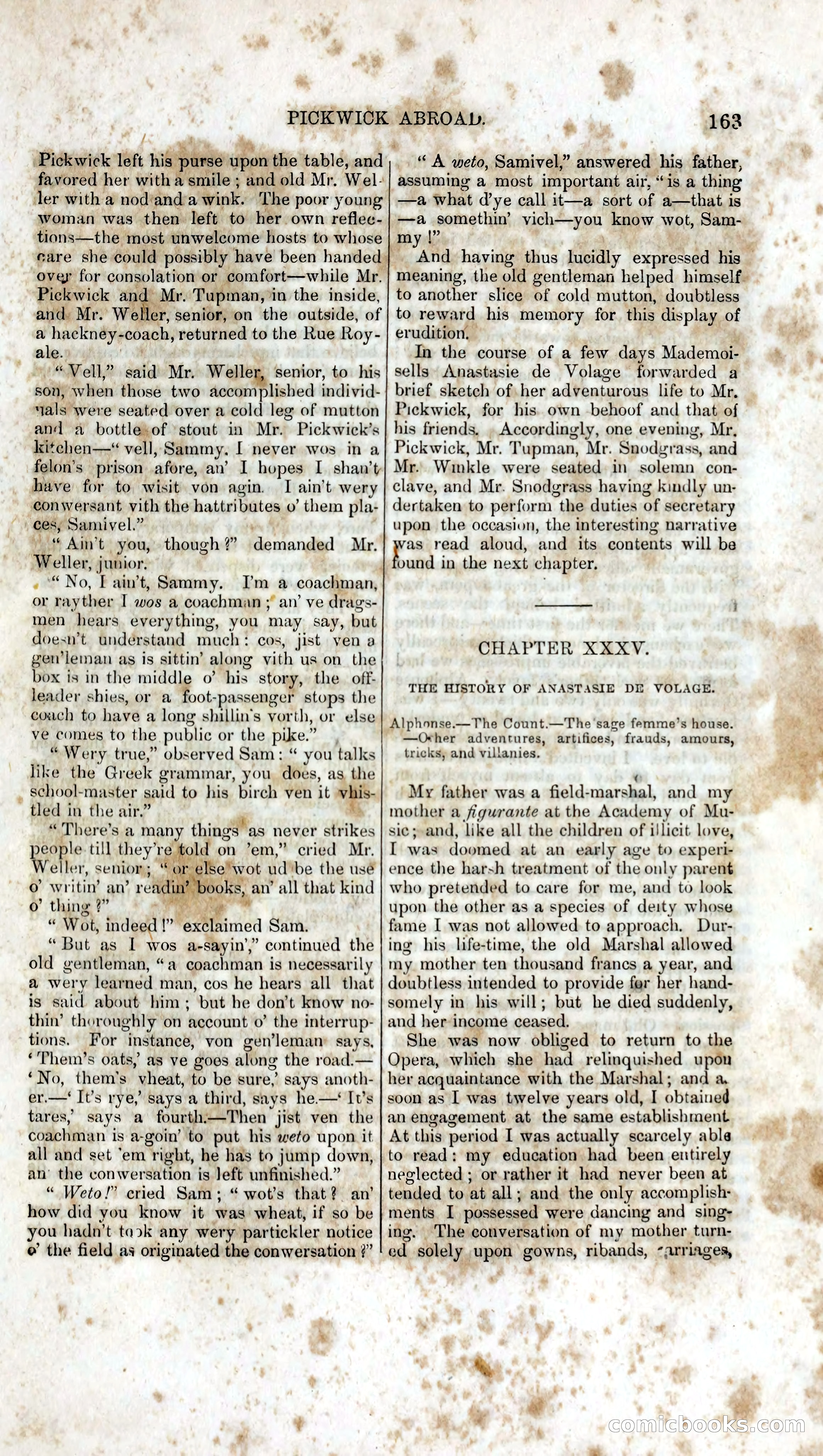
A restored page from Penny Dreadfuls, 1800. Page through the whole issue in the reader above.
📄 Transcribed text from this page (OCR, searchable)
Machine-transcribed from the original scan — historical spelling and the odd misread are preserved.
— on | "age PICKWICK ABROAD. / me Pickwick left his p (a) ey favored her witha smile ; : ae 4 “a ‘2 Pickwick and Mr. Tupman, in the inside, and: Mr. Weller, senior, on the outside, of a hackney-coach, returned to the Rue Roy- ale. “Vell,” said Mr. Weller, senior, to. his son, when those two accomplished individ- als were seated over a cold leg of mutton and a storm ‘stout in Mr. Pickwick’s ell, Sammy, I never wos in a felon’s prison afore, an’ I hopes I shan’t kitehen—* v have for to wisit von agin. I ain't wery conwersant vith the hattributes o’ them pla- ces, Samivel.” Wilh Asin’t you, though ?” ‘Weller, junior, . “No, T ain't, Sammy. or rayther I wos a coachman ; an’ ve drags- men hears everything, you may say, but doesn’t understand much: cos, jist ven a gen’leman as is sittin’ along vith us on the box is in the middle o’ his story, the off- leader shies, or a T chinaealiiell stops the couch to have a long shillin’s vorth, or else ve comes to the public or the pike.” , “Wery true,” observed Sam: “ you talks like the Greek grammar, you does, as the . School-master said to his birch ven it v tled in the air.” | e “ There’s a many things as never strikes a till they’re ld on ’em,” cried Mr. eller, senior; “ore Se wot ud ‘be the usé o’ writin’ an’ readin’ books, an’ all that kind 0’ thing ?” "P ue * | “ Wot, indee: ” exclaimed Sam. “But as I wos a-sayin’, demanded Mr. \s ” continued the old gentleman, “a coachman is necessarily a wery learned man, cos he hears all that is said about him; but he don’t know no- thin’ thoroughly on account o’ the interrup- tions. For instance, von gen’leman says, ‘Them’s oats, as ve goes along the road.— ‘No, them’s vheat, to be sure,’ says anoth- er.—‘ It’s rye,’ says a third, says he.—‘ It’s tares,’ says a fourth—Then jist ven the coachman is a-goin’ to put his weto upon it all and set ‘em right, he has to jump down, an’ the conwersation is Jeft unfinished.” “ Weto!” cried Sam; “ wot’s that? an’ how did you know it was wheat, if so be you hadn’t taok any wery partickler notice o the field as originated the conwersation ?” 4 i upon the table, and : : ile ; and old Mr, Wel- ler with a nod'anda wink. The poor young woman was then left to her own reflec- tions—the most unwelcome hosts to whose care she could possibly have been handed |. over for consolation or comfort—while Mr. I'm a sonnets eo 163 ¥ _“ A weto, Samivel,” answered his father, assuming a most important air, “is a thing —a What d’ye call it—a sort of a—that is —a somethin’ vich—you know wot, Sam- Iny !” | And having thus lucidly expressed his | meaning, the old gentleman helped himself. to another slice of cold mutton, doubtless to reward his memory for this display of erudition. - | | mae In the course of a few days Mademoi- sells Anastasie de Volage forwarded a brief sketch of her adventurous life to Mr, Pickwick, for his. own behoof and that of | his friends. , Accordingly, one evening, Mr, Pickwick, Mr. Tupman, Mr. Snodgrass, and Mr. Winkle were seated in solemn con- clave, and Mr. Snodgrass having kindly un- dertaken to perform the duties of secretary upon the occasion, the interesting narrative ee read aloud, and its contents will be ound in the next chapter. CHAPTER XXXYV. THE HISTORY OF ANASTASIE DE VOLAGE. Alphonse.—The Count.—The'sage femme’s house. —Orher adventures, artifices, frauds, amours, tricks, and villanies. ‘ My father was a field-marshal, and my mother a figurante at the Academy of Mu- sic ;-and, like all the children of ilicit love, I was doomed at an early age to experi ence the harsh treatment of the only parent who pretended to care for me, and to look upon the other as a species of deity whose fame I was not allowed to approach. Dur- ing his life-time, the old Marshal allowed my mother ten thousand francs a year, and doubtless intended to provide fer her hand- somely in his will; but he died suddenly, and her income ceased. She was now obliged to return to the Opera, which she had relinquished upon her acquaintance with the Marshal; and a soon as I was tivelve years old, I obtained an engagement at the same establishment At this period I was actually scarcely able to read: my education had been entirely neglected ; or rather it had never been at tended to at all; and the only accomplish- ments I possessed were dancing and sing- ing. ‘The conversation of my mother turn- ed solely upon gowns, ribands, ‘arriages, ’ , A tH, S COMI|COO® CO