
Penny Dreadfuls, 1800 · page 178 of 400
Pickwick Abroad: A Companion to the Pickwick Papers — page 178: what you’re looking at
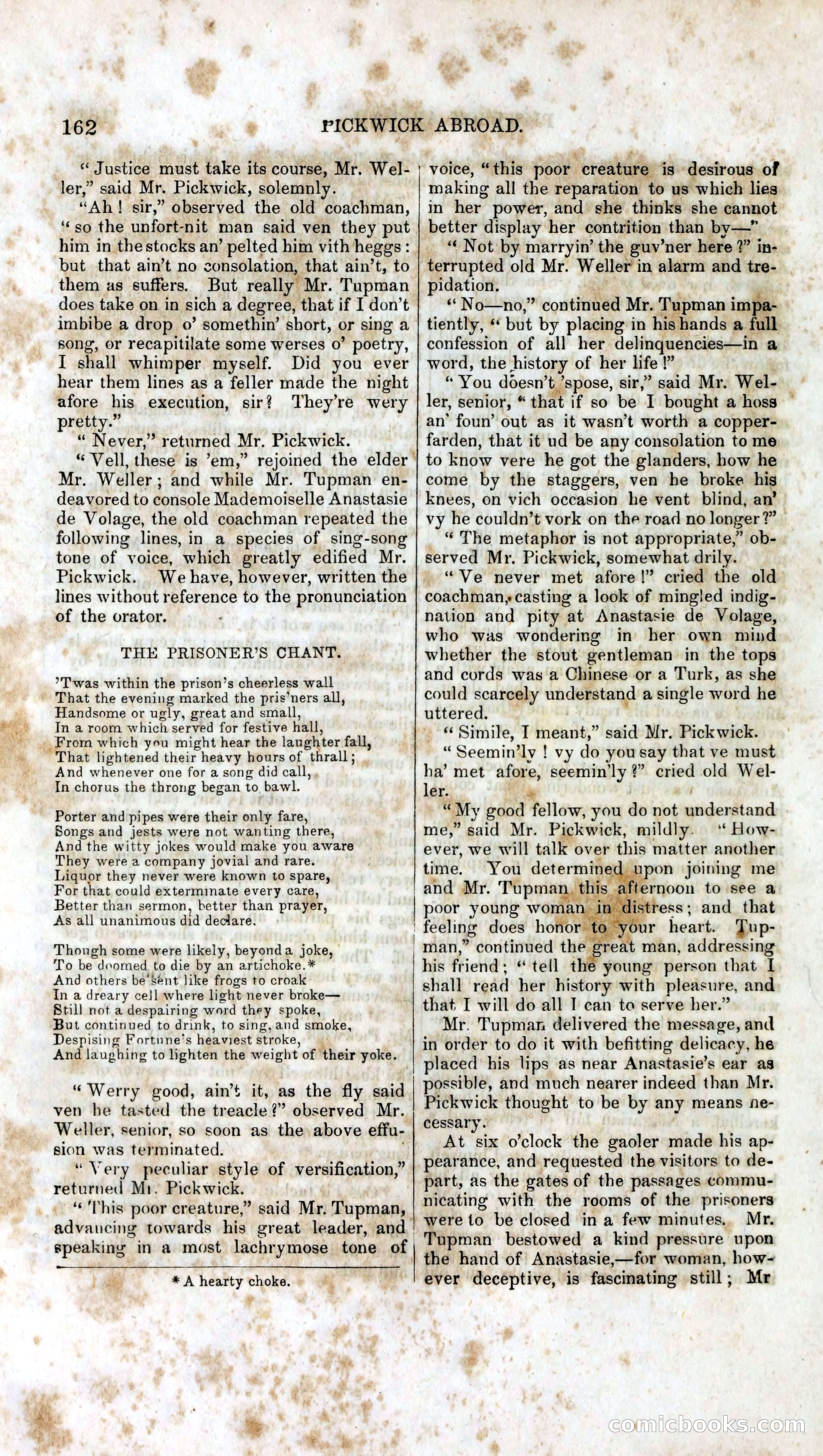
A restored page from Penny Dreadfuls, 1800. Page through the whole issue in the reader above.
📄 Transcribed text from this page (OCR, searchable)
Machine-transcribed from the original scan — historical spelling and the odd misread are preserved.
rie Hees wa) “ Justice must take its course, Mr. Wel- } voice, “this poor natal is» ler,” said Mr. Pickwick, solemnly. cA | sir,” observed the old coachman, “so the unfort-nit man said ven they put him in thestocks an’ pelted him vith heggs: but that ain’t no consolation, that ain’t, to them as suffers. But really Mr. Tupman does take on in sich a degree, that if I don’t imbibe a drop o’ somethin’ short, or sing a song, or recapitilate some werses 0” poetry, I shall whimper myself. Did you ever hear them lines as a feller made the night afore his execution, sir? They’re wery pretty.” “ Never,” returned Mr. Pickwick. “ Vell, these is ’em,” rejoined the elder ’ Mr. Weller; and while Mr. Tupman en- deavored to donsole Mademoiselle Anastasie de Volage, the old coachman repeated the following lines, in a species of sing-song tone of voice, which greatly edified Mr. Pickwick. We have, however, written the lines without reference to the pronunciation of the orator. THE PRISONER’S CHANT. "T'was within the prison’s cheerless wall - That the evening marked the pris’ners all, Handsome or ugly, great and small, In a room which served for festive hall, From which you might hear the laughter fall, That lightened their heavy hours of thrall; And whenever one for a song did call,, In chorus the throng began to bawl. Porter and pipes were their only fare, Songs and jests were not wanting there, And the witty jokes would make you aware They were a company jovial and rare. Liquor they never were known to spare, For that could exterminate every care, Better than sermon, better than prayer, As all unanimous did declare. Though some were likely, beyonda joke, To be doomed to die by an artichoke. * And others be sent like frogs to croak In a dreary cell where light never broke— Still not a despairing word they spoke, But continued to drink, to sing,and smoke, Despising Fortnne’s heaviest stroke, And laughing to lighten the weight of their yoke. “ Werry good, ain’t it, as the fly said ven he tasted the treacle?’ observed Mr. Weller, senior, so soon as the: above effu-_ sion was terminated. “Very peculiar style of versification,” returned M1. Pickwick. . “This poor creature,” said Mr. Tupman, advancing towards his great leader, and. | speaking in a most lachrymose tone of | o~_ —_— | ae * A hearty choke. y oe riCn yee | py, esirous of making all the reparation to us which lies in hex’ power, and she thinks she cannot better display her contrition than by—" _ “Not by marryin’ the guy’ner here ?” in- | terrupted old Mr. Weller’ i in alarm and tre- pidation, “ No—no,” continued Mr. 7 pman impa- tiently, * but by placing in ae confession of all her delinquencies—in a word, the history of her life !” hands a full “You doesn’t ’spose, sir,” said Mr. Wel- _- ler, senior, “ that if so be I bought a hoss an’ foun’ out as it wasn’t worth a copper- farden, that it ud be any consolation to me to know vere he got the glanders, how he come by the staggers, ven he broke his knees, on vich occasion he vent blind, an’ vy he ‘couldn’t vork on the road no longer ?” “ The metaphor is not appropriate,” ob-. served Mr. Pickwick, somewhat drily. “Ve never met afore!” cried the old coachman, casting a look of mingled indig- nation and pity at Anastasie de Volage, who was wondering in her own mind whether the stout gentleman in the tops and cords was a Chinese or a Turk, as she could scarcely understand a single wend he uttered. “ Simile, I meant,” said Mr. Pickwick. r Seemin’ly ! vy do you say that ve must ha’ met afore, seemin ly ?” cried old Wel- ler. ; « My good fellow, you do dot rece “al . me,” said Mr. Pickwick, mildly. ‘“ How- ever, we will talk over this matter another time. You determined upon joining me RRR and Mr. Tupman, this afternoon to see a poor young woman a distress ; and that feeling does honor to your heart. Tup- man,’ continued the reat man, addressing his fr iend; “tell the young person that ii shall read her history with pleasure, and that I will do all I can ta serve her.” Mr. Tupman delivered the message, and in order to do it with befitting delicacy, he placed his lips as near Anastasie’s ear as possible, and much nearer indeed than Mr. Pickwick thought to be by any means he- cessary. At six o’clock the gaoler made his ap- pearance, and requested the visitors to de- part, as the gates of the passages commu- nicating with the rooms of the prisoners were to be closed in a’ few minutes.. Mr. Tupman bestowed a kind pressure upon | the hand of Anastasie,—for woman, how- ever deceptive, is fascinating still; Mr COMMICLOOOKS.E©) im