
Penny Dreadfuls, 1800 · page 180 of 400
Pickwick Abroad: A Companion to the Pickwick Papers — page 180: what you’re looking at
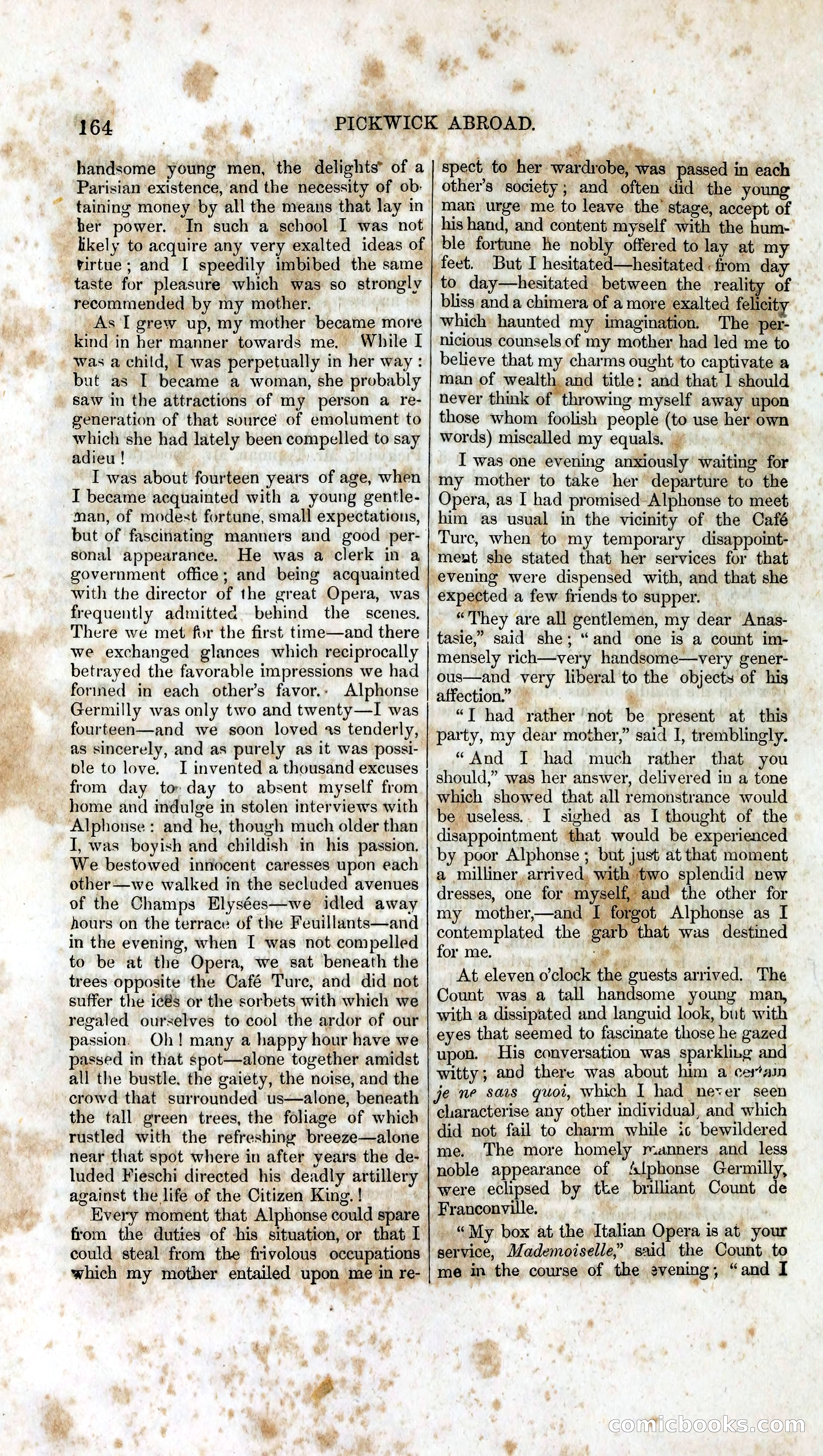
A restored page from Penny Dreadfuls, 1800. Page through the whole issue in the reader above.
📄 Transcribed text from this page (OCR, searchable)
Machine-transcribed from the original scan — historical spelling and the odd misread are preserved.
‘ handsome young men, the delights” of a Parisian existence, and the necessity of ob: taining money by all the means that lay in ber power. In such a school I was not likely to acquire any very exalted ideas of virtue; and I speedily imbibed the same ‘taste for pleasure which was so strongly recommended by my mother. As I grew up, my mother became more kind in her manner towards me. While I was a child, I was perpetually in her way : but as I became a woman, she probably saw in the attractions of my person a re- generation of that source of emolument to which she had lately been compelled to say adieu ! I was about fourteen years of age, when I became acquainted with a young gentle- man, of modest fortune, small expectations, but of fascinating manners and good per- sonal appearance. He was a clerk in a government office; and being acquainted with the director of the great Opera, was frequently admitted behind the scenes. There we met for the first time—and there we exchanged glances which reciprocally betrayed the favorable impressions we had forined in each other’s favor.. Alphonse Germilly was only two and twenty—I was fourteen—and we soon loved as tenderly, as sincerely, and as purely as it was possi- ble to love. I invented a thousand excuses from day tor day to absent myself from home and indulge in stolen interviews with Alphonse : and he, though much older than I, was boyish and childish in his passion. We bestowed innocent caresses upon each other —we walked in the secluded avenues of the Champs Elysées—we idled away hours on the terrace of the Feuillants—and in the evening, when I was ‘not compelled to be at the Opera, we sat beneath the trees opposite the Café Ture, and did not suffer the i¢@s or the sorbets with which we regaled ourselves to cool the ardor of our passion. Oh! many a happy hour have we passed in that spot—alone together amidst all the bustle. the gaiety, the noise, and the crowd that surrounded us—alone, beneath the tall green trees, the foliage of which rustled with the refreshing breeze—alone near that spot where in after years the de- luded Fieschi directed his deadly artillery — against the life of the Citizen King. ! m4 Every moment that Alphonse could spare from the duties of his situation, or that I could steal from the frivolous occupations which my mother entailed upon ‘mein re- ) <4 ee PICKWICK ABROAD. spect to her wardrobe, was passed in each other’s society; and often did the young man urge me to leave the’ stage, accept of his hand, and content myself with the hum- ble fortune he nobly offered to lay at my feet. But I hesitated—hesitated from day to day—hesitated between the na fall of bliss and a chimera of a more exalted felicity which: haunted my itnagination: The per- nicious counsels of my mother had led me to believe that my charms ought ‘to captivate a man of wealth, and title: and that 1 should never think of throwing myself away upon those whom foolish people (to use her own words) miscalled my equals. bp I was one evening anxiously’ waiting for my mother to take her departure to the Opera, as I had promised Alphonse to meet him as usual in the vicinity of the Café Ture, when to my temporary disappoint- meat she stated that her services for that evening were dispensed with, and that she expected a few friends to supper. “They are all gentlemen, my dear Anas- tasie,” said she; “and one is a count im- mensely rich—very handsome—very gener- ous—and very liberal to the objects of his affection.” ~ &. “T had rather not be present at this party, my dear mother,” said I, tremblingly. “And I had much rather that you should,” was her answer, delivered in a tone which showed that all remonstrance would be useless.. I sighed as I thought of the disappointment that would be experienced by poor Alphonse ; but just at that moment a milliner arrived, with two splendid new dresses, one for myself, and the other for my mother,—and I forgot Alphonse as I contemplated the garb that was destined for me. Pa " At eleven o'clock the guests arrived. The Count was a tall handsome young man, with a dissipated and languid look, but with eyes that seemed to fascinate those he gazed upon. His conversation was sparkling and witty; and there was about him a certain je ne sars quot, which I had never seen characterise any other individual], and which did not fail to charm while ic bewildered me. The more homely manners and _ less noble appearance of Alphonse Germilly, were eclipsed by tke bmilliant Count de Franconville. . “My box at the Italian Opera is at your service, Mademoiselle,” said the Count to me in the course of the evening, “and I CORnMCOOOlKS.sE@ @)