
Penny Dreadfuls, 1850 · page 241 of 394
The Mysteries of London; or, Lights and Shadows of London Life — page 241: what you’re looking at
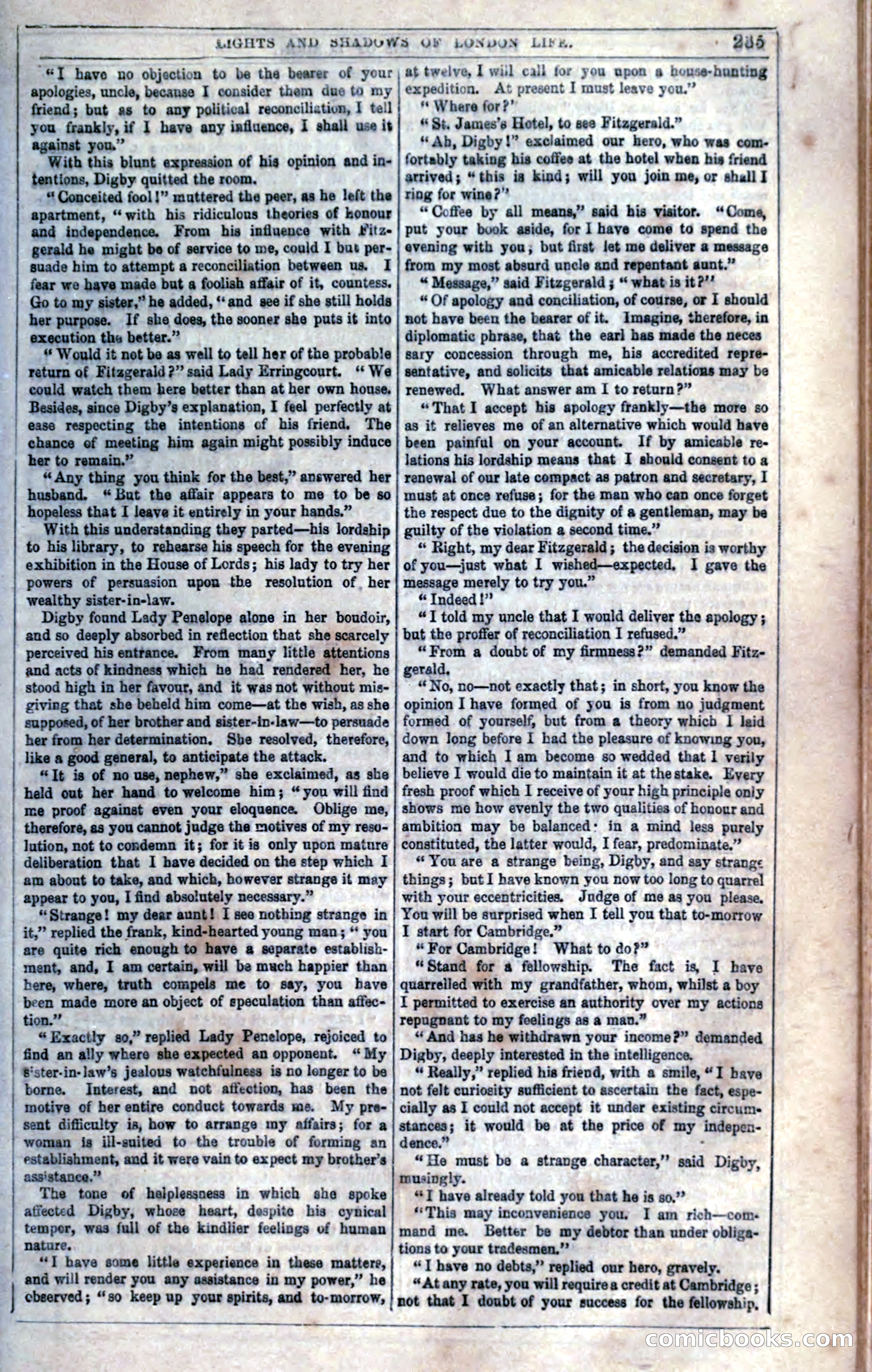
A restored page from Penny Dreadfuls, 1850. Page through the whole issue in the reader above.
📄 Transcribed text from this page (OCR, searchable)
Machine-transcribed from the original scan — historical spelling and the odd misread are preserved.
~®T have no objection ‘to be the bearer of your uncle, becanse I consider them due to my iend; but as to any political reconciliation, I tell 1 frankly, if 1 have any influence, I shall use is With this blunt expression of his opinion and in- tentions, Digby quitted the room. .“ Conceited fool!” muttered the peer, as he left the independence. From his influence with Pitz- gerald he might be of service to me, could I but per- suade him to attempt a reconciliation between us. I fear we have made but a foolish affair of it, countess. 10 to my sister,” he added, ‘and see if she still holds If she does, the sooner she puts it into eagraten, thn batiee. Would it not be as well to tell her of the probable ae ang 2?” said Lady Erringcourt. ‘“ We | watch ere better than at her own house, since D fehcaicasden, 1 fiel portieats of Sapectng intentions of his friend. The po "goes him again might possibly induce you think for the best,” answered her the affair appears to me to be so eee is eotinie ih pier hando” lordship #8 age yall = ee to his , to rehearse his speech for the evening exhibition in the House of Lords; his lady to try her Digby found Lady Penelope alone in her boudoir, and so absorbed in reflection that she scarcely perceived his entrance. From many little tions and acts of kindness which he had rendered her, he stood high in her favour, and it was not without mis- giving that she beheld him come—at the wish, as she supposed, of her brother and sister-in-law—to persuade lution, not to condemn it; for it is only upon mature deliberation that I have decided on the step which I am about to take, and which, however strange it may appear to you, I find absolutely necessary.” “Strange! my dear aunt! I see nothing strange in it,” replied the frank, kind-hearted young man; “ you are quite rich enough to have a separate establish- ment, and, I am certain, will be much happier than compels me to say, you have ore an object of speculation than affec- so,” replied Lady Penelope, rejoiced to find an ally where she expected an opponent. “My ®'ster-in-law’s jealous watchfulness is no lenger to be and not affection, has been the motive of her entire conduct towards me. My pre- sent difficulty is, how to arrange my affairs; for a woman is ill-suited to the trouble of forming an establishment, and it were vain to expect my brother’s assistance.” The tone of halplessness in which she spoke affected Digby, whose heart, despite his cynical tempor, was full of the kindlier feelings of human nature. “I have some little experience in these mattere, and will render you any assistance in my power,” he ebserved; “‘so keep up your spirits, and to-morrow, _—_—_——— ee SIGHTS AND SHADUWSA OF LONDON LIb#. - ' 206 at twelve, I will ‘call for you upon se bouse-hanting expedition. At present I must leave you.” * Where for?’ « $:. James’s Hotel, to see Fitzgerald.” * Ah, Digby!” exclaimed our hero, who was com- fortably taking his coffee at the hotel when his friend arrived; “this is kind; will you join me, or shall I ring for wine?” “ Coffee by all means,” said his visitor. “Come, put your book aside, for 1 haye come to spend the evening with you; but first let me deliver a message from my most absurd uncle and repentant aunt.” “ Message,” said Fitzgerald ; “ what is it?”’ “ Of apology and conciliation, of course, or I should not have been the bearer of it. Imagine, therefore, in diplomatic phrase, that the earl has made the neces sary concession through me, his accredited repre- sentative, and solicits that amicable relations may be renewed. What answer am I to return?” “That I accept his apology frankly—the more so as it relieves me of an alternative which would have been painful on your account. If by amicable re- lations his lordship means that I should consent to a renewal of our late compact as patron and secretary, I must at once refuse; for the man who can once forget the respect due to the dignity of a gentleman, may be guilty of the violation a second time,” “ Right, my dear Fitzgerald; the decision is worthy of you—just what I wished—expected, I gave the message merely to try you.” “ Indeed !” “T told my uncle that I would deliver the apology ; but the proffer of reconciliation I refused.” “From a doubt of my firmness?” demanded Fitz- gerald, _ “No, no—not exactly that; in short, you know the opinion I have formed of you is from no judgment formed of yourself, but from a theory which I leid down long before I had the pleasure of knowing you, and to which I am become so wedded that 1 verily believe 1 would die to maintain it at thestake. Every fresh proof which I receive of your high principle only shows me how evenly the two qualities of honour and ambition may be balanced: in a mind less purely constituted, the latter would, I fear, predominate.” “You are a strange being, Digby, and say strange things; but I have known you now too long to quarrel with your eccentricities. Judge of me as you please, You will be surprised when I tell you that to-morrow I start for Cambridge.” “For Cambridge! What to do?” “Stand for a fellowship. The fact is, I have quarrelled with my grandfather, whom, whilst a boy I permitted to exercise an authority over my actions repugnant to my feelings as a man.” “ And has he withdrawn your income?” demanded Digby, deeply interested in the intelligence, “ Really,” replied his friend, with a smile, “I bave not felt curiosity sufficient to ascertain the fact, espe- cially as I could not accept it under existing circum. stances; it would be at the price of my indepen- dence.” “He must be a strange character,’”’ said Digby, musingly. “T have already told you that he is so.” ‘‘This may inconvenience you, I am rich—com. mand me. Better be my debtor than under obliga- tions to your tradesmen,”’ “IT have no debts,” replied our hero, gravely. “At any rate, you will require a credit at Cambridge ; not that I doubt of your success for the fellowship, eT COLA -——-—s oO | ——_ Glxooks (CO)