
Penny Dreadfuls, 1850 · page 240 of 394
The Mysteries of London; or, Lights and Shadows of London Life — page 240: what you’re looking at
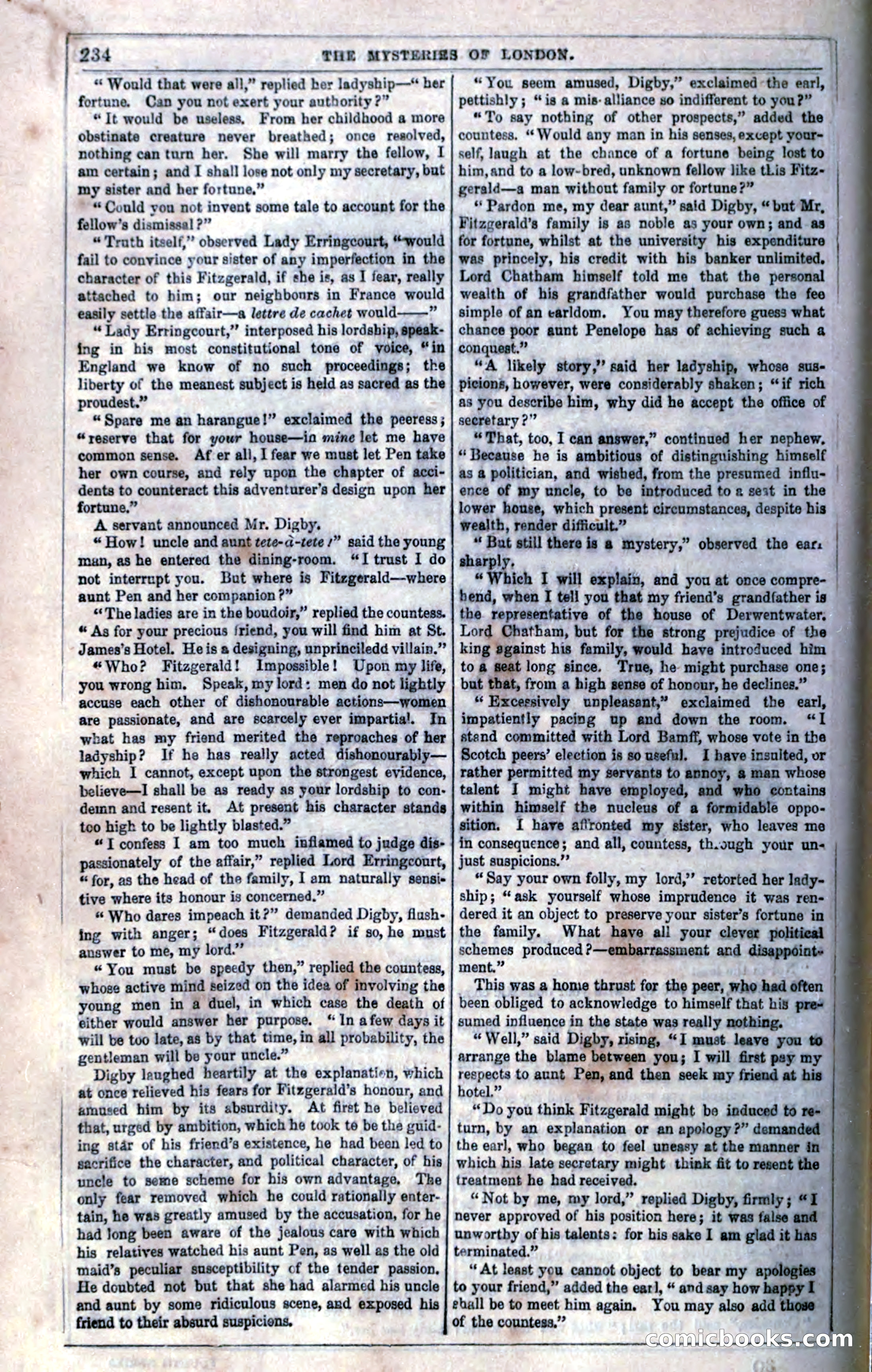
A restored page from Penny Dreadfuls, 1850. Page through the whole issue in the reader above.
📄 Transcribed text from this page (OCR, searchable)
Machine-transcribed from the original scan — historical spelling and the odd misread are preserved.
. - —— -- e THE MYSTHRIZS © oF ‘LONDON. A A / 234 “ Would that were all,” replied her lady lyship—* her fortune. Can you not exert your authority ?” “Tt would be useless, From her childhood a more once resolved, She will marry the fellow, | _ am certain; and I shall lose not only my secretary, but obstinate creature never breathed; nothing can turn her. my sister and her fortune,” ~ “Could vou not invent some tale to account for the fellow’s dismissal ?” “Truth itself,” observed Lady Erringcourt, “would fail to convince your sister of any imperfection in the character of this Fitzgerald, if she is, as I fear, really attached to him; our neighbours in France would | easily settle the affair—a lettre de cachet would——” s Lady Erringcourt,” interposed his lordship, speak- | ing in his most constitutional tone of yoice, “in _ England we know of no such proceedings; the liberty of the meanest subject is held as sacred as the proudest.” A servant announced Mr. Digby, “How! uncle anda man, as he entered the not interrupt you. aunt Pen and her companion ?” “The ladies are in the boudoir,” replied the countess. “ As for your precious friend, you will find him at St. James’s Hotel. Heis a designing, unprinciledd villain.” fortune,” | | | “Who? Fitzgerald! Impossible! Upon my life, you wrong him. Speak, my lord: men do not lightly accuse each other of dishonourable actions—women are passionate, and are scarcely ever impartia!. In ches of her ishonourably— which I cannot, except upon the strongest evidence, believe—I shall be as ready as your lordship to con- demn and resent it. At present his character stands what has my friend merited the r ladyship? If he has really acted too high to be lightly blasted.” “TJ confess I am too much inflamed to judge dis- passionately of the affair,” replied Lord Erringconrt, “for, as the head of the family, I am naturally sensi- - tive where its honour is concerned.” | «“ Who dares impeach it?” demanded Digby, flush- ing with anger; “does Fitzgerald? if so, he must answer to me, my lord.” “You must be speedy then,” replicc whose active mind seized on the idea of young men in a duel, in which case the either would answer her purpose. gentleman will be your uncle.” Digby laughed heartily at the explanatien, which at once relieved his fears for Fitzgerald’s honour, and | amused him by its absurdity. At firet he believed that, urged by ambition, which he took te be the guid- ing star of his friend’s existence, he had been led to sacrifice the character, and political character, of his | uncle to seme scheme for his own advantage, The | only fear removed which he could rationally enter- tain, he was greatly amused by the accusation, for he had Jong been aware of the jealous care with which his relatives watched his aunt Pen, as well as the old maid’s peculiar susceptibility of the tender passion, He doubted not but that she had alarmed his uncle "and aunt by some ridiculous scene, and exposed his _ friend to their absurd suspicions. “Spare me an harangue!” exclaimed the peeress ; “reserve that for your house—ia mine let me have common sense. Af er all, I fear we must let Pen take her own course, and rely upon the chapter of acci- dents to counteract this adventurer’s design upon her tete-a-tete/” said the young ining-room. “I trust I do But where is Fitzgerald—where the countess, volving the th of “In afew days it will be too late, as by that time, in all probability, the “You seem amused, Digby,” exclaimed the earl, | 4 pettishly; “is a mis-alliance so indifferent to you?” | “To say nothing of other prospects,” added the countess. ‘Would any man in his senses, except your- self, laugh at the chance of a fortune being lostto — him,and to a low-bred, unknown fellow like tLis Fitz- gerald—a man without family or fortune?” ‘Pardon me, my dear aunt,” said Digby, “but Mr, Fitzgerald’s family is as noble as your own; and as for fortune, whilst at the university his expenditure was princely, his credit with his banker unlimited, Lord Chatham himself told me that the personal wealth of his grandfather would purchase the fee simple of an earldom. You may therefore guess what chance poor aunt Penelope has of achieving such a conquest.” “A likely story,’”’ said her ladyship, whose sus- picions, however, were considerably shaken; “if rich as you describe him, why did he accept the office of secretary ?” | “That, too, I can answer,” continued her nephew, * Because he is ambitious of distinguishing himeelf as @ politician, and wished, from the presumed influ- r ey of my uncle, to be introduced toa sest in the — wer house, which present circumstances, despite his wealth, render difficult.” Rae * Bt etl there i & mystery,” observed the ear: rye ¢ I will explain, and you at once compre- hend, pad fl: coping Sit grandfather is the representative of the house of Derwentwater, — Lord Chatham, but for the strong prejudice of the e king his family, would Kael introduced him toa seat long since. True, he might purchase one; — but from a high sense of honour, he declines.” ‘“ Excessively unpleasant,” exclaimed the carl fi | impatiently pacing up and down the room. “I~ stend committed with Lord Bamff, whose vote in the Scotch peers’ election is so useful. I have insulted, or rather permitted my servants to ,» & man whose talent I might have employed, : contains within himself the aacieap of a formidable oppo- — sition. I have affronted my sister, who leaves me in consequence; and all, countess, though your un- | just suspicions.”’ | “Say your own folly, my lord,” retorted her lady~ | ; ship; “ask yourself whose imprudence it was ren- © dered it an object to preserve your sister’s fortune in | the family. What have all your clever political schemes produced ?—embarrassment and disappoints ment,” _ This was a home thrust for the peer, who had often | been obliged to acknowledge to himself that his pres sumed influence in the state was really nothing. “ Well,” said Di by, rising, “I must leave you to arrange the blame bet you; I will first pey my | remnee to aunt Pen, and then seek my friend at ae otel,” “Do you think Fitzgerald might be induced to re~ | turn, by an explanation or an apology?” demanded | the earl, who began to feel uneasy at the manner in | which his late secretary might think fit to resent the treatment he had received. ot “Not by me, my lord,” replied Digby, aor $ ot | never approved of his position here; it was false unworthy of his talents: for his sake 1 am glad i terminated.” ' “At least you cannot object to bear my sae | to your friend,” ” added the earl, “ and say how eball be to meet him again. You may also add of the countess,’ Coy ag boo Eieom 3 .