
Penny Dreadfuls, 1850 · page 242 of 394
The Mysteries of London; or, Lights and Shadows of London Life — page 242: what you’re looking at
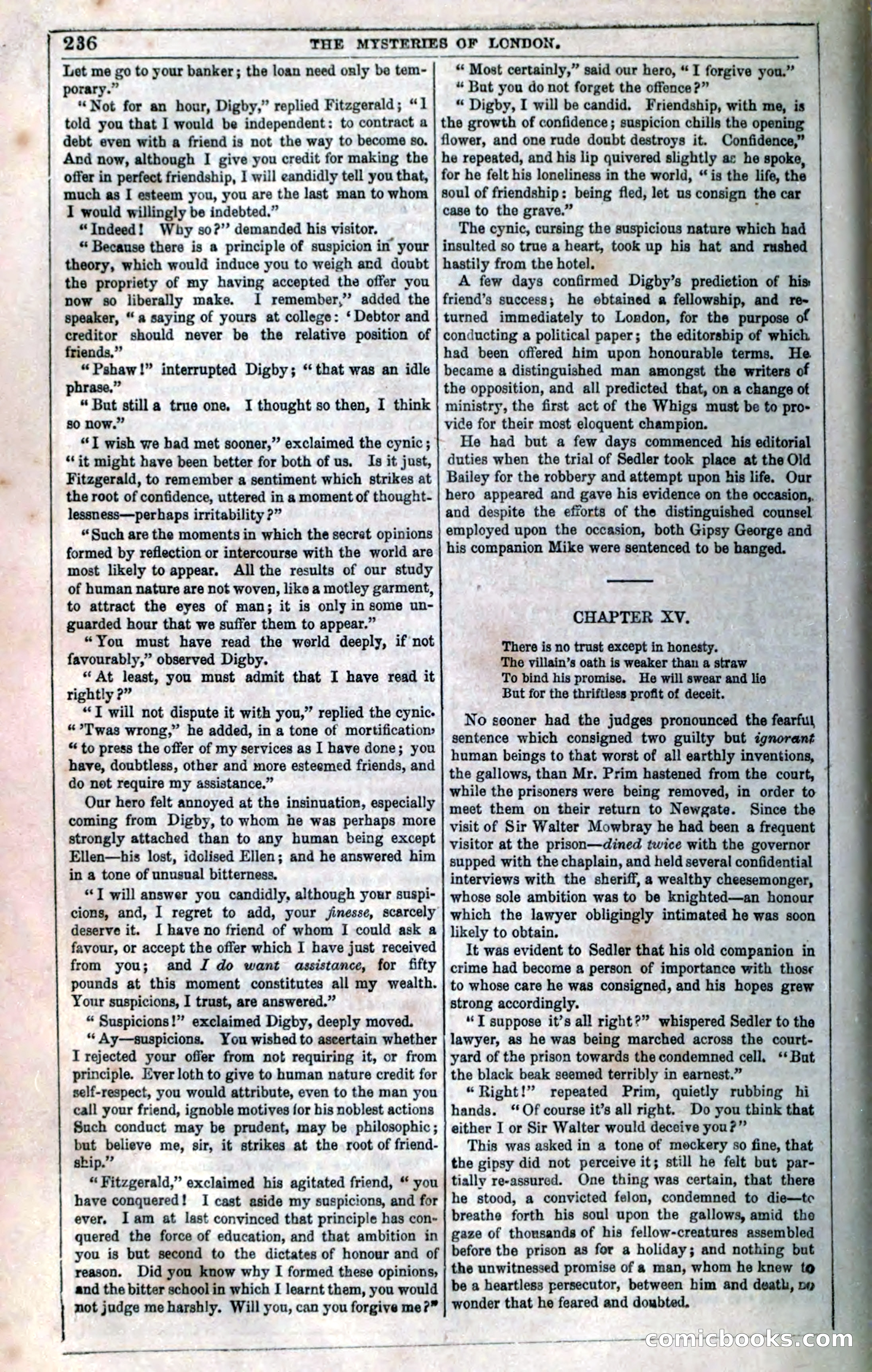
A restored page from Penny Dreadfuls, 1850. Page through the whole issue in the reader above.
📄 Transcribed text from this page (OCR, searchable)
Machine-transcribed from the original scan — historical spelling and the odd misread are preserved.
| 236 rary. “Not for an hour, Digby,” replied Fitzgerald; “1 told you that I would be independent: to contract a debt even with a friend is not the way to become so. And now, although I give you credit for making the offer in perfect friendship, I will eandidly tell you that, much as I esteem you, you are the last man to whom I would willingly be indebted.” “Indeed! Why so?’ demanded his visitor. “ Because there is a principle of suspicion in your theory, which would induce you to weigh ard doubt the propriety of my having accepted the offer you now so liberally make. I remember,” added the speaker, “a saying of yours at college: ‘ Debtor and creditor should never be the relative position of friends,” “Pshaw!” interrupted Digby; “that was an idle phrase,” “ But stilla true one. I thought so then, I think so now.” “‘T wish we bad met sooner,” exclaimed the cynic; ‘it might have been better for both of us, Is it just, Fitzgerald, to remember a sentiment which strikes at the root of confidence, uttered in a moment of thought- lessness—perhaps irritability ?” “Such are the moments in which the secret opinions formed by reflection or intercourse with the world are most likely to appear. All the results of our study of human nature are not woven, like a motley garment, to attract the eyes of man; it is only in some un- guarded hour that we suffer them to appear.” “You must have read the world deeply, if not favourably,” observed Digby. “ At least, you must admit that I have read it rightly ?” “T will not dispute it with you,” replied the cynic. “°Twas wrong,” he added, in a tone of mortification: “ to press the offer of my services as I have done; you have, doubtless, other and more esteemed friends, and do not require my assistance.” Our hero felt annoyed at the insinuation, especially coming from Digby, to whom he was perhaps more strongly attached than to any human being except Ellen—his lost, idolised Ellen; and he answered him in a tone of unusual bitterness. “‘] will answer you candidly, although your suspi- cions, and, I regret to add, your jinesse, scarcely deserve it. I have no friend of whom I could ask a favour, or accept the offer which I have just received from you; and J do want assistance, for fifty pounds at this moment constitutes all my wealth. Your suspicions, I trust, are answered.” “ Suspicions!” exclaimed Digby, deeply moved. “* Ay—suspicions. You wished to ascertain whether I rejected your offer from not requiring it, or from principle. Ever loth to give to human nature credit for self-respect, you would attribute, even to the man you call your friend, ignoble motives for his noblest actions Such conduct may be prudent, may be philosophic; but believe me, sir, it strikes at the root of friend- ship.” “ Fitzgerald,” exclaimed his agitated friend, “ you have conquered! I cast aside my suspicions, and for ever, Iam at last convinced that principle has con-~ quered the force of education, and that ambition in you is but second to the dictates of honour and of reason. Did you know why I formed these opinions, and the bitter school in which I learnt them, you would not judge me harshly. Will you, can you forgive me?” THE MYSTERIES OF LONDON, —— “=X oe Let me go to your banker; the loan need only be tem- “ Most certainly,” said our hero, “I forgive you.” * But you do not forget the offence?” “ Digby, I will be candid, Friendship, with me, is the growth of confidence ; suspicion chills the opening flower, and one rude doubt destroys it. Confidence,” he repeated, and his lip quivered slightly ac he spoke, for he felt his loneliness in the world, “is the life, the soul of friendship: being fled, let us consign the car case to the grave.” : The cynic, cursing the suspicious nature which had insulted so true a heart, took up his hat and rushed hastily from the hotel. A few days confirmed Digby’s prediction of his friend’s success; he ebtained a fellowship, and re~ turned immediately to London, for the purpose of conducting a political paper; the editorship of which had been offered him upon honourable terms, He became a distinguished man amongst the writers of the opposition, and all predicted that, on a change of ministry, the first act of the Whigs must be to pro- vide for their most eloquent champion. He had but a few days commenced his editorial duties when the trial of Sedler took place at the Old Bailey for the robbery and attempt upon his life. Our hero appeared and gave his evidence on the occasion, and despite the efforts of the distinguished counsel employed upon the occasion, both Gipsy George and his companion Mike were sentenced to be banged. CHAPTER XV. There is no trust except in honesty. The villain’s oath is weaker than a straw To bind his promise. He will swear and lie But for the thriftiess profit of deceit. No sooner had the judges pronounced the fearful sentence which consigned two guilty but ignorant human beings to that worst of all earthly inventions, the gallows, than Mr. Prim hastened from the court, while the prisoners were being removed, in order to meet them on their return to Newgate. Since the visit of Sir Walter Mowbray he had been a frequent visitor at the prison—dined twice with the governor supped with the chaplain, and held several confidential interviews with the sheriff, a wealthy cheesemonger, whose sole ambition was to be knighted—an honour which the lawyer obligingly intimated he was soon likely to obtain. It was evident to Sedler that his old companion in crime had become a person of importance with those to whose care he was consigned, and his hopes grew strong accordingly. “T suppose it’s all right?” whispered Sedler to the lawyer, as he was being marched across the court- yard of the prison towards the condemned cell, * But the black beak seemed terribly in earnest.” “Right!” repeated Prim, quietly rubbing hi hands. ‘ Of course it’s all right. Do you think that either I or Sir Walter would deceive you?” This was asked in a tone of mockery so fine, that the gipsy did not perceive it; still he felt but par- tially re-assured. One thing was certain, that there he stood, a convicted felon, condemned to die—te breathe forth his soul upon the gallows, amid the gaze of thousands of his fellow-creatures assembled before the prison as for a holiday; and nothing but the unwitnessed promise of a man, whom he knew to be a heartless persecutor, between him and death, po wonder that he feared and doubted, = OO CLD OO) <SicO