
Penny Dreadfuls, 1849 · page 109 of 394
The Mysteries of the Court of London — page 109: what you’re looking at
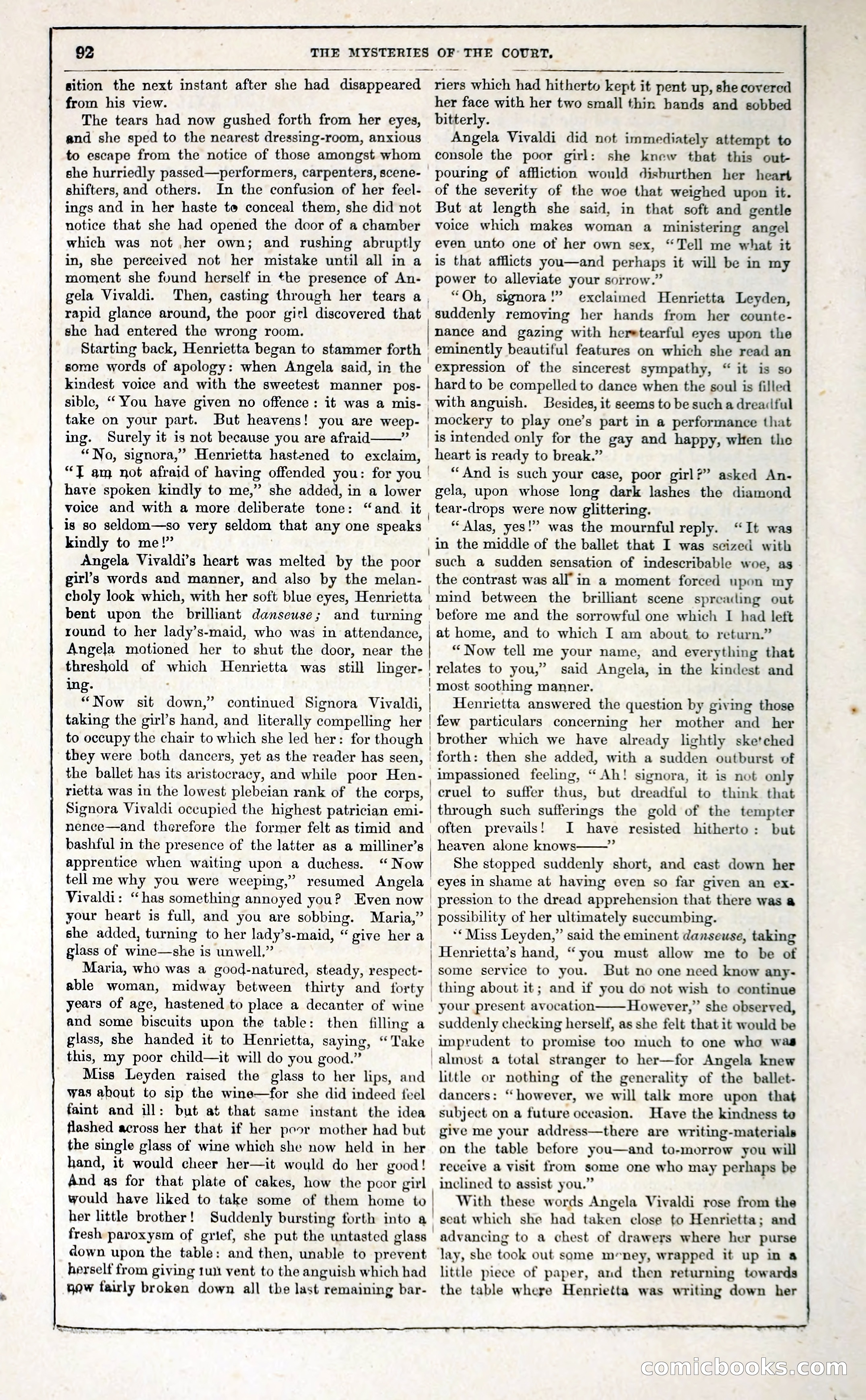
A restored page from Penny Dreadfuls, 1849. Page through the whole issue in the reader above.
📄 Transcribed text from this page (OCR, searchable)
Machine-transcribed from the original scan — historical spelling and the odd misread are preserved.
92 — from his view. The tears had now gushed forth from her eyes, and she sped to the nearest dressing-room, anxious to escape from the notice of those amongst whom she hurriedly passed—performers, carpenters, scene- shifters, and others. In the confusion of her feel- ings and in her haste te conceal them, she did not notice that she had opened the door of a chamber which was not ,her own; and rushing abruptly in, she perceived not her mistake until all in a moment she found herself in the presence of An- gela Vivaldi. rapid glance around, the poor girl discovered that she had entered the wrong room. Starting back, Henrietta began to stammer forth some words of apology: when Angela said, in the sition the next instant after she had disappeared Then, casting through her tears a. THE MYSTERIES OF THE COURT, riers which had hitherto kept it pent up, she covered her face with her two small thin hands and sobbed bitterly. Angela Vivaldi did not immediately attempt to console the poor girl: she knew that this out- pouring of affliction would dishurthen her heart of the severity of the woe that weighed upon it. But at length she said, in that soft and gentle voice which makes woman a ministering angel even unto one ot her own sex, “Tell me what it is that afflicts you—and perhaps it will be in my power to alleviate your sorrow.” “Oh, signora!” exclaimed Henrietta Leyden, suddenly removing her hands from her counte- nance and gazing with heretearful eyes upon the eminently beautiful features on which she read an expression of the sincerest sympathy, “it is so kindest voice and with the sweetest manner pos- | hard to be compelled to dance when the soul is filled sible, “You have given no offence: it was a mis- with anguish. LBesides, it seems to be such a dreadful take on your part. But heavens! you are weep- ing. Surely it is not because you are afraid-——” “No, signora,” Henrietta hastened to exclaim, “TY am not afraid of having offended you: for you | have spoken kindly to me,” she added, in a lower voice and with a more deliberate tone: “and. it is so seldom—so very seldom that any one speaks kindly to me!” : Angela Vivaldi’s heart was melted by the poor girl’s words and manner, and also by the melan- choly look which, with her soft blue eyes, Henrietta | | | mockery to play one’s part in a performance that is intended only for the gay and happy, when the heart is ready to break.” “And is such your case, poor girl?” asked An- gela, upon whose long dark lashes the diamond tear-drops were now glittering. “Alas, yes!” was the mournful reply. “It was in the middle of the ballet that I was seized with such a sudden sensation of indescribable woe, as the contrast was all” in a moment forced upon my mind between the brilliant scene spreading out bent upon the brilliant danseuse; and turning before me and the sorrowful one which I had left round to her lady’s-maid, who was in attendance, Angela motioned her to shut the door, near the | at home, and to which I am about to return.” “ Now tell me your name, and everything that threshold of which Henrietta was still linger-! relates to you,’ said Angela, in the kindest and ing. “Now sit down,” continued Signora Vivaldi, most soothing manner. Henrietta answered the question by giving those taking the girl’s hand, and literally compelling her | few particulars concerning her mother and her to occupy the chair to which she led her: for though | brother which we have already lightly sketched they were both dancers, yet as the reader has seen, the ballet has its aristocracy, and while poor Hen- rietta was in the lowest plebeian rank of the corps, Signora Vivaldi oceupied the highest patrician emi- nence—and therefore the former felt as timid and bashful in the presence of the latter as a milliner’s apprentice when waiting upon a duchess. “Now j | forth: then she added, with a sudden outburst of impassioned feeling, “Ah! signora, it is not only cruel to suffer thus, but dreadful to think that through such sufferings the gold of the tempter often prevails! I have resisted hitherto: but heaven alone knows 7 She stopped suddenly short, and cast down her tell me why you were weeping,” resumed Angela eyes in shame at having even so far given an ex- Vivaldi: “has something annoyed you? Even now pression to the dread apprehension that there was @ your heart is full, and you are sobbing. Maria,” | possibility of her ultimately succumbing. she added, turning to her lady’s-maid, “ give her a glass of wine—she is unwell,” Maria, who was a good-natured, steady, respect- able woman, midway between thirty and forty years of age, hastened to place a decanter of wine > and some biscuits upon the table: then filling a glass, she handed it to Henrietta, saying, “Take this, my poor child—it will do you good.” Miss Leyden raised the glass to her lips, and was ahout to sip the wine—for she did indeed feel faint and ill: but at that same instant the idea flashed across her that if her poor mother had but the single glass of wine which she now held in her hand, it would cheer her—it would do her good! And as for that plate of cakes, how the poor girl would have liked to take some of them home to her little brother! Suddenly bursting forth into a fresh paroxysm of grief, she put the untasted glass — down upon the table: and then, unable to prevent herself from giving 1u1 vent to the anguish which had gow fairly broken down all the last remaining bar- ‘* Miss Leyden,” said the eminent danseuse, taking Henrietta’s hand, “you must allow me to be of some service to you. But no one need know any- thing about it; and if you do not wish to continue your present avocation However,” she observed, suddenly checking herself, as she felt that it would be imprudent to promise too much to one who was almost a total stranger to her—for Angela knew little or nothing of the generality of the ballet- dancers: “however, we will talk more upon that subject on a future occasion. Have the kindness te give me your address—there are writing-materials on the table before you—and to-morrow you will receive a visit from some one who may perhaps be inclined to assist you.” With these words Angela Vivaldi rose from the seat which she had taken close to Henrietta; and advancing to a chest of drawers where her purse lay, she took out some mney, wrapped it up in a little piece of paper, and then returning towards the table where Henrietta was writing down her COMIC OO© <S) (€©)