
Penny Dreadfuls, 1849 · page 110 of 394
The Mysteries of the Court of London — page 110: what you’re looking at
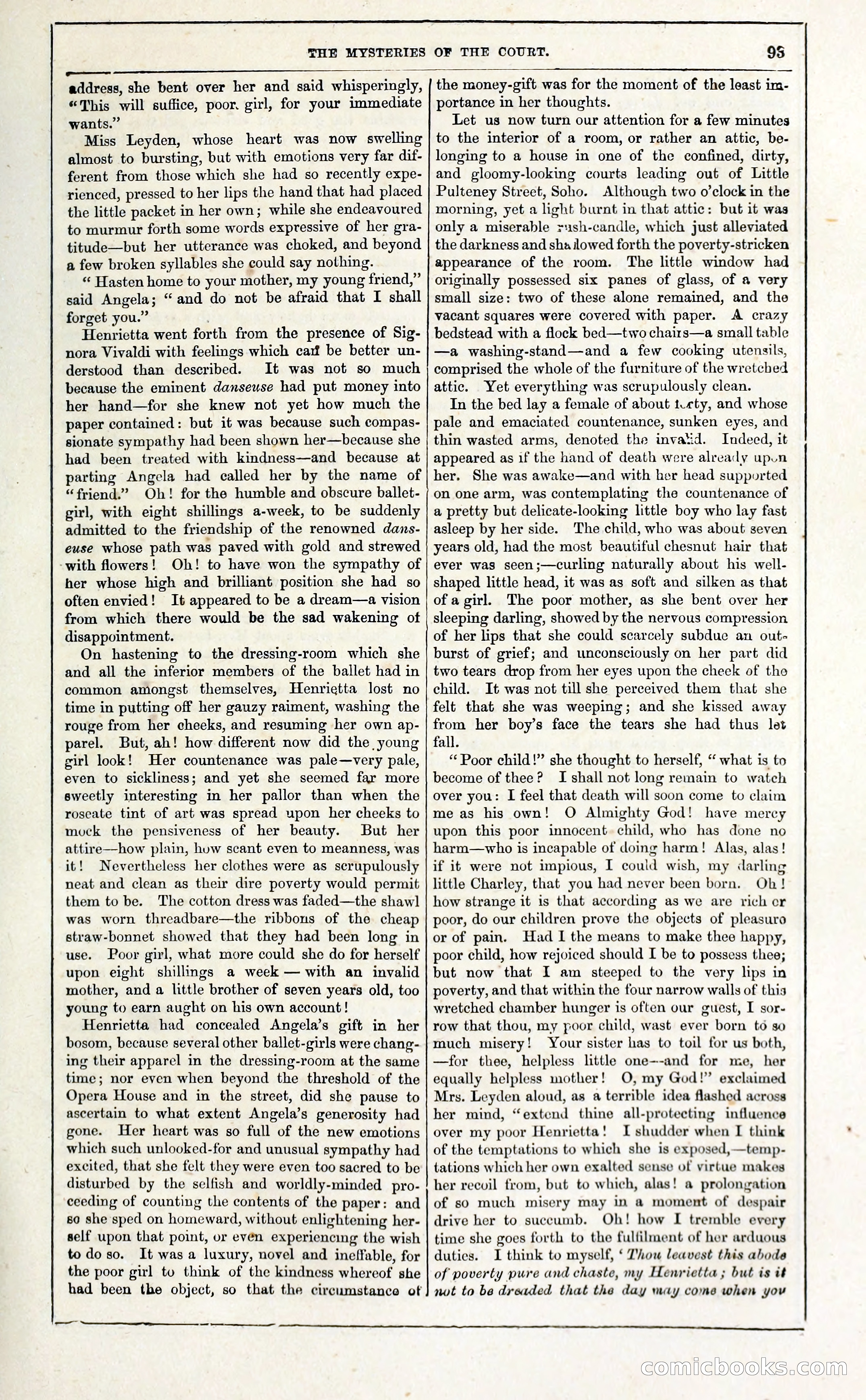
A restored page from Penny Dreadfuls, 1849. Page through the whole issue in the reader above.
📄 Transcribed text from this page (OCR, searchable)
Machine-transcribed from the original scan — historical spelling and the odd misread are preserved.
rrr eT THE MYSTERIES OF THE COURT. address, she bent over her and said whisperingly, “This will suffice, poor. girl, for your immediate wants.” Miss Leyden, whose heart was now swelling almost to bursting, but with emotions very far dif- ferent from those which she had so recently expe- rienced, pressed to her lips the hand that had placed the little packet in her own; while she endeavoured to murmur forth some words expressive of her gra- titude—but her utterance was choked, and beyond a few broken syllables she could say nothing. «‘ Hasten home to your mother, my young friend,” said Angela; “and do not be afraid that I shall forget you.” | Henrietta went forth from the presence of Sig- nora Vivaldi with feelings which carf be better un- derstood than described. It was not so much because the eminent danseuse had put money into her hand—for she knew not yet how much the paper contained: but it was because such compas- sionate sympathy had been shown her—because she had been treated with kindness—and because at parting Angela had ealled her by the name of “friend.” Oh! for the humble and obscure ballet- girl, with eight shillings a-week, to be suddenly admitted to the friendship of the renowned dans- euse whose path was paved with gold and strewed -with flowers! Oh! to have won the sympathy of her whose high and brilliant position she had so often envied! It appeared to be a dream—a vision from which there would be the sad wakening of disappointment. | On hastening to the dressing-room which she and all the inferior members of the ballet had in common amongst themselves, Henrietta lost no time in putting off her gauzy raiment, washing the rouge from her cheeks, and resuming her own ap- parel. But, ah! how different now did the young girl look! Her countenance was pale—very pale, even to sickliness; and yet she seemed far more sweetly interesting in her pallor than when the roseate tint of art was spread upon her cheeks to mock the pensiveness of her beauty. But her attire—how plain, huw scant even to meanness, was it! Nevertheless her clothes were as scrupulously neat and clean as their dire poverty would permit them to be. The cotton dress was faded—the shawl was worn threadbare—the ribbons of the cheap straw-bonnet showed that they had been long in use. Poor girl, what more could she do for herself upon eight shillings a week — with an invalid mother, and a little brother of seven years old, too young to earn aught on his own account! Henrietta had concealed Angela’s gift in her bosom, because several other ballet-girls were chang- ing their apparel in the dressing-room at the same time; nor eyen when beyond the threshold of the Opera House and in the street, did she pause to ascertain to what extent Angela’s generosity had gone. Her heart was so full of the new emotions which such unlooked-for and unusual sympathy had excited, that she felt they were even too sacred to be disturbed by the selfish and worldly-minded pro- ceeding of counting the contents of the paper: and so she sped on homeward, without enlightening her- self upon that point, or even experiencing the wish to do so. It was a luxury, novel and ineffable, for the poor girl tu think of the kindness whereof she had been the object, so that the circumstance of 95 the money-gift was for the moment of the least im- portance in her thoughts. Let us now turn our attention for a few minutes to the interior of a room, or rather an attic, be- longing to a house in one of the confined, dirty, and gloomy-looking courts leading out of Little Pulteney Street, Soho. Although two o'clock in the morning, yet a light burnt in that attic: but it was only a miserable sush-candle, which just alleviated the darkness and sha lowed forth the poverty-stricken appearance of the room. The little window had originally possessed six panes of glass, of a very small size: two of these alone remained, and the vacant squares were covered with paper. A crazy bedstead with a flock bed—two chairs—a small table —a washing-stand—and a few cooking utensils, comprised the whole of the furniture of the wretcbed attic. Yet everything was scrupulously clean. In the bed lay a female of about turty, and whose pale and emaciated countenance, sunken eyes, and thin wasted arms, denoted the invatid. Indeed, it appeared as if the hand of death were already upun her. She was awake—and with her head supported on one arm, was contemplating the countenance of a pretty but delicate-looking little boy who lay fast asleep by her side. The child, who was about seven years old, had the most beautiful chesnut hair that ever was seen;—curling naturally about his well- shaped little head, it was as soft and silken as that of a girl. The poor mother, as she bent over her sleeping darling, showed by the nervous compression of her lips that she could scarcely subdue an out- burst of grief; and unconsciously on her part did two tears drop from her eyes upon the cheek of tho child. It was not till she perceived them that she felt that she was weeping; and she kissed away from her boy’s face the tears she had thus let fall. “Poor child!” she thought to herself, “ what is to become of thee? I shall not long remain to watch over you: I feel that death will soon come to claim me as his own! O Almighty God! have mercy upon this poor innocent child, who has done no harm—who is incapable ot doing harm! Alas, alas! if it were not impious, I could wish, my darling little Charley, that you had never been born. Ob! how strange it is that according as we are rich cr poor, do our children prove the objects of pleasuro or of pain. Had I the means to make thee happy, poor child, how rejoiced should I be to possess thee; but now that I am steeped to the very lips in poverty, and that within the four narrow walls of this wretched chamber hunger is often our guest, I sor- row that thou, my poor child, wast ever born to so much misery! Your sister has to toil for us both, —for thee, helpless little one--and for me, her equally helpless mother! O, my God!” exclaimed Mrs. Leyden aloud, as a terrible idea flashed across her mind, “extend thine all-protecting influence over my poor Henrietta! I shudder when I think of the temptations to which she is exposed,—temp- tations which her own exalted sense of virtue makes her recoil from, but to which, alas! a prolongation of so much misery may in a moment of despair drive her to succumb. Oh! how I tremble every time she goes forth to the fulfilment of her arduous dutics. I think to myself, ‘ Thou leavest this abode of poverty pure and chaste, my Henrietta ; but is it not to be dreaded that the day may come when you JOO (SO) SS (CO)