
Penny Dreadfuls, 1849 · page 108 of 394
The Mysteries of the Court of London — page 108: what you’re looking at
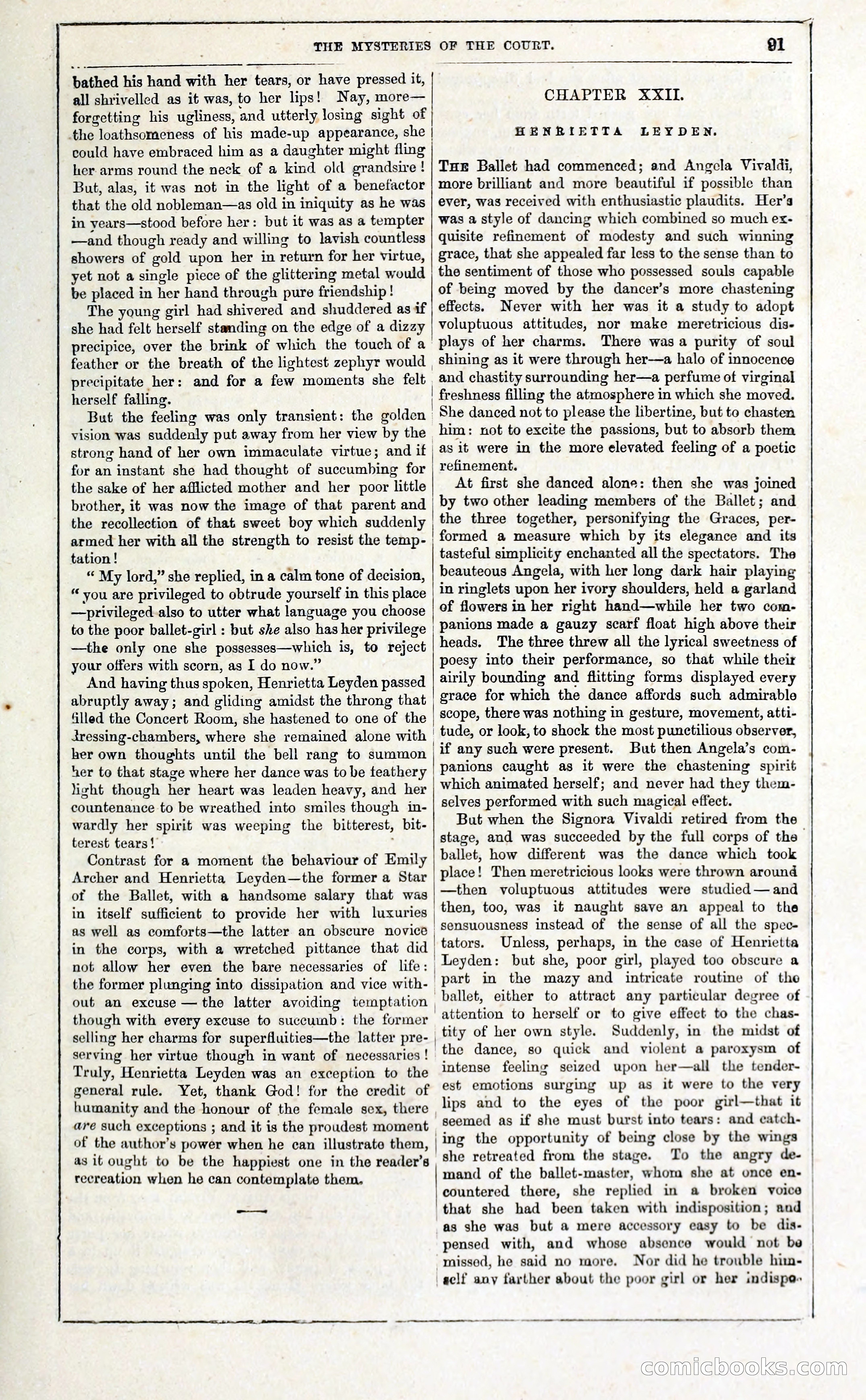
A restored page from Penny Dreadfuls, 1849. Page through the whole issue in the reader above.
📄 Transcribed text from this page (OCR, searchable)
Machine-transcribed from the original scan — historical spelling and the odd misread are preserved.
a THE MYSTERIES bathed his hand with her tears, or have pressed it, all shrivelled as it was, to her lips! Nay, more— forgetting his ugliness, and utterly losing sight of the loathsomeness of his made-up appearance, she | could have embraced him as a daughter might fling her arms round the neck of a kind old grandsire! But, alas, it was not in the light of a benefactor that the old nobleman—as old in iniquity as he was in years—stood before her: but it was as a tempter —and though ready and willing to lavish countless showers of gold upon her in return for her virtue, yet not a single piece of the glittering metal would be placed in her hand through pure friendship! The young girl had shivered and shuddered as if she had felt herself standing on the edge of a dizzy precipice, over the brink of which the touch of a feather or the breath of the lightest zephyr would | precipitate her: and for a few moments she felt herself falling. But the feeling was only transient: the golden vision was suddenly put away from her view by the | strong hand of her own immaculate virtue; and if | for an instant she had thought of succumbing for the sake of her afflicted mother and her poor little brother, it was now the image of that parent and the recollection of that sweet boy which suddenly | armed her with all the strength to resist the temp- | tation! “ My lord,” she replied, in a calm tone of decision, you are privileged to obtrude yourself in this place —privileged.also to utter what language you choose to the poor ballet-girl : but she also has her privilege —the only one she possesses—which is, to reject your offers with scorn, as I do now.” And having thus spoken, Henrietta Leyden passed abruptly away; and gliding amidst the throng that filled the Concert Room, she hastened to one of the dressing-chambers, where she remained alone with her own thoughts until the bell rang to summon her to that stave where her dance was to be teathery licht though her heart was leaden heavy, and her countenance to be wreathed into smiles though in- wardly her spirit was weeping the bitterest, bit- terest tears! Contrast for a moment the behaviour of Emily Archer and Henrietta Leyden—the former a Star of the Ballet, with a handsome salary that was in itself sufficient to provide her with luxuries as well as comforts—the latter an obscure novice in the corps, with a wretched pittance that did not allow her even the bare necessaries of life: the former plunging into dissipation and vice with- out an excuse — the latter avoiding temptation | though with every excuse to succumb: the former selling her charms for superfluities—the latter pre- serving her virtue though in want of necessaries ! Truly, Henrietta Leyden was an exception to the general rule. Yet, thank God! for the credit of humanity and the honour of the female sex, there are such exceptions ; and it is the proudest moment | of the author’s power when he can illustrate them, | as it ought to be the happiest one in the reader’s recreation when he can contemplate them. i ee ——— missed, he said no more, ee ee OF THE COURT. a 81 CHAPTER XXII. HENRIETTA LEYDEN. THE Ballet had commenced; and Angela Vivaldi, more brilliant and more beautiful if possible than ever, was received with enthusiastic plaudits. Her’s was a style of dancing which combined so much ex- quisite refinement of modesty and such winning grace, that she appealed far less to the sense than to the sentiment of those who possessed souls capable of being moved by the dancer’s more chastening effects. Never with her was it a study to adopt voluptuous attitudes, nor make meretricious dis- plays of her charms. There was a purity of soul shining as it were through her—a halo of innocence and chastity surrounding her—a perfume of virginal | freshness filling the atmosphere in which she moved. She danced not to please the libertine, but to chasten him: not to excite the passions, but to absorb them as it were in the more elevated feeling of a poetic refinement. At first she danced alone: then she was joined by two other leading members of the Ballet; and the three together, personifying the Graces, per- formed a measure which by its elegance and its tasteful simplicity enchanted all the spectators. The beauteous Angela, with her long dark hair playing | in ringlets upon her ivory shoulders, held a garland of flowers in her right hand—while her two com- panions made a gauzy scarf float high above their heads. The three threw all the lyrical sweetness of poesy into their performance, so that while their airily bounding and flitting forms displayed every grace for which the dance affords such admirable scope, there was nothing in gesture, movement, atti- tude, or look, to shock the most punctilious observer, if any such were present. But then Angela’s com- panions caught as it were the chastening spirit which animated herself; and never had they them- selves performed with such magical effect. But when the Signora Vivaldi retired from the stage, and was succeeded by the full corps of the ballet, how different was the dance which took place! Then meretricious looks were thrown around —then voluptuous attitudes were studied —and then, too, was it naught save an appeal to the | sensuousness instead of the sense of all the spec- tators. Unless, perhaps, in the case of Henrietta Leyden: but she, poor girl, played too obscure a part in the mazy and intricate routine of the ballet, either to attract any particular degree of -attention to herself or to give effect to the chas- tity of her own style. Suddenly, in the midst of the dance, so quick and violent a paroxysm of intense feeling seized upon her—all the tender- est emotions surging up as it were to the very lips and to the eyes of the poor girl—that it seemed as if she must burst into tears: and catch- ing the opportunity of being close by the wings she retreated from the stage. To the angry de- mand of the ballet-master, whom she at once en- countered there, she replied in a broken voice that she had been taken with indisposition; and as she was but a mere accessory easy to be dis- pensed with, and whose absence would not be Nor did he trouble him- sclf any farther about the poor girl or her indispe- me meee ee ———— a ea eee | CORNICLOO (Cc S (CO)