
Penny Dreadfuls, 1849 · page 107 of 394
The Mysteries of the Court of London — page 107: what you’re looking at
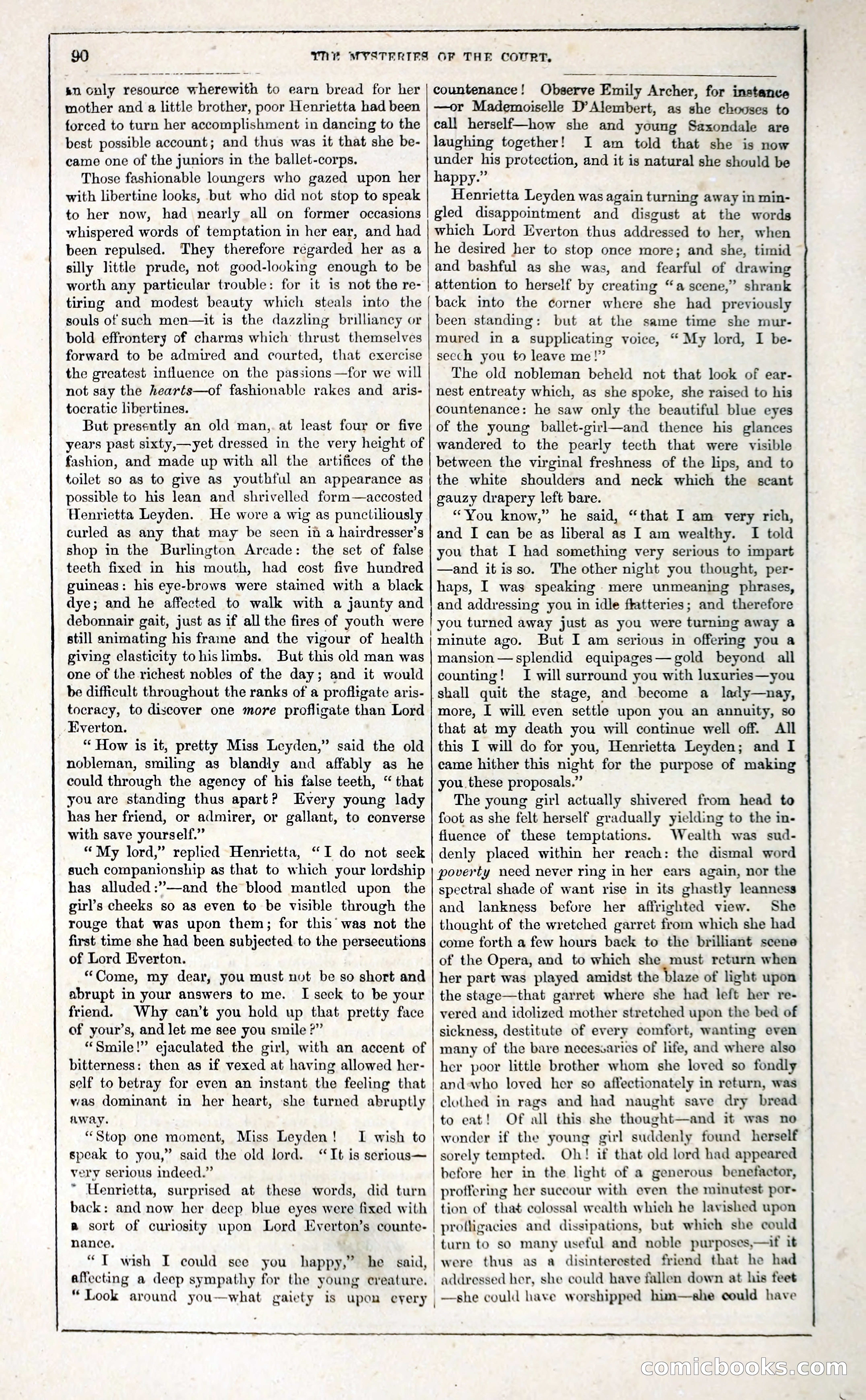
A restored page from Penny Dreadfuls, 1849. Page through the whole issue in the reader above.
📄 Transcribed text from this page (OCR, searchable)
Machine-transcribed from the original scan — historical spelling and the odd misread are preserved.
90 ee re CO sn only resource wherewith to earn bread for her mother and a little brother, poor Henrietta had been forced to turn her accomplishment in dancing to the best possible account; and thus was it that she be- came one of the juniors in the ballet-corps. Those fashionable loungers who gazed upon her with libertine looks, but who did not stop to speak to her now, had nearly all on former occasions whispered words of temptation in her ear, and had been repulsed. They therefore regarded her as a silly little prude, not good-looking enough to be worth any particular trouble: for it is not the re- tiring and modest beauty which steals into the souls of such men—it is the dazzling brilliancy or bold effrontery of charms which thrust themselves forward to be admired and courted, that exercise the greatest influence on the passions —for we will not say the hearts—of fashionable rakes and aris- tocratic libertines. But presently an old man, at least four or five years past sixty,—yet dressed in the very height of fashion, and made up with all the artifices of the toilet so as to give as youthful an appearance as possible to his lean and shrivelled form—accosted Uenrietta Leyden. He wore a wig as punctiliously curled as any that may be seen 10 a hairdresser’s shop in the Burlington Arcade: the set of false teeth fixed in his mouth, had cost five hundred guineas: his eye-brows were stained with a black dye; and he affected to walk with a jaunty and debonnair gait, just as if all the fires of youth were still animating his frame and the vigour of health giving elasticity tohis limbs. But this old man was one of the richest nobles of the day; and it would be difficult throughout the ranks of a profligate aris- tocracy, to discover one more profligate than Lord Everton. | “ How is it, pretty Miss Leyden,” said the old nobleman, smiling as blandly and affably as he could through the agency of his false teeth, “ that you are standing thus apart? Livery young lady has her friend, or admirer, or gallant, to converse with save yourself.” “My lord,” replied Henrietta, “I do not seek such companionship as that to which your lordship has alluded :”—and the blood mantled upon the girl’s cheeks so as even to be visible through the rouge that was upon them; for this was not the first time she had been subjected to the persecutions of Lord Everton. “Come, my dear, you must not be so short and abrupt in your answers to me. I seck to be your friend. Why can’t you hold up that pretty face of your’s, and let me see you smile ?” “Smile!” ejaculated the girl, with an accent of bitterness: then as if vexed at having allowed her- self to betray for even an instant the fecling that vas dominant in her heart, she turned abruptly Away. “Stop one moment, Miss Leyden ! speak to you,” said the old lord. very serious indeed.” “ Henrietta, surprised at these words, did turn back: and now her deep blue eyes were fixed with I wish to “Tt is scrious— INV MYSTERIES OF THE COURT, countenance! Observe Emily Archer, for instance —or Mademoiselle D’Alembert, as she chooses to call herself—how she and young Saxondale are laughing together! I am told that she is now under his protection, and it is natural she should be happy.” Henrietta Leyden was again turning away in min- gled disappointment and disgust at the words which Lord Everton thus addressed to her, when he desired her to stop once more; and she, timid and bashful as she was, and fearful of drawing attention to herself by creating “a scene,” shrank [back into the corner where she had previously been standing: but at the same time she mur- mured in a supplicating voice, “ My lord, I be- secch you to leave me!” The old nobleman beheld not that look of ear- nest entreaty which, as she spoke, she raised to his countenance: he saw only the beautiful blue eyes of the young ballet-girl—and thence his glances wandered to the pearly tecth that were visible between the virginal freshness of the lips, and to the white shoulders and neck which the scant gauzy drapery left bare. “You know,” he said, “that I am very rich, and I can be as liberal as I am wealthy. I told you that I had something very serious to impart —and itisso. The other night you thought, per- haps, I was speaking mere unmeaning phrases, and addressing you in idle fratteries; and therefore you turned away just as you were turning away a minute ago. But I am serious in offering you a mansion — splendid equipages—gold beyond all counting! I will surround you with luxuries—you shall quit the stage, and become a lady—nay, more, I will even settle upon you an annuity, so that at my death you will continue well off. All this I will do for you, Henrietta Leyden; and I eame hither this night for the purpose of making you.these proposals.” The young girl actually shivered from head to foot as she felt herself gradually yielding to the in- fiuence of these temptations. Wealth was sud- denly placed within her reach: the dismal word poverty need never ring in her ears again, nor the spectral shade of want rise in its ghastly leanness and lankness before her affrighted view. She thought of the wretched garret from which she had come forth a few hours back to the brilliant scene of the Opera, and to which she_must return when her part was played amidst the blaze of light upon the stage—that garret where she had left her re- vered and idolized mother stretched upon the bed of sickness, destitute of every comfort, wanting even many of the bare necessaries of life, and where also her poor little brother whom she loved so fondly andavho loved her so affectionately in return, was clothed in rags and had naught save dry bread to eat! Of all this she thought—and it was no wonder if the young girl suddenly found herself sorely tempted. Oh! if that old lord had appeared before her in the light of a generous benefactor, proffering her succour with even the minutest por- tion of that colossal wealth which he lavished upon a sort of curiosity upon Lord Everton’s counte- | profligacies and dissipations, but which she could | turn to so many useful and noble purposes,—if it nance. “T wish I cowd sce you happy,” he said,| were thus as a disinterested friend that he had affecting a deop sympathy for the young creature. addressed her, she could have fallen down at his feet * Look around you—what gaiety 1s upon eyery _—she could have worshipped him—she could have et (EO) MICLOOOMKKS (E©)