
Penny Dreadfuls, 1849 · page 103 of 394
The Mysteries of the Court of London — page 103: what you’re looking at
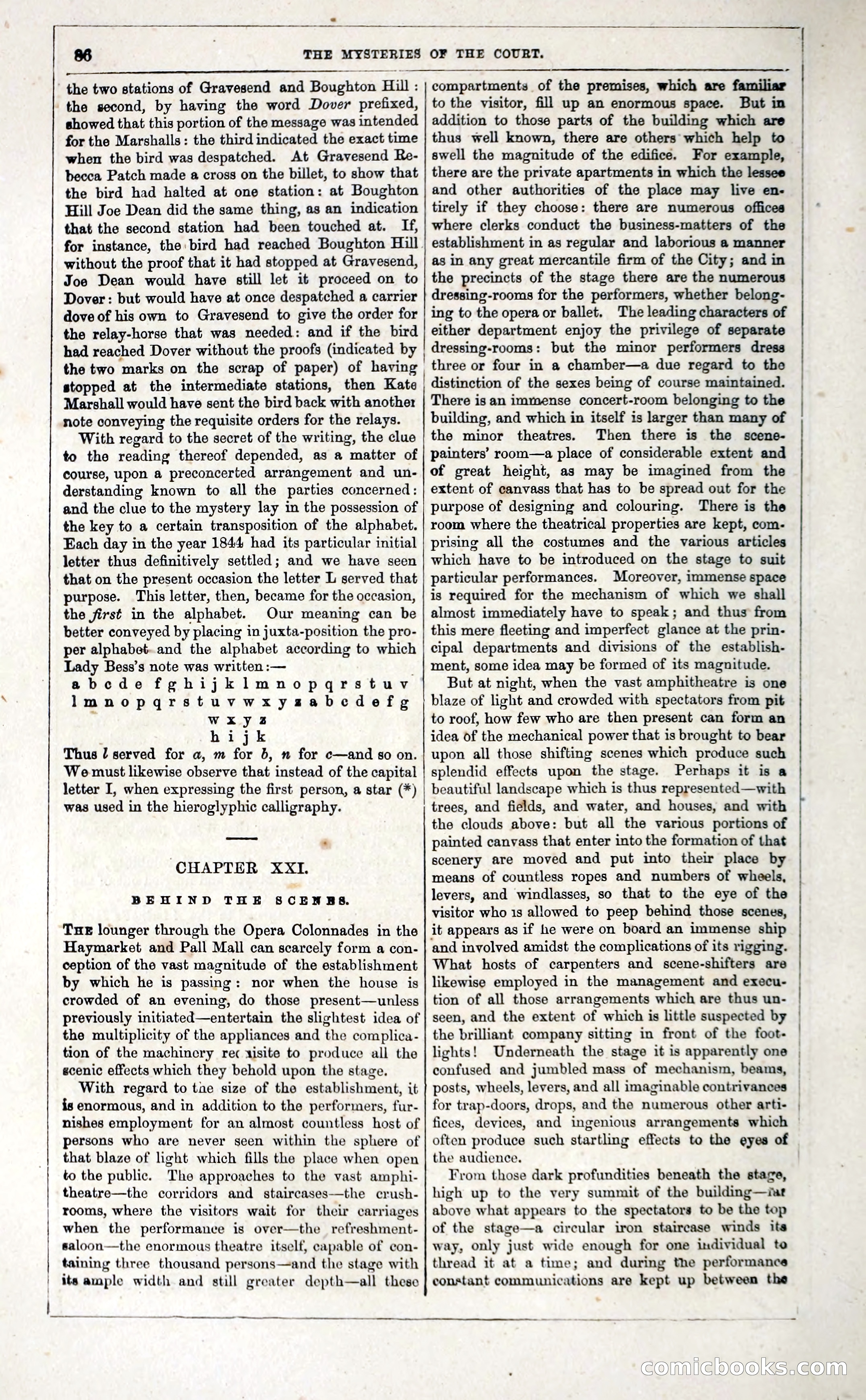
A restored page from Penny Dreadfuls, 1849. Page through the whole issue in the reader above.
📄 Transcribed text from this page (OCR, searchable)
Machine-transcribed from the original scan — historical spelling and the odd misread are preserved.
—_ -_ —@s ——- -- - --- amie 86 THE MYSTERIES showed that this portion of the message was intended for the Marshalls: the third indicated the exact time when the bird was despatched. At Gravesend Re- becca Patch made a cross on the billet, to show that the bird had halted at one station: at Boughton Hill Joe Dean did the same thing, as an indication that the second station had been touched at. If, for instance, the bird had reached Boughton Hill. without the proof that it had stopped at Gravesend, Joe Dean would have still let it proceed on to Dover: but would have at once despatched a carrier dove of his own to Gravesend to give the order for the relay-horse that was needed: and if the bird had reached Dover without the proofs (indicated by the two marks on the scrap of paper) of having stopped at the intermediate stations, then Kate Marshall would have sent the bird back with another note conveying the requisite orders for the relays. With regard to the secret of the writing, the clue to the reading thereof depended, as a matter of course, upon a preconcerted arrangement and un- derstanding known to all the parties concerned: and the clue to the mystery lay in the possession of the key to a certain transposition of the alphabet. Each day in the year 1844 had its particular initial letter thus definitively settled; and we have seen that on the present occasion the letter L served that purpose. This letter, then, became for the occasion, the first in the alphabet. Our meaning can be better conveyed by placing in juxta-position the pro- per alphabet. and the alphabet according to which Lady Bess’s note was written :— abcde fghijklmnopqrstuvyv Imnopqrstuvwxyszabcecdefg ‘ wxys hijk Thus / served for a, m for 6, n for c—and so on. We must likewise observe that instead of the capital letter I, when expressing the first person, a star (*) was used in the hieroglyphic calligraphy. CHAPTER XXI. BEHIND THE SCEN SBS. THE lounger through the Opera Colonnades in the Haymarket and Pall Mall can scarcely form a con- ception of the vast magnitude of the establishment by which he is passing: nor when the house is crowded of an evening, do those present—unless previously initiated—entertain the slightest idea of the multiplicity of the appliances and the complica- tion of the machinery rec xisite to produce all the scenic effects which they behold upon the stage. With regard to tae size of the establishment, it is enormous, and in addition to the performers, fur- nishes employment for an almost countless host of persons who are never seen within the sphere of that blaze of light which fills the place when open to the public. The approaches to the vast amphi- theatre—the corridors and staircases—the crush- rooms, where the visitors wait for their carriages when the performance is over—the refreshment- saloon—the enormous theatre itself, capable of con- taining three thousand persons—and the stage with its ample width and still greater depth—all these . —_ ee $e the two stations of Gravesend and Boughton Hill : | compartments of the premises, which are familiar the second, by having the word Dover prefixed, uae ee OF THE COURT. - to the visitor, fill up an enormous space. But in addition to those parts of the building which are thus well known, there are others which help to swell the magnitude of the edifice. For example, there are the private apartments in which the lessee and other authorities of the place may live en- tirely if they choose: there are numerous offices where clerks conduct the business-matters of the establishment in as regular and laborious a manner as in any great mercantile firm of the City; and in the precincts of the stage there are the numerous dressing-rooms for the performers, whether belong- ing to the opera or ballet. The leading characters of either department enjoy the privilege of separate dressing-rooms: but the minor performers dress three or four in a chamber—a due regard to the | distinction of the sexes being of course maintained. There is an immense concert-room belonging to the building, and which in itself is larger than many of the minor theatres. Then there is the scene- painters’ room—a place of considerable extent and of great height, as may be imagined from the extent of canvass that has to be spread out for the purpose of designing and colouring. There is the room where the theatrical properties are kept, com- prising all the costumes and the various articles which have to be introduced on the stage to suit particular performances. Moreover, immense space is required for the mechanism of which we shall almost immediately have to speak; and thus from this mere fleeting and imperfect glance at the prin- cipal departments and divisions of the establish- ment, some idea may be formed of its magnitude. But at night, when the vast amphitheatre is one blaze of light and crowded with spectators from pit to roof, how few who are then present can form an idea of the mechanical power that is brought to bear upon all those shifting scenes which produce such splendid effects upon the stage. Perhaps it is a beautiful landscape which is thus represented—with trees, and fields, and water, and houses, and with the clouds above: but all the various portions of painted canvass that enter into the formation of that scenery are moved and put into their place by means of countless ropes and numbers of wheels, levers, and windlasses, so that to the eye of the visitor who 1s allowed to peep behind those scenes, it appears as if he were on board an immense ship and involved amidst the complications of its rigging. What hosts of carpenters and scene-shifters are likewise employed in the management and execu- tion of all those arrangements which are thus un- seen, and the extent of which is little suspected by the brilliant company sitting in front of the foot- lights! Underneath the stage it is apparently one confused and jumbled mass of mechanism, beams, posts, wheels, levers, and all imaginable contrivances for trap-doors, drops, and the numerous other arti- fices, devices, and ingenious arrangements which often produce such startling effects to the eyes of the audience. From those dark profundities beneath the stage, high up to the very summit of the building—iar above what appears to the spectators to be the top of the stage—a circular iron staircase winds its way, only just wide enough for one individual to thread it at a time; and during the performance constant communications are kept up between the ee ee ee ee ee > . GoOmicdoo S (E()