
Penny Dreadfuls, 1849 · page 102 of 394
The Mysteries of the Court of London — page 102: what you’re looking at
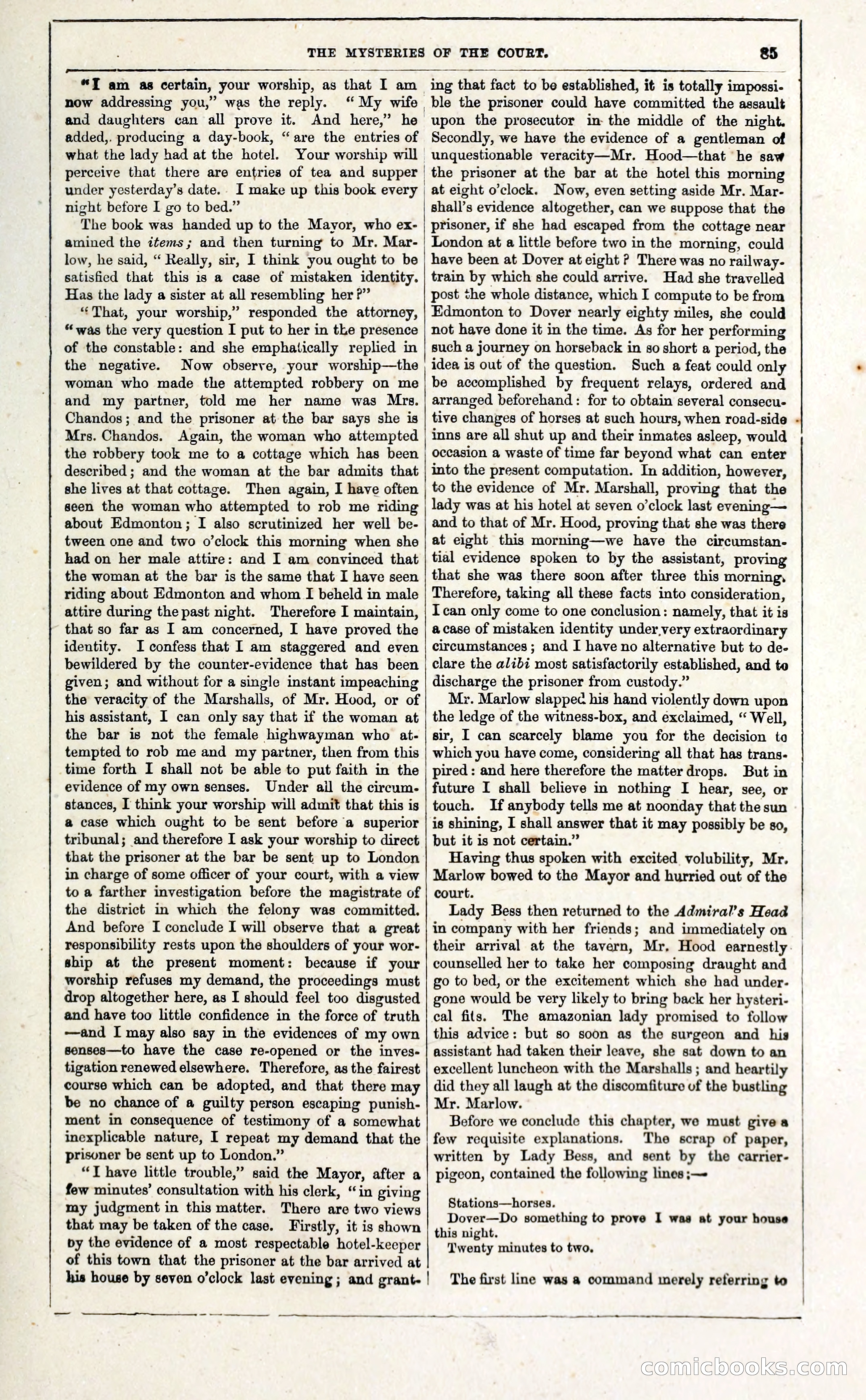
A restored page from Penny Dreadfuls, 1849. Page through the whole issue in the reader above.
📄 Transcribed text from this page (OCR, searchable)
Machine-transcribed from the original scan — historical spelling and the odd misread are preserved.
eS THE MYSTERIES OF THE COURT. eoo— &5 “YT am as certain, your worship, as that I am_ ing that fact to be established, it is totally impossi- now addressing you,” was the reply. “My wife ble the prisoner could have committed the assault and daughters can all prove it. And here,’ he upon the prosecutor in the middle of the night. added,. producing a day-book, “are the entries of Secondly, we have the evidence of a gentleman of what the lady had at the hotel. perceive that there are entries of tea and supper under yesterday’s date. I make up this book every night before I go to bed.” The book was handed up to the Mayor, who ex- amined the items; and then turning to Mr. Mar- low, he said, “ Really, sir, I think you ought to be satisfied that this 1s a case of mistaken identity. Has the lady a sister at all resembling her ?” “‘That, your worship,” responded the attorney, “was the very question I put to her in tke presence of the constable: and she emphatically replied in the negative. Now observe, your worship—the woman who made the attempted robbery on me and my partner, told me her name was Mrs. Chandos; and the prisoner at the bar says she is Mrs. Chandos. Again, the woman who attempted the robbery took me to a cottage which has been described; and the woman at the bar admits that she lives at that cottage. Then again, I have often seen the woman who attempted to rob me riding about Edmonton; I also scrutinized her well be- tween one and two o’clock this morning when she had on her male attire: and I am convinced that the woman at the bar is the same that I have seen riding about Edmonton and whom I beheld in male attire during the past night. Therefore I maintain, that so far as I am concerned, I have proved the identity. JI confess that I am staggered and even bewildered by the counter-evidence that has been given; and without for a single instant impeaching the veracity of the Marshalls, of Mr. Hood, or of his assistant, 1 can only say that if the woman at the bar is not the female highwayman who at- tempted to rob me and my partner, then from this time forth I shall not be able to put faith in the evidence of my own senses. Under ail the circum- stances, I think your worship will admit that this is a case which ought to be sent before a superior tribunal; and therefore I ask your worship to direct that the prisoner at the bar be sent up to London in charge of some officer of your court, with a view to a farther investigation before the magistrate of the district in which the felony was committed. And before I conclude I will observe that a great responsibility rests upon the shoulders of your wor- ship at the present moment: because if your worship refuses my demand, the proceedings must drop altogether here, as I should feel too disgusted and have too little confidence in the force of truth -——and I may also say in the evidences of my own senses—to have the case re-opened or the inves- tigation renewed elsewhere. Therefore, as the fairest course which can be adopted, and that there may be no chance of a guilty person escaping punish- ment in consequence of testimony of a somewhat inexplicable nature, I repeat my demand that the prisoner be sent up to London.” “T have little trouble,” said the Mayor, after a few minutes’ consultation with his clerk, “in giving my judgment in this matter. There are two views that may be taken of the case. Firstly, it is shown by the evidence of a most respectable hotel-keeper of this town that the prisoner at the bar arrived at his house by seven o’clock last evening; and grant. | _:eer oro — ———— —_ ———__— — | | Your worship will unquestionable veracity—Mr. Hood—that ‘he saw the prisoner at the bar at the hotel this morning at eight o’clock. Now, even setting aside Mr. Mar- shall’s evidence altogether, can we suppose that the prisoner, if she had escaped from the cottage near London at a little before two in the morning, could have been at Dover at eight ? There was no railway- train by which she could arrive. Had she travelled post the whole distance, which I compute to be from Edmonton to Dover nearly eighty miles, she could not have done it in the time. As for her performing such a journey on horseback in so short a period, the idea is out of the question. Such a feat could only be accomplished by frequent relays, ordered and arranged beforehand: for to obtain several consecu- tive changes of horses at such hours, when road-side inns are all shut up and their inmates asleep, would occasion a waste of time far beyond what can enter into the present computation. In addition, however, to the evidence of Mr. Marshall, proving that the lady was at his hotel at seven o’clock last evening— and to that of Mr. Hood, proving that she was there at eight this morning—we have the circumstan- tial evidence spoken to by the assistant, proving that she was there soon after three this morning, Therefore, taking all these facts into consideration, Ican only come to one conclusion: namely, that it is a case of mistaken identity under,very extraordinary circumstances; and I have no alternative but to de- clare the alibi most satisfactorily established, and te discharge the prisoner from custody.” My. Marlow slappec his hand violently down upon the ledge of the witness-box, and exclaimed, “ Well, sir, I can scarcely blame you for the decision ta which you have come, considering all that has trans- pired : and here therefore the matter drops. But in future I shall believe in nothing I hear, see, or touch. If anybody tells me at noonday that the sun is shining, I shall answer that it may possibly be so, but it is not certain.” Having thus spoken with excited volubility, Mr. Marlow bowed to the Mayor and hurried out of the court. Lady Bess then returned to the Admiral’s Head in company with her friends; and immediately on their arrival at the tavern, Mr, Hood earnestly. counselled her to take her composing draught and go to bed, or the excitement which she had under- gone would be very likely to bring back her hysteri- eal fits. The amazonian lady promised to follow this advice: but so soon as the surgeon and his assistant had taken their leave, she sat down to an excellent luncheon with the Marshalls ; and heartily did they all laugh at the discomfiture of the bustling Mr. Marlow. Before we conclude this chapter, we must give a few requisite explanations. The scrap of paper, written by Lady Bess, and sent by the carrier- pigeon, contained the following lines ;—~ Stations—horses. Dover—Do something to prove I was at your house this night. Twenty minutes to two. The first line was a command merely referring to ——— er ee ee es ee ECORNICLOO €5) (CO)