
Penny Dreadfuls, 1849 · page 104 of 394
The Mysteries of the Court of London — page 104: what you’re looking at
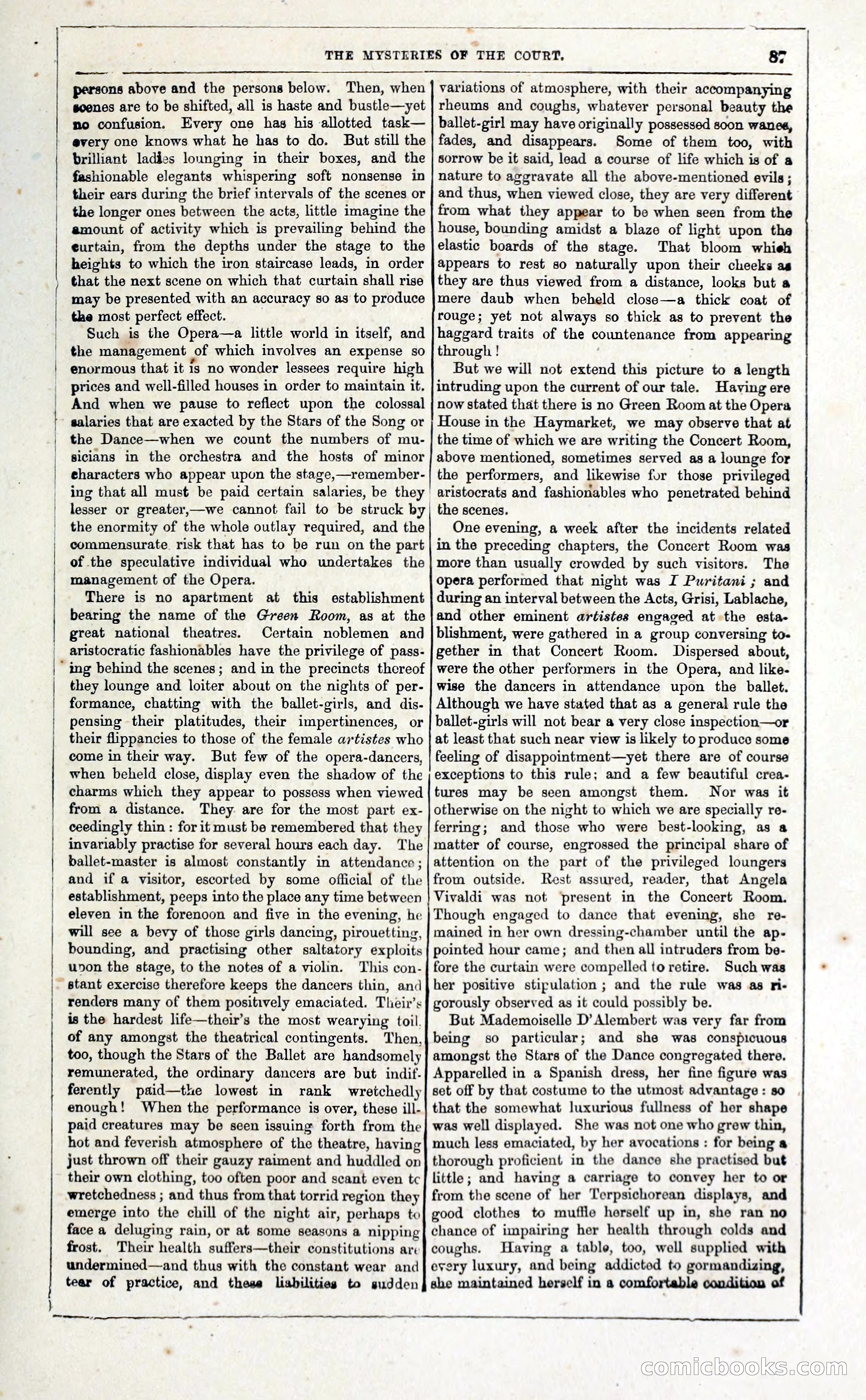
A restored page from Penny Dreadfuls, 1849. Page through the whole issue in the reader above.
📄 Transcribed text from this page (OCR, searchable)
Machine-transcribed from the original scan — historical spelling and the odd misread are preserved.
8 Se THE MYSTERIES OF THE COURT. persons above and the persons below. Then, when scenes are to be shifted, all is haste and bustle—yet no confusion. Every one has his allotted task— every one knows what he has to do. But still the brilliant ladies lounging in their boxes, and the fashionable elegants whispering soft nonsense in their ears during the brief intervals of the scenes or the longer ones between the acts, little imagine the amount of activity which is prevailing behind the eurtain, from the depths under the stage to the heights to which the iron staircase leads, in order that the next scene on which that curtain shall rise may be presented with an accuracy so as to produce the most perfect effect. Such is the Opera—a little world in itself, and the management of which involves an expense so enormous that it is no wonder lessees require high prices and well-filled houses in order to maintain it. And when we pause to reflect upon the colossal salaries that are exacted by the Stars of the Song or the Dance—when we count the numbers of mu- sicians in the orchestra and the hosts of minor eharacters who appear upon the stage,—remember- ing that all must be paid certain salaries, be they lesser or greater,—we cannot fail to be struck by the enormity of the whole outlay required, and the commensurate risk that has to be run on the part of the speculative individual who undertakes the management of the Opera. There is no apartment at this establishment bearing the name of the Green Room, as at the great national theatres. Certain noblemen and aristocratic fashionables have the privilege of pass- ‘ ing behind the scenes; and in the precincts thereof they lounge and loiter about on the nights of per- formance, chatting with the ballet-girls, and dis- pensing their platitudes, their impertinences, or their flippancies to those of the female aztistes who come in their way. But few of the opera-dancers, when beheld close, display even the shadow of the charms which they appear to possess when viewed from a distance. They. are for the most part ex- ceedingly thin : for it must be remembered that they invariably practise for several hours each day. The ballet-master is almost constantly in attendanco ; and if a visitor, escorted by some official of the establishment, peeps into the place any time between eleven in the forenoon and five in the evening, he will see a bevy of those girls dancing, pirouetting, bounding, and practising other saltatory exploits uvon the stage, to the notes of a violin. This con- - stant exercise therefore keeps the dancers thin, and renders many of them positively emaciated. Their’s is the hardest life—their’s the most wearying toil. of any amongst the theatrical contingents. Then, too, though the Stars of the Ballet are handsomely remunerated, the ordinary dancers are but indif- ferently paid—the lowest in rank wretchedly enough! When the performance is over, these ill- paid creatures may be seen issuing forth from the hot and feverish atmosphere of the theatre, having just thrown off their gauzy raiment and huddled on their own clothing, too often poor and scant even tc wretchedness ; and thus from that torrid region they emerge into the chill of the night air, perhaps to face a deluging rain, or at some seasons a nipping frost. Their health suffers—their constitutions are undermined—and thus with the constant wear and tear of practice, and these liabilities to sudden CR ——— $m —_ —_— -- 87 variations of atmosphere, with their accompanying rheums and coughs, whatever personal beauty the ballet-girl may have originally possessed soon wanes, fades, and disappears. Some of them too, with sorrow be it said, lead a course of life which is of a nature to aggravate all the above-mentioned evils ; and thus, when viewed close, they are very different from what they appear to be when seen from the house, bounding amidst a blaze of light upon the elastic boards of the stage. That bloom whieh appears to rest so naturally upon their cheeks ag they are thus viewed from a distance, looks but a mere daub when beheld close—a thick coat of rouge; yet not always so thick as to prevent the haggard traits of the countenance from appearing through ! But we will not extend this picture to a length intruding upon the current of our tale. Having ere now stated that there is no Green Room at the Opera House in the Haymarket, we may observe that at the time of which we are writing the Concert Room, above mentioned, sometimes served as a lounge for the performers, and likewise for those privileged aristocrats and fashionables who penetrated behind the scenes. One evening, a week after the incidents related in the preceding chapters, the Concert Room was more than usually crowded by such visitors. The opera performed that night was I Puritani ; and during an interval between the Acts, Grisi, Lablache, and other eminent artistes engaged at the esta- blishment, were gathered in a group conversing to- gether in that Concert Ruom. Dispersed about, were the other performers in the Opera, and like- wise the dancers in attendance upon the ballet. Although we have stated that as a general rule the ballet-girls will not bear a very close inspection—or at least that such near view is likely to produce some feeling of disappointment—yet there are of course exceptions to this rule; and a few beautiful crea- tures may be seen amongst them. Nor was it otherwise on the night to which we are specially re- ferring; and those who were best-looking, as a matter of course, engrossed the principal share of attention on the part of the privileged loungers from outside. Rest assured, reader, that Angela Vivaldi was not present in the Concert Room. Though engaged to dance that evening, she re- mained in her own dressing-chamber until the ap- pointed hour came; and then all intruders from be- fore the curtain were compelled to retire. Such was her positive stipulation ; and the rule was as ri- gorously observed as it could possibly be. But Mademoiselle D’Alembert was very far from being so particular; and she was conspicuous amongst the Stars of the Dance congregated there. Apparelled in a Spanish dress, her fine figure was set off by that costume to the utmost advantage : so that the somewhat luxurious fullness of her shape was well displayed. She was not one who grew thin, much less emaciated, by her avocations : for being a thorough proficient in the dance she practised but little; and having a carriage to convey her to or from the scene of her Terpsichorean displays, and good clothes to muffle herself up in, she ran no chance of impairing her health through colds and coughs. Having a table, too, well supplied with every luxury, and being addicted to gormandizing, she maintained herself in a comfortable condition of COMmMICcboookxs (CO)