
Penny Dreadfuls, 1854 · page 129 of 399
Joseph Wilmot, or, The Memoirs of a Man-Servant — page 129: what you’re looking at
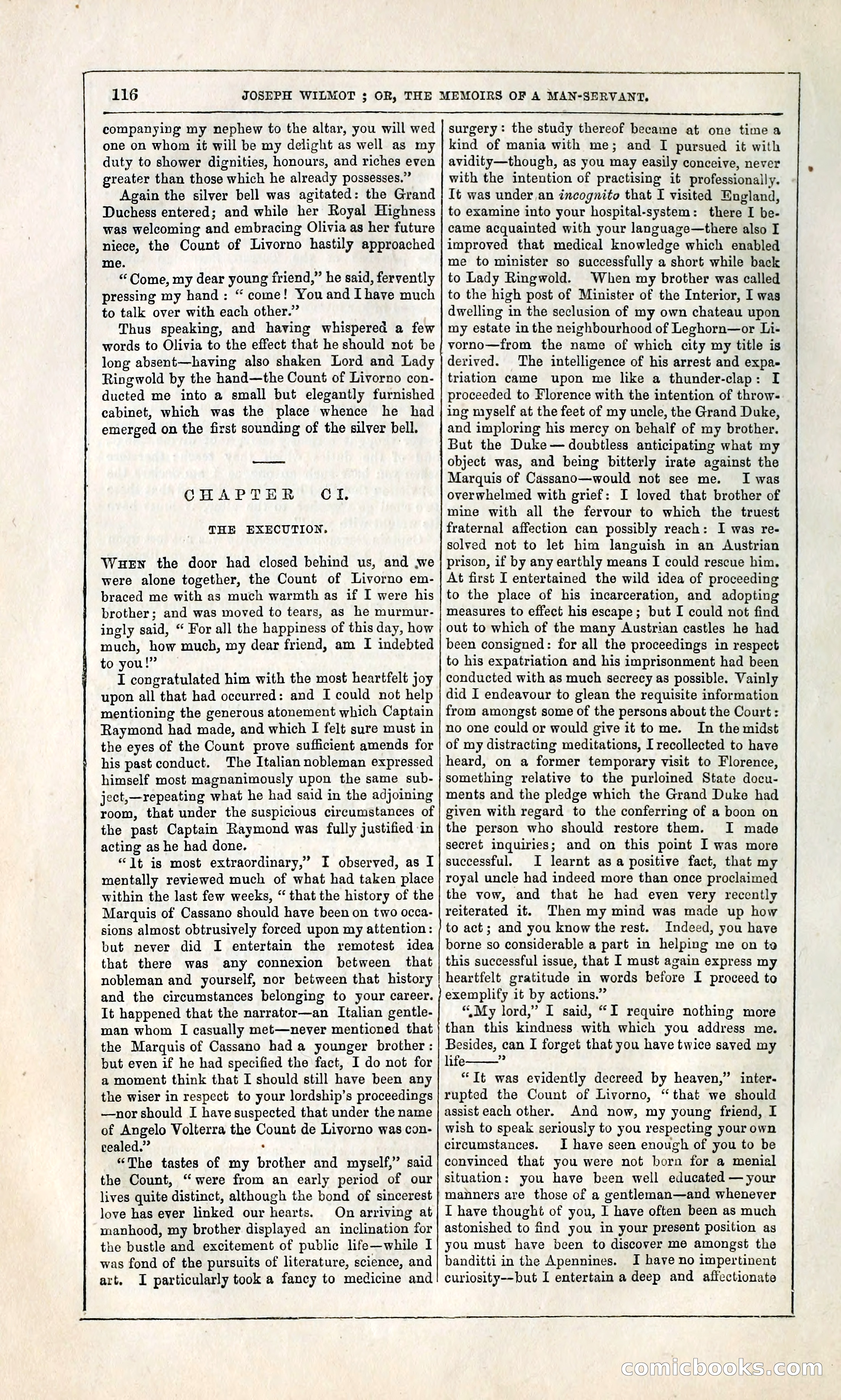
A restored page from Penny Dreadfuls, 1854. Page through the whole issue in the reader above.
📄 Transcribed text from this page (OCR, searchable)
Machine-transcribed from the original scan — historical spelling and the odd misread are preserved.
116 JOSEPH WILMOT ; OR, THE MEMOIRS OF A MAN-SERVANT, companying my nephew to the altar, you will wed one on whom it will be my delight as well as my duty to shower dignities, honours, and riches even greater than those which he already possesses.” Again the silver bell was agitated: the Grand Duchess entered; and while her Royal Highness was welcoming and embracing Olivia as her future niece, the Count of Livorno hastily approached me. “Come, my dear young friend,” he said, fervently pressing my hand: “ come! Youand Ihave much to talk over with each other.” Thus speaking, and having whispered a few words to Olivia to the effect that he should not be long absent—having also shaken Lord and Lady Ringwold by the hand—the Count of Livorno con- ducted me into a small but elegantly furnished cabinet, which was the place whence he had emerged on the first sounding of the silver bell. s atnnetiniencemil CHAPTER Cl. THE EXECUTION, Wuewn the door had closed behind us, and we were alone together, the Count of Livorno em- braced me with as much warmth as if I were his brother; and was moved to tears, as he murmur- ingly said, “ For all the happiness of this day, how much, how much, my dear friend, am I indebted to you!” I congratulated him with the most heartfelt joy upon all that had occurred: and I could not help mentioning the generous atonement which Captain Raymond had made, and which I felt sure must in the eyes of the Count prove sufficient amends for his past conduct. The Italian nobleman expressed himself most magnanimously upon the same sub- ject,—repeating what he had said in the adjoining room, that under the suspicious circumstances of the past Captain Raymond was fully justified in acting as he had done. “lt is most extraordinary,” I observed, as I mentally reviewed much of what had taken place within the last few weeks, “ that the history of the Marquis of Cassano should have been on two occa- sions almost obtrusively forced upon my attention: but never did I entertain the remotest idea that there was any connexion between that surgery: the study thereof became at one time a kind of mania with me; and I pursued it with avidity—though, as you may easily conceive, never with the intention of practising it professionally. {t was under an incognito that I visited England, to examine into your hospital-system: there I be- came acquainted with your language—there also I improved that medical knowledge which enabled me to minister so successfully a short while back to Lady Ringwold. When my brother was called to the high post of Minister of the Interior, I was dwelling in the seclusion of my own chateau upon my estate in the neighbourhood of Leghorn—or Li- vorno—from the name of which city my title is derived. The intelligence of his arrest and expa- triation came upon me like a thunder-clap: I proceeded to Florence with the intention of throw- ing myself at the feet of my uncle, the Grand Duke, and imploring his mercy on behalf of my brother. But the Duke— doubtless anticipating what my object was, and being bitterly irate against the Marquis of Cassano—would not see me. I was overwhelmed with grief: I loved that brother of mine with all the fervour to which the truest fraternal affection can possibly reach: I was re- solved not to let him languish in an Austrian prison, if by any earthly means I could rescue him. At first I entertained the wild idea of proceeding to the place of his incarceration, and adopting measures to effect his escape; but I could not find out to which of the many Austrian castles he had been consigned: for all the proceedings in respect to his expatriation and his imprisonment had been conducted with as much secrecy as possible. Vainly did I endeavour to glean the requisite information from amongst some of the persons about the Court: no one could or would give it to me. In the midst of my distracting meditations, I recollected to have heard, on a former temporary visit to Florence, something relative to the purloined State docu- ments and the pledge which the Grand Duke had given with regard to the conferring of a boon on the person who should restore them. I made secret inquiries; and on this point I was more successful. I learnt asa positive fact, that my royal uncle had indeed more than once proclaimed the vow, and that he had even very recently reiterated it. Then my mind was made up how to act; and you know the rest. Indeed, you have borne so considerable a part in helping me on te this successful issue, that I must again express my nobleman and yourself, nor between that history | heartfelt gratitude in words before I proceed to and the circumstances belonging to your career. / exemplify it by actions.” It happened that the narrator—an Italian gentle- man whom I casually met—never mentioned that the Marquis of Cassano had a younger brother : but even if he had specified the fact, I do not for a moment think that I should still have been any the wiser in respect to your lordship’s proceedings —nor should I have suspected that under the name of Angelo Volterra the Count de Livorno was con- cealed.” : “The tastes of my brother and myself,” said the Count, “were from an early period of our lives quite distinct, although the bond of sincerest love has ever linked our hearts. On arriving at manhood, my brother displayed an inclination for the bustle and excitement of public life—while I was fond of the pursuits of literature, science, and art. I particularly took a fancy to medicine and “My lord,’ I said, “I require nothing more than this kindness with which you address me. Besides, can I forget that you have twice saved my life + “It was evidently decreed by heaven,” inter- rupted the Count of Livorno, “ that we should assist each other. And now, my young friend, I wish to speak seriously to you respecting your own circumstances. I have seen enough of you to be convinced that you were not born for a menial situation: you have been well educated — your manners are those of a gentleman—and whenever I have thought of you, I have often been as much astonished to find you in your present position as you must have been to discover me amongst the banditti in the Apennines. I have no impertinent curiosity--but I entertain a deep and affectionate ECORNICLOOKSseE@