
Penny Dreadfuls, 1854 · page 128 of 399
Joseph Wilmot, or, The Memoirs of a Man-Servant — page 128: what you’re looking at
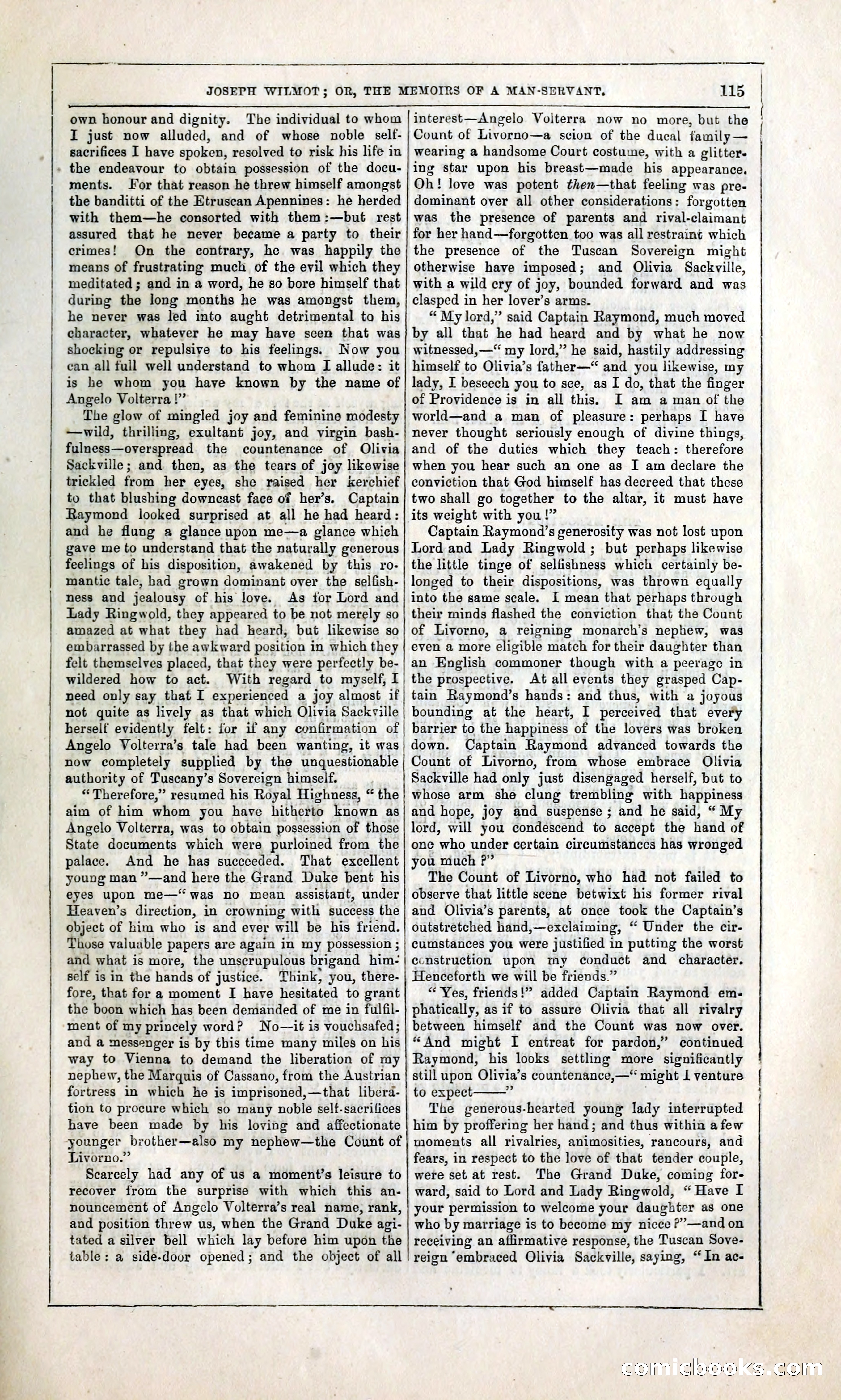
A restored page from Penny Dreadfuls, 1854. Page through the whole issue in the reader above.
📄 Transcribed text from this page (OCR, searchable)
Machine-transcribed from the original scan — historical spelling and the odd misread are preserved.
- eee On 0 eee ee. OO JOSEPH WILMOT; OR, THE MEMOIRS OF A MAN-SERVANT, own honour and dignity. The individual to whom I just now alluded, and of whose noble self- sacrifices I have spoken, resolved to risk his life in » the endeavour to obtain possession of the docu- ments. For that reason he threw himself amongst the banditti of the Etruscan Apennines: he herded with them—he consorted with them:—but rest assured that he never became a party to their crimes! On the contrary, he was happily the means of frustrating much of the evil which they meditated ; and in a word, he so bore himself that during the long months he was amongst them, he never was led into aught detrimental to his character, whatever he may have seen that was shocking or repulsive to his feelings. Now you can all full well understand to whom I allude: it is he whom you haye known by the name of Angelo Volterra !” The glow of mingled joy and feminine modesty —wild, thrilling, exultant joy, and virgin bash- fulness—oyerspread the countenance of Olivia Sackville; and then, as the tears of joy likewise trickled from her eyes, she raised her kerchief to that blushing downcast face of her’s. Captain Raymond looked surprised at all he had heard: and he flung a glance upon me—a glance which gave me to understand that the naturally generous feelings of his disposition, awakened by this ro- mantic tale, had grown dominant over the selfish- ness and jealousy of his love. As for Lord and Lady Ringwold, they appeared to be not merely so amazed at what they had heard, but likewise so embarrassed by the awkward position in which they felt themselves placed, that they were perfectly be- wildered how to act. With regard to myself, I need only say that I experienced a joy almost if not quite as lively as that which Olivia Sackville herself evidently felt: for if any confirmation of Angelo Volterra’s tale had been wanting, it was now completely supplied by the unquestionable authority of Tuscany’s Sovereign himself. “Therefore,” resumed his Royal Highness, “ the aim of him whom you have hitherto known as Angelo Volterra, was to obtain possession of those State documents which were purloined from the palace. And he has succeeded. That excellent young man ”—and here the Grand Duke bent his eyes upon me—“ was no mean assistant, under Heaven’s direction, in crowning with success the object of him who is and ever will be his friend. Those valuable papers are again in my possession ; and what is more, the unscrupulous brigand him- self is in the hands of justice. Think, you, there- fore, that for a moment I have hesitated to grant the boon which has been demanded of me in fulfil- ment of my princely word? No—it is vouchsafed; and a messenger is by this time many miles on his way to Vienna to demand the liberation of my nephew, the Margnis of Cassano, from the Austrian fortress in which he is imprisoned,—that liberd- tion to procure which so many noble self-sacrifices have been made by his loving and affectionate younger brother—also my nephew—the Count of Livorno.” Scarcely had any of us a moment’s leisure to recover from the surprise with which this an- nouncement of Angelo Volterra’s real name, rank, and position threw us, when the Grand Duke agi- tated a silver bell which lay before him upon the table: a side-door opened; and the object of all interest—Angelo Volterra now no more, but the Count of Livorno—a scion of the ducal family — wearing a handsome Court costume, with a glitter. ing star upon his breast—made his appearance. Oh! love was potent then—that feeling was pre- dominant over all other considerations: forgotten was the presence of parents and rival-claimant for her hand—forgotten too was all restraint which the presence of the Tuscan Sovereign might otherwise have imposed; and Olivia Sackville, with a wild cry of joy, bounded forward and was clasped in her lover’s arms. “ My lord,” said Captain Raymond, much moved by all that he had heard and by what he now witnessed,—“ my lord,’ he said, hastily addressing himself to Olivia’s father—“ and you likewise, my lady, I beseech you to see, as I do, that the finger of Providence is in all this. I am a man of the world—and a man of pleasure: perhaps I have never thought seriously enough of divine things, and of the duties which they teach: therefore when you hear such an one as I am declare the conviction that God himself has decreed that these two shall go together to the altar, it must have its weight with you!” Captain Raymond’s generosity was not lost upon Lord and Lady Ringwold ; but perhaps likewise the little tinge of selfishness which certainly be- longed to their dispositions, was thrown equally into the same scale. I mean that perhaps through their minds flashed the conviction that the Count of Livorno, a reigning monarch’s nephew, was even a more eligible match for their daughter than an English commoner though with a peerage in the prospective. At all events they grasped Cap- tain Raymond’s hands: and thus, with a joyous bounding at the heart, I perceived that every barrier to the happiness of the lovers was broken down. Captain Raymond advanced towards the Count of Livorno, from whose embrace Olivia Sackville had only just disengaged herself, but to whose arm she clung trembling with happiness and hope, joy and suspense ; and he said, “ My lord, will you condescend to accept the hand of one who under certain circumstances has wronged you much P” The Count of Livorno, who had not failed to observe that little scene betwixt his former rival and Olivia’s parents, at once took the Captain’s outstretched hand,—exclaiming, “ Under the cir- cumstances you were justified in putting the worst ccnstruction upon my conduct and character. Henceforth we will be friends.” “Yes, friends!” added Captain Raymond em- phatically, as if to assure Olivia that all rivalry between himself and the Count was now over. “And might I entreat for pardon,” continued Raymond, his looks settling more significantly still upon Olivia’s countenance,—* might 1 venture to expect . The generous-hearted young lady interrupted him by proffering her hand; and thus within afew moments all rivalries, animosities, rancours, and fears, in respect to the love of that tender couple, were set at rest. The Grand Duke, coming for- ward, said to Lord and Lady Ringwold, “Have I your permission to welcome your daughter as one who by marriage is to become my niece ?”’—and on receiving an affirmative response, the Tuscan Sove- reion “embraced Olivia Sackville, saying, “In ac- Glyoo Ss (E()