
Penny Dreadfuls, 1854 · page 130 of 399
Joseph Wilmot, or, The Memoirs of a Man-Servant — page 130: what you’re looking at
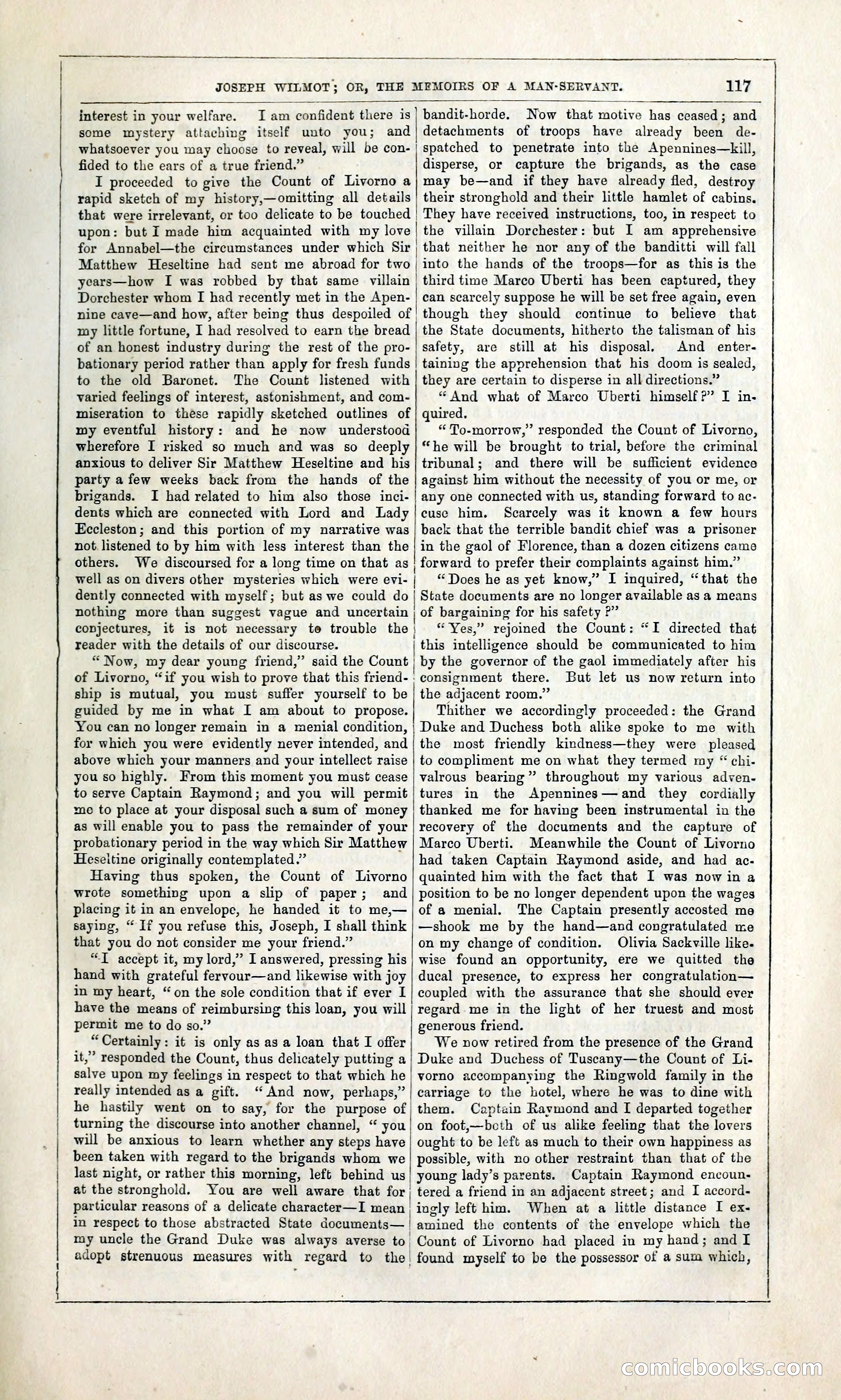
A restored page from Penny Dreadfuls, 1854. Page through the whole issue in the reader above.
📄 Transcribed text from this page (OCR, searchable)
Machine-transcribed from the original scan — historical spelling and the odd misread are preserved.
en ee ee . — ——— ee — :-sti—i— Ce JOSEPH WILMOT; OR, THE MEMOIRS OF A MAN-SERVANT. interest in your welfare. Iam confident there is some mystery attaching itself unto you; and whatsoever you may choose to reveal, will be con- fided to the ears of a true friend.” I proceeded to give the Count of Livorno a rapid sketch of my history,—omitting all details _- 117 bandit-horde. detachments of troops have already been de- spatched to penetrate into the Apennines—kill, disperse, or capture the brigands, as the case may be—and if they have already fled, destroy their stronghold and their little hamlet of cabins. Now that motive has ceased; and that were irrelevant, or too delicate to be touched | They have received instructions, too, in respect to upon: but i made him acquainted with my love! the villain Dorchester: but I am apprehensive for Annabel—the circumstances under which Sir | that neither he nor any of the banditti will fall Matthew MHeseltine had sent me abroad for two/ into the hands of the troops—for as this is the years—how I was robbed by that same villain | Dorchester whom I had recently met in the Apen- nine cave—and how, after being thus despoiled of | my little fortune, I had resolved to earn the bread of an honest industry during the rest of the pro- bationary period rather than apply for fresh funds to the old Baronet. The Count listened with | varied feelings of interest, astonishment, and com- miseration to these rapidly sketched outlines of my eventful history: and he now understood wherefore I risked so much and was so deeply anxious to deliver Sir Matthew Heseltine and his party afew weeks back from the hands of the brigands. I had related to him also those inci- dents which are connected with Lord and Lady Eccleston; and this portion of my narrative was not. listened to by him with less interest than the others. We discoursed for a long time on that as well as on divers other mysteries which were evi- dently connected with myself; but as we could do nothing more than suggest vague and uncertain conjectures, it is not necessary te trouble the | reader with the details of our discourse. “ Now, my dear young friend,” said the Count | of Livorno, “if you wish to prove that this friend- ; ship is mutual, you must suffer yourself to be guided by me in what I am about to propose. You can no longer remain in a menial condition, for which you were evidently never intended, and above which your manners and your intellect raise you so highly. From this moment you must cease to serve Captain Raymond; and you will permit me to place at your disposal such a sum of money as will enable you to pass the remainder of your probationary period in the way which Sir Matthew Heseltine originally contemplated.” Having thus spoken, the Count of Livorno wrote something upon a slip of paper; and placing it in an envelope, he handed it to me,— saying, “ If you refuse this, Joseph, I shall think that you do not consider me your friend.” “T accept it, my lord,’ I answered, pressing his hand with grateful fervour—and likewise with joy in my heart, “on the sole condition that if ever I have the means of reimbursing this loan, you will permit me to do so.” “Certainly: it is only as as a loan that I offer it,’ responded the Count, thus delicately putting a salve upon my feelings in respect to that which he really intended as a gift. ‘“ And now, perhaps,” he hastily went on to say, for the purpose of turning the discourse into another channel, “ you will be anxious to learn whether any steps have been taken with regard to the brigands whom we last night, or rather this morning, left behind us at the stronghold. You are well aware that for particular reasons of a delicate character—I mean | in respect to those abstracted State documents— | my uncle the Grand Duke was always averse to. adopt strenuous measures with regard to the a OO ts ne ten’ third time Marco Uberti has been captured, they can scarcely suppose he will be set free again, even though they should continue to believe that the State documents, hitherto the talisman of his safety, are still at his disposal. And enter- taining the apprehension that his doom is sealed, they are certain to disperse in all directions.” “And what of Marco Uberti himself?” I in- quired, * 7'o-morrow,”’ responded the Count of Livorno, “he will be brought to trial, before the criminal tribunal; and there will be sufficient evidence against him without the necessity of you or me, or any one connected with us, standing forward to ac- cuse him. Scarcely was it known a few hours back that the terrible bandit chief was a prisoner in the gaol of Florence, than a dozen citizens came forward to prefer their complaints against him.” “ Does he as yet know,” I inquired, “that the State documents are no longer available as a means of bargaining for his safety ?” “Yes,” rejoined the Count: “I directed that this intelligence should be communicated to him by the governor of the gaol immediately after his consignment there. But let us now return into the adjacent room.” Thither we accordingly proceeded: the Grand Duke and Duchess both alike spoke to me with the most friendly kindness—they were pleased to compliment me on what they termed my “ chi- valrous bearing ” throughout my various adven- tures in the Apennines—and they cordially thanked me for having been instrumental in the recovery of the documents and the capture of Marco Uberti. Meanwhile the Count of Livorno had taken Captain Raymond aside, and had ac- quainted him with the fact that I was nowin a position to be no longer dependent upon the wages of a menial. The Captain presently accosted me —shook me by the hand—and congratulated me on my change of condition. Olivia Sackville like. wise found an opportunity, ere we quitted the ducal presence, to express her congratulation— coupled with the assurance that she should ever regard me in the light of her truest and most generous friend. We now retired from the presence of the Grand Duke and Duchess of Tuscany—the Count of Li- vyorno accompanying the Ringwold family in the carriage to the hotel, where he was to dine with them. Captain Raymond and I departed together on foot,—bcth of us alike feeling that the lovers ought to be left as much to their own happiness as possible, with no other restraint than that of the young lady’s parents. Captain Raymond encoun- tered a friend in an adjacent street; and I accord- ingly left him. When at a little distance I ex- amined the contents of the envelope which the Count of Livorno had placed in my hand; and I found myself to be the possessor of a sum which, Giyoo S (C@)