
Penny Dreadfuls, 1854 · page 59 of 394
Joseph Wilmot, or, The Memoirs of a Man-Servant — page 59: what you’re looking at
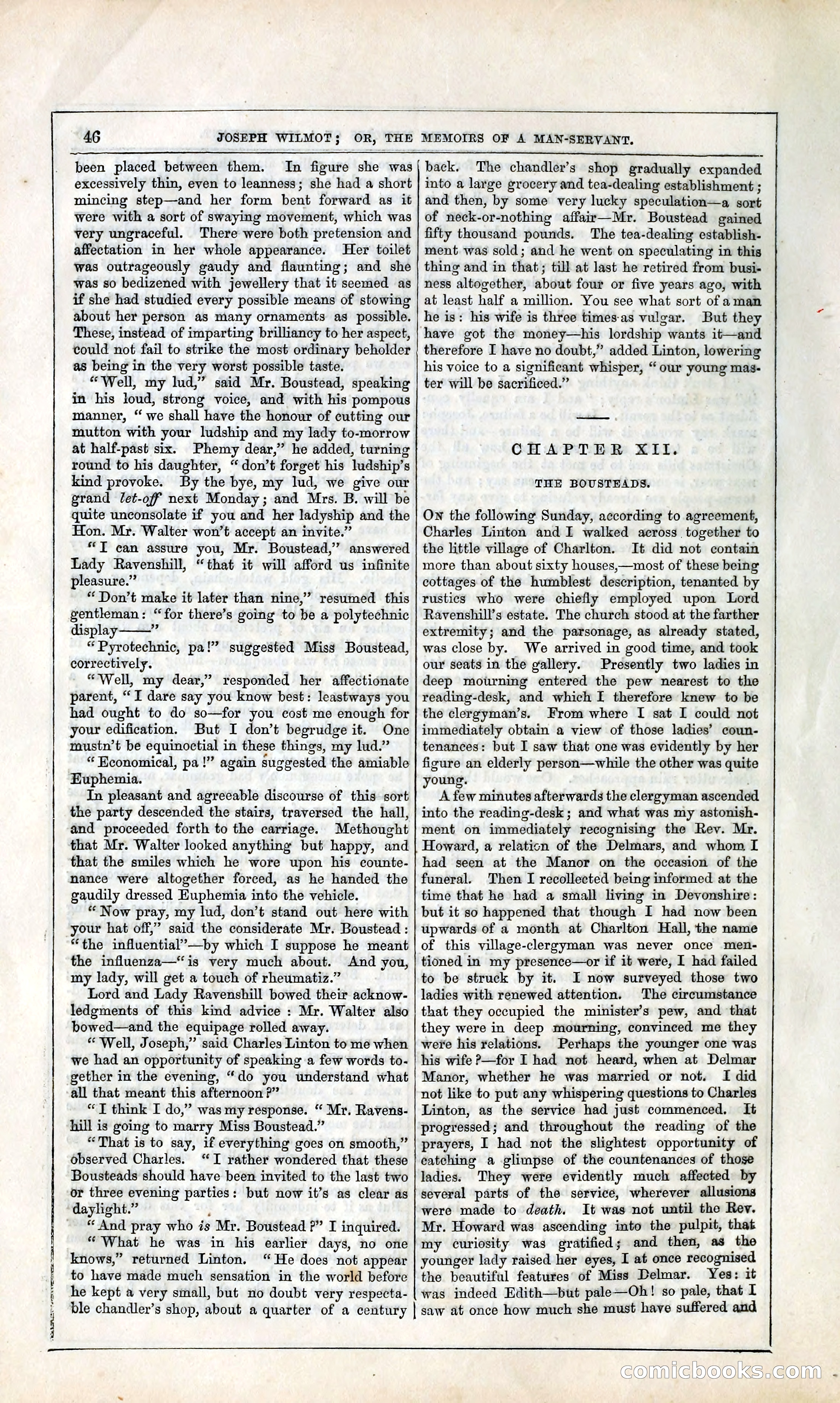
A restored page from Penny Dreadfuls, 1854. Page through the whole issue in the reader above.
📄 Transcribed text from this page (OCR, searchable)
Machine-transcribed from the original scan — historical spelling and the odd misread are preserved.
46 been placed between them. Im figure she was excessively thin, even to leanness; she had a short mincing step—and her form bent forward as it were with a sort of swaying movement, which was very ungraceful. There were both pretension and affectation in her whole appearance. Her toilet was outrageously gaudy and flaunting; and she was so bedizened with jewellery that it seemed as if she had studied every possible means of stowing about her person as many ornaments as possible. These, instead of imparting brilliancy to her aspect, could not fail to strike the most ordinary beholder as being in the very worst possible taste. “Well, my lud,” said Mr. Boustead, speaking in his loud, strong voice, and with his pompous manner, “ we shall have the honour of cutting our mutton with your ludship and my lady to-morrow at half-past six. Phemy dear,” he added, turning round to his daughter, “don’t forget his ludship’s kind provoke. By the bye, my lud, we give our grand Jlet-off next Monday; and Mrs. B. will be quite unconsolate if you and her ladyship and the Hon. Mr. Walter won’t accept an invite.” “T can assure you, Mr. Boustead,” answered Lady Ravenshill, “that it will afford us infinite pleasure.” ** Don’t make it later than nine,’ resumed this gentleman: “for there’s going to be a polytechnic display m “Pyrotechnic, pa!” suggested Miss Boustead, correctively. “Well, my dear,” responded her affectionate parent, “I dare say you know best: leastways you had ought to do so—for you cost me enough for your edification. But I don’t begrudge it. One mustn’t be equinoctial in these things, my lud.” “ Economical, pa!” again suggested the amiable Euphemia. | In pleasant and agreeable discourse of this sort the party descended the stairs, traversed the hall, and proceeded forth to the carriage. Methought that Mr. Walter looked anything but happy, and that the smiles which he wore upon his counte- nance were altogether forced, as he handed the gaudily dressed Huphemia into the vehicle. ** Now pray, my lud, don’t stand out here with your hat off,” said the considerate Mr. Boustead : “the influential”—by which I suppose he meant the influenza—‘is very much about. And you, my lady, will get a touch of rheumatiz.” Lord and Lady Ravenshill bowed their acknow- ledgments of this kind advice : Mr. Walter also bowed—and the equipage rolled away. “Well, Joseph,” said Charles Linton to me when we had an opportunity of speaking a few words to- gether in the evening, “do you understand what all that meant this afternoon P” “IT think I do,” was my response. “ Mr. Ravens- hill is going to marry Miss Boustead.” “That is to say, if everything goes on smooth,” observed Charles. “TI rather wondered that these Bousteads should have been invited to the last two or three evening parties: but now it’s as clear as daylight.” “And pray who is Mr. Boustead ?” I inquired. “What he was in his earlier days, no one knows,” returned Linton. “He does not appear to have made much sensation in the world before he kept a very small, but no doubt very respecta- back. The chandler’s shop gradually expanded into a large grocery and tea-dealing establishment ; and then, by some very lucky speculation—a sort of neck-or-nothing affair—Mr. Boustead gained fifty thousand pounds. The tea-dealing establish- ment was sold; and he went on speculating in this thing and in that; till at last he retired from busi- ness altogether, about four or five years ago, with at least half a million. You see what sort of aman he is: his wife is three times-as vulgar. But they have got the money—his lordship wants it—and therefore I have no doubt,” added Linton, lowering his voice to a significant whisper, “our young mas- ter will be sacrificed.” ——=_ CHAPTER XII. THE BOUSTEADS. Own the following Sunday, according to agreement, Charles Linton and I walked across together to the little village of Charlton. It did not contain more than about sixty houses,—most of these being cottages of the humblest description, tenanted by rustics who were chiefly employed upon Lord Ravenshill’s estate. The church stood at the farther extremity; and the parsonage, as already stated, was close by. We arrived in good time, and took our seats in the gallery. Presently two ladies in deep mourning entered the pew nearest to the reading-desk, and which I therefore knew to be the clergyman’s. From where I sat I could not immediately obtain a view of those ladies’ coun- tenances: but I saw that one was evidently by her firure an elderly person—while the other was quite young. | A few minutes afterwards the clergyman ascende into the reading-desk; and what was my astonish- ment on immediately recognising the Rey. Mr. Howard, a relaticn of the Delmars, and whom I had seen at the Manor on the occasion of the funeral. Then I recollected being informed at the time that he had a small living in Devonshire: but it so happened that though I had now been upwards of a month at Charlton Hall, the name of this village-clergyman was never once men- tioned in my presence—or if it were, I had failed to be struck by it. I now surveyed those two ladies with renewed attention. The circumstance that they occupied the minister’s pew, and that they were in deep mourning, convinced me they were his relations. Perhaps the younger one was his wife P—for I had not heard, when at Delmar Manor, whether he was married or not. I did not like to put any whispering questions to Charles Linton, as the service had just commenced. It progressed; and throughout the reading of the prayers, I had not the slightest opportunity of catching a glimpse of the countenances of those ladies: They were evidently much affected by several parts of the service, wherever allusions were made to death. It was not until the Rev. Mr. Howard was ascending into the pulpit, that my curiosity was gratified ; and them, as the younger lady raised her eyes, I af once recognised the beautiful features of Miss Delmar. Yes: it was indeed Edith—but pale—Oh! so pale, that I ble chandler’s shop, about a quarter of a century | saw at once how much she must have suffered and JOSEPH WILMOT; OR, THE MEMOIRS OF A MAN-SERVANT. | GOmiGwvooks (c@) m.