
Penny Dreadfuls, 1854 · page 60 of 394
Joseph Wilmot, or, The Memoirs of a Man-Servant — page 60: what you’re looking at
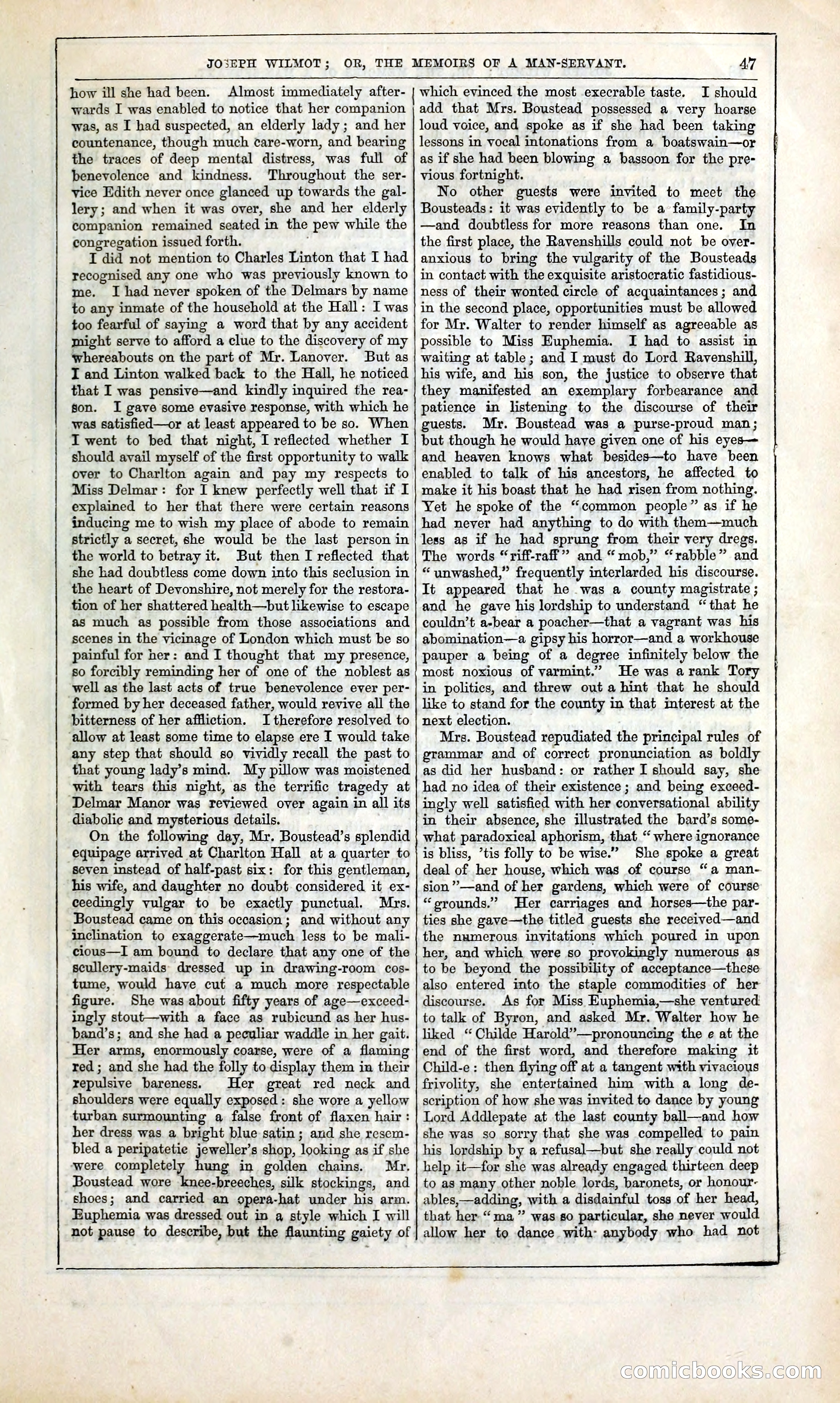
A restored page from Penny Dreadfuls, 1854. Page through the whole issue in the reader above.
📄 Transcribed text from this page (OCR, searchable)
Machine-transcribed from the original scan — historical spelling and the odd misread are preserved.
JOSEPH WILMOT ; OR, THE MEMOIRS OF A MAN-SERVANT. Ai7 how ill she had been. Almost immediately after- | which evinced the most execrable taste. I should wards I was enabled to notice that her companion was, as I had suspected, an elderly lady; and her countenance, though much ¢are-worn, and bearing the traces of deep mental distress, was full of benevolence and kindness. Throughout the ser- vice Edith never once glanced up towards the gal- lery; and when it was over, she and her elderly companion remained seated in the pew while the congregation issued forth. I did not mention to Charles Linton that I had recognised any one who was previously known to me. I had never spoken of the Delmars by name to any inmate of the household at the Hall: I was too fearful of saying a word that by any accident might serve to afford a clue to the discovery of my whereabouts on the part of Mr. Lanover. But as I and Linton walked back to the Hall, he noticed that I was pensive—and kindly inquired the rea- son. I gave some evasive response, with which he was satisfied—or at least appeared to be so. When I went to bed that night, I reflected whether I should avail myself of the first opportunity to walk over to Charlton again and pay my respects to Miss Delmar: for I knew perfectly well that if I explained to her that there were certain reasons inducing me to wish my place of abode to remain strictly a secret, she would be the last person in the world to betray it. But then I reflected that she had doubtless come down into this seclusion in the heart of Devonshire, not merely for the restora- tion of her shattered health—but likewise to escape as much as possible from those associations and scenes in the vicinage of London which must be so painful for her: and I thought that my presence, so forcibly reminding her of one of the noblest as well as the last acts of true benevolence ever per- formed by her deceased father, would revive all the bitterness of her affliction. I therefore resolved to ‘allow at least some time to elapse ere I would take any step that should so vividly recall the past to that young lady’s mind. My pillow was moistened with tears this night, as the terrific tragedy at ‘Delmar Manor was reviewed over again in all its diabolic and mysterious details. | On the following day, Mr. Boustead’s splendid equipage arrived at Charlton Hall at a quarter to seven instead of half-past six: for this gentleman, his wife, and daughter no doubt considered it ex- ceedingly vulgar to be exactly punctual. Mrs. Boustead came on this occasion; and without any inclination to exaggerate—much less to be mali- cious—I am bound to declare that any one of the scullery-maids dressed up in drawing-room cos- tume, would haye cut a much more respectable figure. She was about fifty years of age—exceed- ingly stout—with a face as rubicund as her hus- band’s; and she had a peculiar waddle in her gait. Her arms, enormously coarse, were of a flaming red ; and she had the folly to display them in their repulsive bareness. Her great red neck and shoulders were equally exposed: she wore a yellow turban surmounting a false front of flaxen hair : her dress was a bright blue satin; and she resem- bled a peripatetie jeweller’s shop, looking as if she were completely hung in golden chains. Mr, Boustead wore knee-breeches, silk stockings, and shoes; and carried an opera-hat under his arm. Huphemia was dressed out in a style which I will not pause to describe, but the flaunting gaiety of add that Mrs. Boustead possessed a very hoarse loud voice, and spoke as if she had been taking lessons in vocal intonations from a boatswain—or as if she had been blowing a bassoon for the pre- vious fortnight. No other guests were invited to meet the Bousteads: it was evidently to be a family-party —and doubtless for more reasons than one. In the first place, the Ravenshills could not be over- anxious to bring the vulgarity of the Bousteads in contact with the exquisite aristocratic fastidious- ness of their wonted circle of acquaintances; and in the second place, opportunities must be allowed for Mr. Walter to render himself as agreeable as possible to Miss Euphemia. I had to assist in waiting at table; and I must do Lord Ravenshill, his wife, and his son, the justice to observe that they manifested an exemplary forbearance and patience in listening to the discourse of their guests. Mr. Boustead was a purse-proud man; but though he would haye given one of his eyes— and heaven knows what besides—to have been enabled to talk of his ancestors, he affected to make it his boast that he had risen from nothing. Yet he spoke of the “common people” as if he had never had anything to do with them—much less as if he had sprung from their very dregs. The words “riff-raff” and “mob,” “rabble” and “ unwashed,” frequently interlarded his discourse. It appeared that he was a county magistrate ; and he gave his lordship to understand “that he couldn’t a-bear a poacher—that a vagrant was his abomination—a gipsy his horror—and a workhouse pauper a being of a degree infinitely below the most noxious of varmint.” He was a rank Tory in politics, and threw outa hint that he should like to stand for the county in that interest at the next election. Mrs. Boustead repudiated the principal rules of grammar and of correct pronunciation as boldly as did her husband: or rather I should say, she had no idea of their existence; and being exceed- ingly well satisfied with her conversational ability in their absence, she illustrated the bard’s some- what paradoxical aphorism, that “ where ignorance is bliss, ’tis folly to be wise.” She spoke a great deal of her house, which was of course “a man- sion ”’—and of her gardens, which were of course “orounds.” Her carriages and horses—the par- ties she gave—the titled guests she received—and the numerous invitations which poured in upon her, and which were so provokingly numerous as to be beyond the possibility of acceptance—these also entered into the staple commodities of her discourse. As for Miss Euphemia,—she ventured to talk of Byron, and asked Mr. Walter how he liked ‘“ Childe Harold”—pronouncing the e at the end of the first word, and therefore making it Child-e: then flying off at a tangent with vivacious frivolity, she entertained him with a long de- scription of how she was invited to dance by young Lord Addlepate at the last county ball—and how she was so sorry that she was compelled to pain his lordship by a refusal—but she really could not help it—for she was already engaged thirteen deep to as many other noble lords, baronets, or honour- ables,—adding, with a disdainful toss of her head, that her “ma ” was so particular, she never would allow her to dance with: anybody who had not ElN@QO) SS (CO) im