
Penny Dreadfuls, 1854 · page 58 of 394
Joseph Wilmot, or, The Memoirs of a Man-Servant — page 58: what you’re looking at
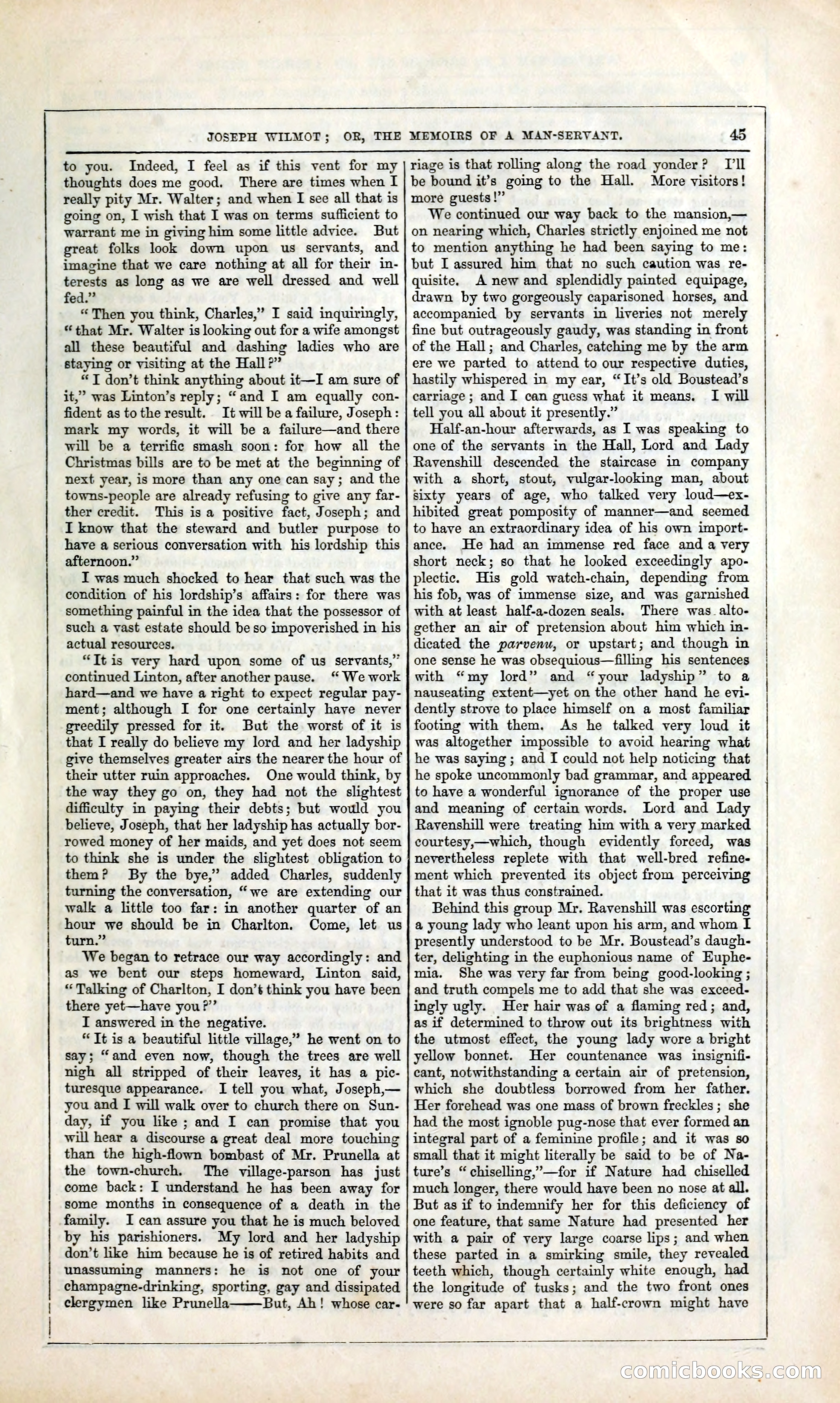
A restored page from Penny Dreadfuls, 1854. Page through the whole issue in the reader above.
📄 Transcribed text from this page (OCR, searchable)
Machine-transcribed from the original scan — historical spelling and the odd misread are preserved.
JOSEPH WILMOT; OR, THE MEMOIRS OF A MAN-SERVANT. 45 to you. Indeed, I feel as if this vent for my thoughts does me good, There are times when I really pity Mr. Walter; and when I see all that is going on, I wish that I was on terms sufficient to warrant me in giving him some little advice. But great folks look down upon us servants, and imagine that we care nothing at all for their in- terests as long as we are well dressed and well fed.” “Then you think, Charles,” I said inquiringly, “that Mr. Walter is looking out for a wife amongst all these beautiful and dashing ladies who are staying or visiting at the Hall?” “T don’t think anything about it—I am sure of it,” was Linton’s reply; “and I am equally con- fident as tothe result. It will be a failure, Joseph: mark my words, it will be a failure—and there will be a terrific smash soon: for how all the Christmas bills are to be met at the beginning of next year, is more than any one can say; and the towns-people are already refusing to give any far- ther credit. This is a positive fact, Joseph; and I know that the steward and butler purpose to have a serious conversation with his lordship this afternoon.” I was much shocked to hear that such was the condition of his lordship’s affairs: for there was something painful in the idea that the possessor of such a vast estate should be so impoverished in his actual resources. “Tt is very hard upon some of us servants,” continued Linton, after another pause. “ We work hard—and we have a right to expect regular pay- ment; although I for one certainly have never greedily pressed for it. But the worst of it is that I really do believe my lord and her ladyship give themselves greater airs the nearer the hour of their utter ruin approaches. One would think, by the way they go on, they had not the slightest difficulty in paying their debts; but would you believe, Joseph, that her ladyship has actually bor- rowed money of her maids, and yet does not seem to think she is under the slightest obligation to them? By the bye,” added Charles, suddenly turning the conversation, “we are extending our walk a little too far: in another quarter of an hour we should be in Charlton. Come, let us turn.” We began to retrace our way accordingly: and as we bent our steps homeward, Linton said, “Talking of Charlton, I don’t think you have been there yet—have you?”’ I answered in the negative. “Tt is a beautiful little village,” he went on to say; “and even now, though the trees are well nigh all stripped of their leaves, it has a pic- turesque appearance. I tell you what, Joseph,— you and I will walk over to church there on Sun- day, if you like; and I can promise that you will hear a discourse a great deal more touching than the high-flown bombast of Mr. Prunella at the town-church. The village-parson has just come back: I understand he has been away for some months in consequence of a death in the family. I can assure you that he is much beloved by his parishioners. My lord and her ladyship don’t like him because he is of retired habits and unassuming manners: he is not one of your champagne-drinking, sporting, gay and dissipated clergymen like Prunella But, Ah! whose car- . —__ __ SS — eee riage is that rolling along the road yonder? I'll be bound it’s going to the Hall. More visitors! more guests!’ We continued our way back to the mansion,— on nearing which, Charles strictly enjoined me not to mention anything he had been saying to me: but I assured him that no such caution was re- quisite. A new and splendidly painted equipage, drawn by two gorgeously caparisoned horses, and accompanied by servants in liveries not merely fine but outrageously gaudy, was standing in front of the Hall; and Charles, catching me by the arm ere we parted to attend to our respective duties, hastily whispered in my ear, “It’s old Boustead’s carriage ; and I can guess what it means. I will tell you all about it presently.” Half-an-hour afterwards, as I was speaking to one of the servants in the Hall, Lord and Lady Ravenshill descended the staircase in company with a short, stout, vulgar-looking man, about sixty years of age, who talked very loud—ex- hibited great pomposity of manner—and seemed to have an extraordinary idea of his own import- ance. He had an immense red face and a very short neck; so that he looked exceedingly apo- plectic. His gold watch-chain, depending from his fob, was of immense size, and was garnished with at least half-a-dozen seals. There was_alto- gether an air of pretension about him which in- dicated the parvenu, or upstart; and though in one sense he was obsequious—filling his sentences with “my lord” and “your ladyship” to a nauseating extent—yet on the other hand he evi- dently strove to place himself on a most familiar footing with them. As he talked very loud it was altogether impossible to avoid hearing what he was saying ; and I could not help noticing that he spoke uncommonly bad grammar, and appeared to have a wonderful ignorance of the proper use and meaning of certain words. Lord and Lady Rayenshill were treating him with a very marked courtesy,—which, though evidently forced, was nevertheless replete with that well-bred refine- ment which prevented its object from perceiving that it was thus constrained. Behind this group Mr. Ravenshill was escorting a young lady who leant upon his arm, and whom I presently understood to be Mr. Boustead’s daugh- ter, delighting in the euphonious name of Euphe- mia. She was very far from being good-looking ; and truth compels me to add that she was exceed- ingly ugly. Her hair was of a flaming red; and, as if determined to throw out its brightness with the utmost effect, the young lady wore a bright yellow bonnet. Her countenance was insignifi- cant, notwithstanding a certain air of pretension, which she doubtless borrowed from her father. Her forehead was one mass of brown freckles ; she had the most ignoble pug-nose that ever formed an integral part of a feminine profile; and it was so small that it might literally be said to be of Na- ture’s “ chiselling,”—for if Nature had chiselled much longer, there would have been no nose at all. But as if to indemnify her for this deficiency of one feature, that same Nature had presented her with a pair of very large coarse lips; and when these parted in a smirking smile, they revealed teeth which, though certainly white enough, had the longitude of tusks; and the two front ones were so far apart that a half-crown might have _- CoOnnicloOokXs (CO) im