
Penny Dreadfuls, 1854 · page 57 of 394
Joseph Wilmot, or, The Memoirs of a Man-Servant — page 57: what you’re looking at
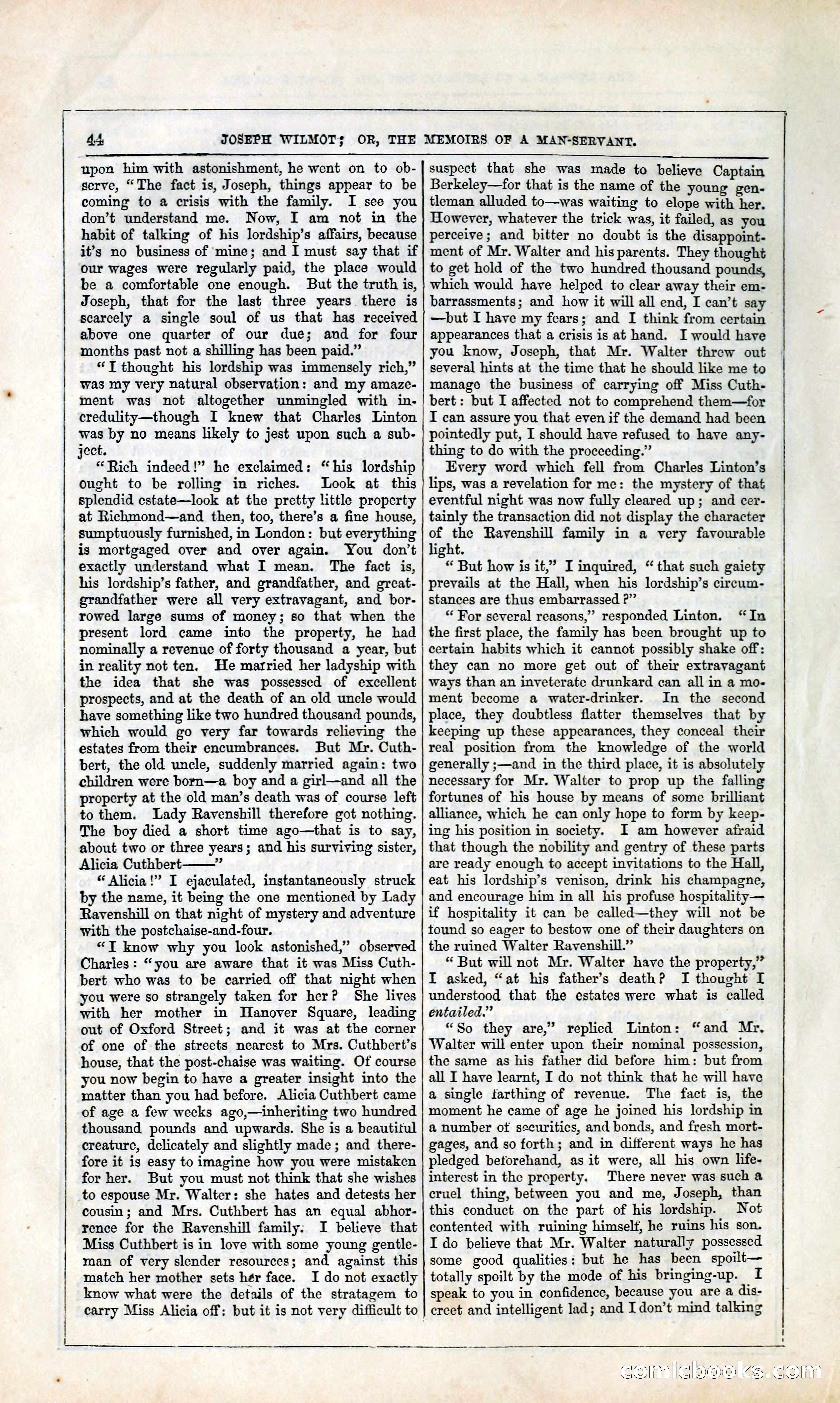
A restored page from Penny Dreadfuls, 1854. Page through the whole issue in the reader above.
📄 Transcribed text from this page (OCR, searchable)
Machine-transcribed from the original scan — historical spelling and the odd misread are preserved.
_—- -——-— OO Ooo a SS eae aes oreo" Ads JOSEPH WILMOT; upon him with astonishment, he went on to ob- serve, “The fact is, Joseph, things appear to be coming to a crisis with the family. I see you don’t understand me. Now, I am not in the habit of talking of his lordship’s affairs, because it’s no business of mine; and I must say that if our wages were regularly paid, the place would be a comfortable one enough. But the truth is, Joseph, that for the last three years there is scarcely a single soul of us that has received above one quarter of our due; and for four months past not a shilling has been paid.” “T thought his lordship was immensely rich,” was my very natural observation: and my amaze- ment was not altogether unmingled with in- credulity—though I knew that Charles Linton was by no means likely to jest upon such a sub- ject. * Rich indeed!’ he exclaimed: “his lordship ought to be rolling in riches. Look at this splendid estate—look at the pretty little property at Richmond—and then, too, there’s a fine house, sumptuously furnished, in London: but everything is mortgaged over and over again. You don’t exactly understand what I mean. The fact is, his lordship’s father, and grandfather, and great- grandfather were all very extravagant, and bor- rowed large sums of money; so that when the present lord came into the property, he had nominally a revenue of forty thousand a year, but in reality not ten. He married her ladyship with the idea that she was possessed of excellent prospects, and at the death of an old uncle would have something like two hundred thousand pounds, which would go very far towards relieving the estates from their encumbrances. But Mr. Cuth- bert, the old uncle, suddenly married again: two children were born—a boy and a girl—and all the property at the old man’s death was of course left to them. Lady Ravenshill therefore got nothing. The boy died a short time ago—that is to say, about two or three years; and his surviving sister, Alicia Cuthbert - “ Alicia!” I ejaculated, instantaneously struck by the name, it being the one mentioned by Lady Ravenshill on that night of mystery and adventure with the postchaise-and-four. “T know why you look astonished,’ observed Charles: “you are aware that it was Miss Cuth- bert who was to be carried off that night when you were so strangely taken for her? She lives with her mother in Hanover Square, leading out of Oxford Street; and it was at the corner of one of the streets nearest to Mrs. Cuthbert’s house, that the post-chaise was waiting. Of course you now begin to have a greater insight into the matter than you had before. Alicia Cuthbert came of age a few weeks ago,—inheriting two hundred thousand pounds and upwards. She is a beautitul creature, delicately and slightly made; and there- fore it is easy to imagine how you were mistaken for her. But you must not think that she wishes to espouse Mr. Walter: she hates and detests her cousin; and Mrs. Cuthbert has an equal abhor- rence for the Ravenshill family: I believe that Miss Cuthbert is in love with some young gentle- man of very slender resources; and against this match her mother sets hér face. I do not exactly know what were the details of the stratagem to carry Miss Alicia off: but it is not very difficult to OR, THE MEMOIRS OF A MAN-SERVANT. suspect that she was made to believe Captain Berkeley—for that is the name of the young gen- tleman alluded to—was waiting to elope with her. However, whatever the trick was, it failed, as you perceive; and bitter no doubt is the disappoint- ment of Mr. Walter and his parents. They thought to get hold of the two hundred thousand pounds, which would have helped to clear away their em- barrassments; and how it will all end, I can’t say —but I have my fears; and I think from certain appearances that a crisis is at hand. I would have you know, Joseph, that Mr. Walter threw out several hints at the time that he should like me to manage the business of carrying off Miss Cuth- bert: but I affected not to comprehend them—for IT can assure you that even if the demand had been pointedly put, I should have refused to have any- thing to do with the proceeding.” Every word which fell from Charles Linton’s lips, was a revelation for me: the mystery of that eventful night was now fully cleared up; and cer- tainly the transaction did not display the character of the Ravyenshill family in a very favourable light. “ But how is it,” I inquired, “ that such gaiety prevails at the Hall, when his lordship’s circum- stances are thus embarrassed ?” “For several reasons,” responded Linton. “In the first place, the family has been brought up to certain habits which it cannot possibly shake off: they can no more get out of their extravagant ways than an inveterate drunkard can all in a mo- ment become a water-drinker. In the second place, they doubtless flatter themselves that by keeping up these appearances, they conceal their real position from the knowledge of the world generally ;—and in the third place, it is absolutely necessary for Mr. Walter to prop up the falling fortunes of his house by means of some brilliant alliance, which he can only hope to form by keep- ing his position in society. I am however afraid that though the nobility and gentry of these parts are ready enough to accept invitations to the Hall, eat his lordship’s venison, drink his champagne, and encourage him in all his profuse hospitality— if hospitality it can be called—they will not be tound so eager to bestow one of their daughters on the ruined Walter Ravenshill.” * But will not Mr. Walter have the property,” I asked, “at his father’s death? I thought I understood that the estates were what is called entailed,” “So they are,” replied Linton: “and Mr, Walter will enter upon their nominal possession, the same as his father did before him: but from all I have learnt, I do not think that he will have a single tarthing of revenue. The fact is, the moment he came of age he joined his lordship in a& number of securities, and bonds, and fresh mort- gages, and so forth; and in different ways he has pledged betorehand, as it were, all his own life- interest in the property. There never was such a cruel thing, between you and me, Joseph, than this conduct on the part of his lordship. Not contented with ruining himself, he ruins his son. I do believe that Mr. Walter naturally possessed some good qualities: but he has been spoilt— totally spoilt by the mode of his bringing-up. _ speak to you in confidence, because you are a dis- creet and intelligent lad; and I don’t mind talking ECORMNICLSO@ <S (C@) im