
Penny Dreadfuls, 1897 · page 46 of 52
Army and Navy Weekly — page 46: what you’re looking at
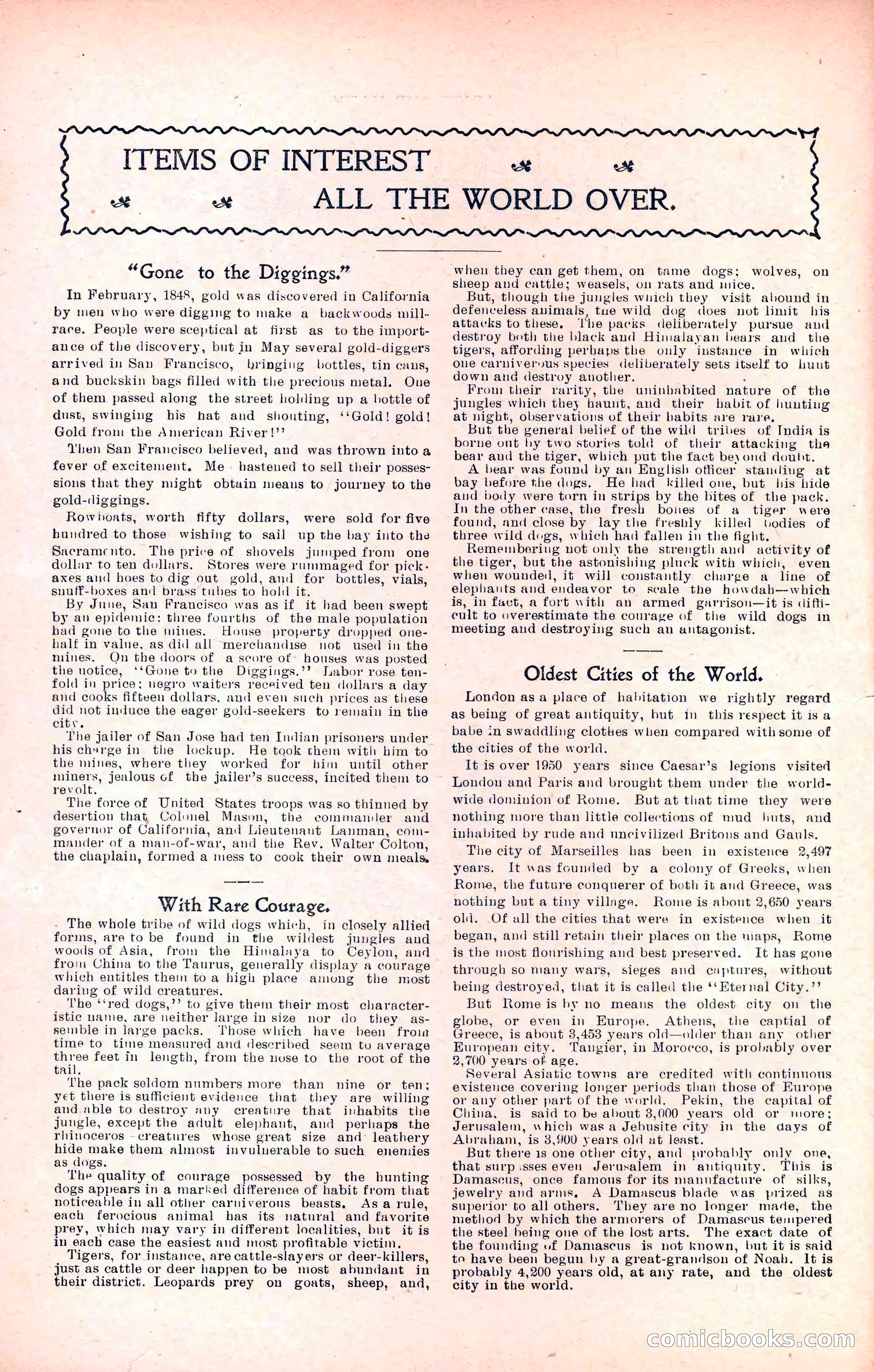
A restored page from Penny Dreadfuls, 1897. Page through the whole issue in the reader above.
📄 Transcribed text from this page (OCR, searchable)
Machine-transcribed from the original scan — historical spelling and the odd misread are preserved.
ITEMS OF INTEREST St Se “Gone to the Diggings,” In February, 1848, gold was discovered in California by men who ware digging to make a backwoods mill- race. People were sceptical at first as to the import- ance of the discovery, but in May several gold-diggers arrived in San Francisco, bringing bottles, tin cans, and buckskin bags filled with the precious metal. One of them passed along the street holding up a bottle of dust, swinging his hat and shouting, ‘*Gold! gold! Gold from the American River !”? Vhen San Francisco believed, and was thrown into a fever of excitement. Me. hastened to sell their posses- sions that they might obtain means to journey to the gold-diggings. Rowhboats, worth fifty dollars, were sold for five bundred to those wishing to sail up the bay into the Sacramento. The price of shovels jumped from one dollar to ten dollars. Stores were rummaged for pick- axes and hoes to dig out gold, and for bottles, vials, snuff-boxes and brass tubes to hold it. By June, San Francisco was as if it had been swept by an epidemic: three fourths of the male population bad gone to the mines. House property dropped one- half in value, as did all merchandise not used in the mines. On the doors of a score of houses was posted the notice, ‘Gone to the Diggings.’’? Jabor rose ten- fold in price; negro waiters received ten dollars a day and cooks fifteen dollars, and even such prices as these did not induce the eager gold-seekers to remain in the city. The jailer of San Jose had ten Indian prisoners under his charge in the lockup. He took them with him to the mines, where they worked for him until other miners, jealous of the jailer’s success, incited them to revolt. The force of United States troops was so thinned by desertion that, Colonel Mason, the commander and governor of California, and Lieutenant Lanman, com- mander of a man-of-war, and the Rev. Walter Colton, the chaplain, formed a mess to cook their own meals, — 7 With Rare Courage. - The whole tribe of wild dogs which, in closely allied forins, are to be found in the wildest jungles and woods of Asia, from the Himalaya to Ceylon, and froin China to the Taurus, generally display a courage which entitles them to a high place among the most daring of wild creatures. The ‘‘red dogs,’’ to give them their most character- istic uname, are neither large in size nor do they as- senible in large packs. Those which have been froi time to time measured and described seem tu average three feet in length, from the nuse to the root of the tail. The pack seldom numbers more than yet there is sufficient evidence that they are willing and able to destroy any ecreatire that inhabits the jungle, except the adult elephant, and perhaps the rhinoceros -creatures whose great size and leathery hide make them almost invulnerable to such enemies as dogs. The quality of courage possessed by the hunting dogs appears in a marked difference of habit from that noticeable in all other carniverons beasts, Asa rule, each ferocious animal has its natural and favorite prey, which may vary in different localities, but it is in each case the easiest and most profitable victim. Tigers, for instance, are cattle-slayers or deer-killers, just as cattle or deer happen to be most abundant in their district. Leopards prey on goats, sheep, and, nine or ten; ASP eS cS ALL THE WORLD OVER. MOS ALVA WF when they can get them, on tame dogs; wolves, on sheep and cattle; weasels, on rats and mice. But, though the jungles which they visit abound in defenceless animals, tue wild dog «does not limit his attacks to these, The packs deliberately pursue and destroy beth the black and Himalayan bears and the tigers, affording perbaps the only instance in which one Carniverous species deliberately sets itself to lhuut down ana destroy another. ‘ Frou their rarity, the uninhabited nature of the jungles which they haunt, and their babit of hunting at night, observations of their babits are rare, But the general belief of the wild tribes of India is borne ont by two stories told of their attacking the bear and the tiger, which put the fact beyond doubt. A bear was found by an English officer standing at bay before the dogs. He had killed one, but his hide and body were torn in ee by the bites of the pack. In the other case, the fresh bones of a tiger were found, and close by lay the freshly killed todies of three wild dogs, which had fallen in the fight. Remembering not only the strength and activity of the tiger, but the astonishing pluck with whicl, even when wounded, it will constantly charge a line of elephants and endeavor to scale the howdah—which is, in fact, a fort with an armed garrisou—it is difti- cult to overestimate the courage of the wild dogs in meeting aud destroying such an antagonist. Oldest Cities of the World. London as a place of habitation we rightly regard as being of great antiquity, but in this respect it is a babe in swaddling clothes when compared with some of the cities of the world. It is over 1950 years since Caesar’s legions visited London and Paris and brought them under the world- wide dominion of Rome. But at that time they were nothing more than little collections of mud huts, and inhabited by rude and uncivilized Britons and Gauls. The city of Marseilles has been in existence 2,497 years. It was founded by a colony of Greeks, when Rome, the future conquerer of both it and Greece, was nothing but a tiny village. Romie is about 2,650 years old. Of all the cities that were in existence when it began, and still retain their places on the maps, Rome is the most flourishing and best preserved. It has gone through so many wars, sieges and captures, without being destroyed, that it is called the ‘‘ Eternal City.’’ But Rome is by no means the oldest city on the globe, or even in Europe. Athens, the captial of Greece, is about 3,458 years old—older than any other European city. Tangier, in Morocco, is probably over 2,700 years of age. Several Asiatic towns are credited with continuous existence covering longer periods than those of Kurope or any other part of the world. Pekin, the capital of China, is said to be about 8,000 years old or more; Jerusalem, which was a Jebusite city in the days of Abraham, is 8,900 years old at least. But there 1s one other city, and probably only one, that surp:sses even Jerusalem in antiquity. This is Damascus, once famous for its manufacture of silks, jewelry and arms, A Damascus blade was prized as superior to all others. They are no longer made, the method by which the armorers of Damascus te:nipered the steel being one of the lost arts. The exact date of the founding of Damascus is not known, but it is said to have been begun by a great-grandson of Noah. It is probably 4,200 years old, at any rate, and the oldest city in the world. DOO) S}. (C@ (C@ 5}