
Penny Dreadfuls, 1897 · page 45 of 52
Army and Navy Weekly — page 45: what you’re looking at
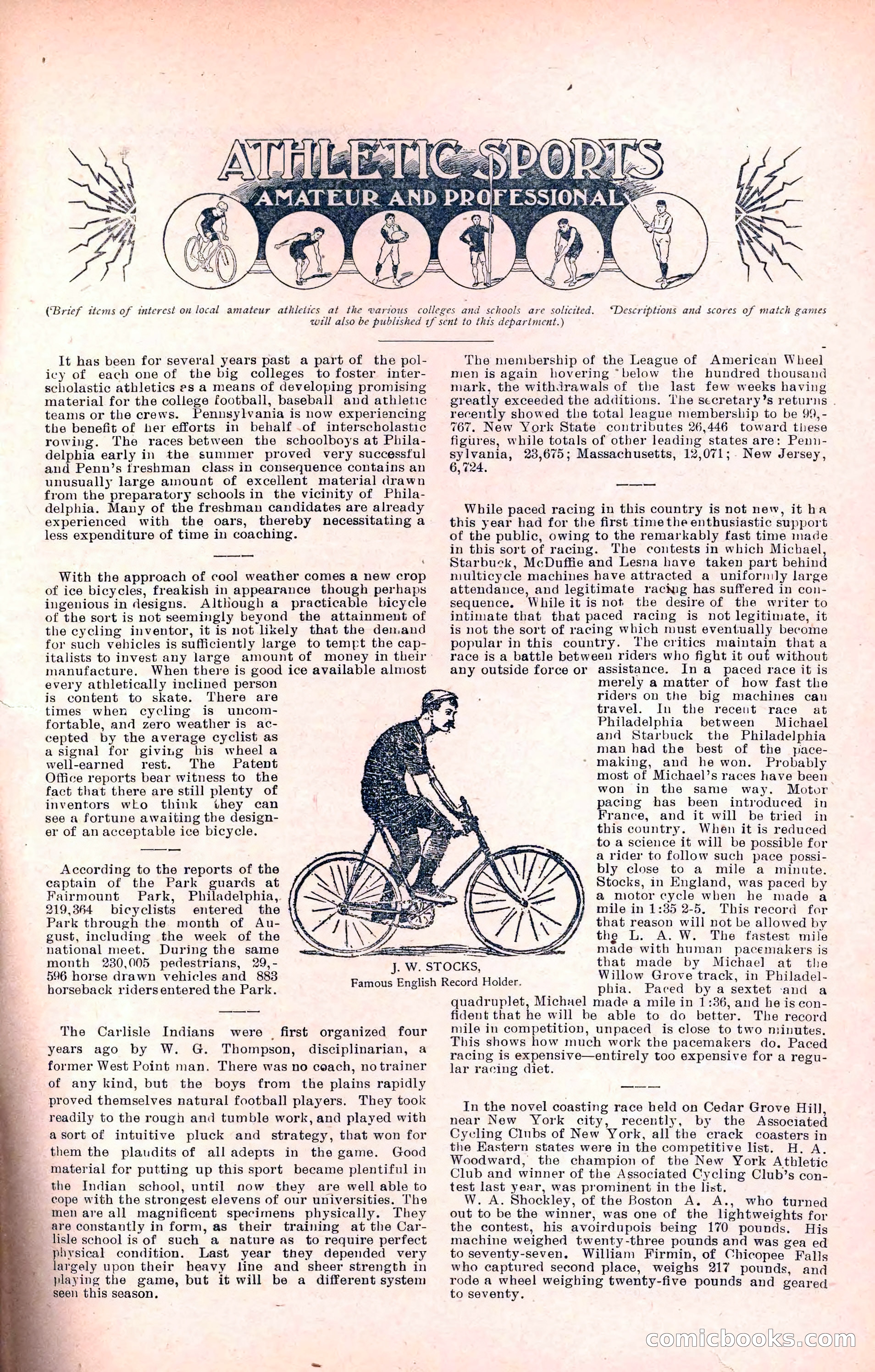
A restored page from Penny Dreadfuls, 1897. Page through the whole issue in the reader above.
📄 Transcribed text from this page (OCR, searchable)
Machine-transcribed from the original scan — historical spelling and the odd misread are preserved.
Ct ee i al A ! " / Dea [a | A ‘AND PROFESSIONAL<@a ea (Brief items of interest on local amateur athleitcs at the various colleges and schools are solicited. ‘Descriptions and scores of match games will also be published tf sent to thts depariment.) It has been for several years past a part of the pol- icy of each one of the big colleges to foster inter- scholastic athletics es a means of developing promising material for the college football, baseball and athletic teams or the crews. Pennsylvania is now experiencing the benefit of her efforts in behalf .of interscholastic rowing. The races between the schoolboys at Phila- delphia early in the summer proved very successful and Penn’s freshman class in consequence contains an unusually large amount of excellent material drawn from the preparatory schools in the vicinity of Phila- delphia. Many of the freshman candidates are already experienced with the oars, thereby necessitating a less expenditure of time in coaching. Se With the approach of coo] weather comes a new crop of ice bicycles, freakish in appearance though perhaps ingenious in designs. Although a_ practicable bicycle of the sort is not seemingly beyond the attainment of the cycling inventor, it is not likely that the demand for such vehicles is sufficiently large to tempt the cap- italists to invest any large amount of money in their. manufacture. When there is good ice available almost every athletically inclined person is content to skate. There are times when cycling is uncom- fortable, and zero weather is ac- cepted by the average cyclist as a signal for giving his wheel a well-earned rest. The Patent Office reports bear witness to the fact that there are still plenty of inventors wko think they can see a fortune awaiting the design- er of an acceptable ice bicycle. nd According to the reports of the captain of the Park guards at Fairmount Park, Philadelphia, 219,364 bicyclists entered the Park through the. month of Au- gust, including the week of the national meet. During the same month 230,005 pedestrians, 29,- 596 horse drawn vehicles and 883 horseback ridersentered the Park. The Carlisle Indians were | first organized four years ago by W. G. Thompson, disciplinarian, a former West Point man. There was no coach, no trainer of any kind, but the boys from the plains rapidly proved themselves natural football players. They took readily to the rough and tumble work, and played with asort of intuitive pluck and strategy, that won for them the plaudits of all adepts in the game. Good material for putting up this sport became plentiful in the Indian school, until now they are well able to cope with the strongest elevens of our universities. The men are all magnificent specimens physically. They are constantly in form, as their training at the Car- lisle school is of such a nature as_ to require perfect physical condition. Last year they depended very _ largely upon their heavy line and sheer strength in playing the game, but it will be a different system seen this season, Famous English Record Holder. The menibership of the League of American Wheel men is again hovering “below the hundred thousand mark, the withdrawals of the last few weeks having greatly exceeded the additions. The secretary’s returns . recently showed the total league membership to be 99,- 767. New York State contributes 26,446 toward these figures, while totals of other leading states are: Penn- sylvania, 23,675; Massachusetts, 12,071;- New Jersey, 6, 724. ee While paced racing in this country is not new, it ha this year had for the first time the enthusiastic support of the public, owing to the remarkably fast time made in this sort of racing. The contests in which Michael, Starbuck, McDuffie and Lesna have taken part behind nmiulticycle machines have attracted a unifornily large attendance, and legitimate racNg has suffered in con- sequence. While it is not the desire of the writer to intimate that that paced racing is not legitimate, it is not the sort of racing which must eventually become popular in this country. The critics maintain that a race is a battle between riders who fight it ouf without any outside force or assistance. In a_ paced race it is merely a matter of how fast the riders on the big machines cau travel. In the receiut race at Philadelphia between Michael and Starbuck the Philadelphia man had the best of the pace- * making, and he won. Probably most of Michael’s races have been won in the same way. Motor pacing has been introduced in France, and it will be tried in this country. When it is reduced to a science it will be possible for a rider to follow such pace possi- bly close to a mile a minute. Stocks, in England, was paced by a motor cycle when he made a mile in 1:35 2-5. This record for that reason will not be allowed by the L. A. W. The fastest mile made with human pacemakers is that made by Michael at the Willow Grove track, in Philadel- phia. Paced by a sextet ‘and a quadruplet, Michael made a mile in 1:36, and he is eon- fident that he will be able to do better. The record mile in competition, unpaced is close to two minutes. This shows how much work the pacemakers do. Paced racing is expensive—entirely too expensive for a regu- lar racing diet. In the novel coasting race held on Cedar Grove Hill, near New York city, recently, by the Associated Cycling Clubs of New York, all the crack coasters in the EKastern states were in the competitive list. H. A. Woodward, the champion of the New York Athletic Club and winner of the Associated Cycling Club’s con- test last year, was prominent in the list. W. A. Shockley, of the Boston A. A., who turned out to be the winner, was one of the lightweights for the contest, his avoirdupois being 170 pounds. His machine weighed twenty-three pounds and was gea ed to seventy-seven, William Firmin, of Chicopee Falls who captured second place, weighs 217 pounds, and rode a wheel weighing twenty-five pounds and geared to seventy. COnmmiclbooks (C@