
Penny Dreadfuls, 1897 · page 47 of 52
Army and Navy Weekly — page 47: what you’re looking at
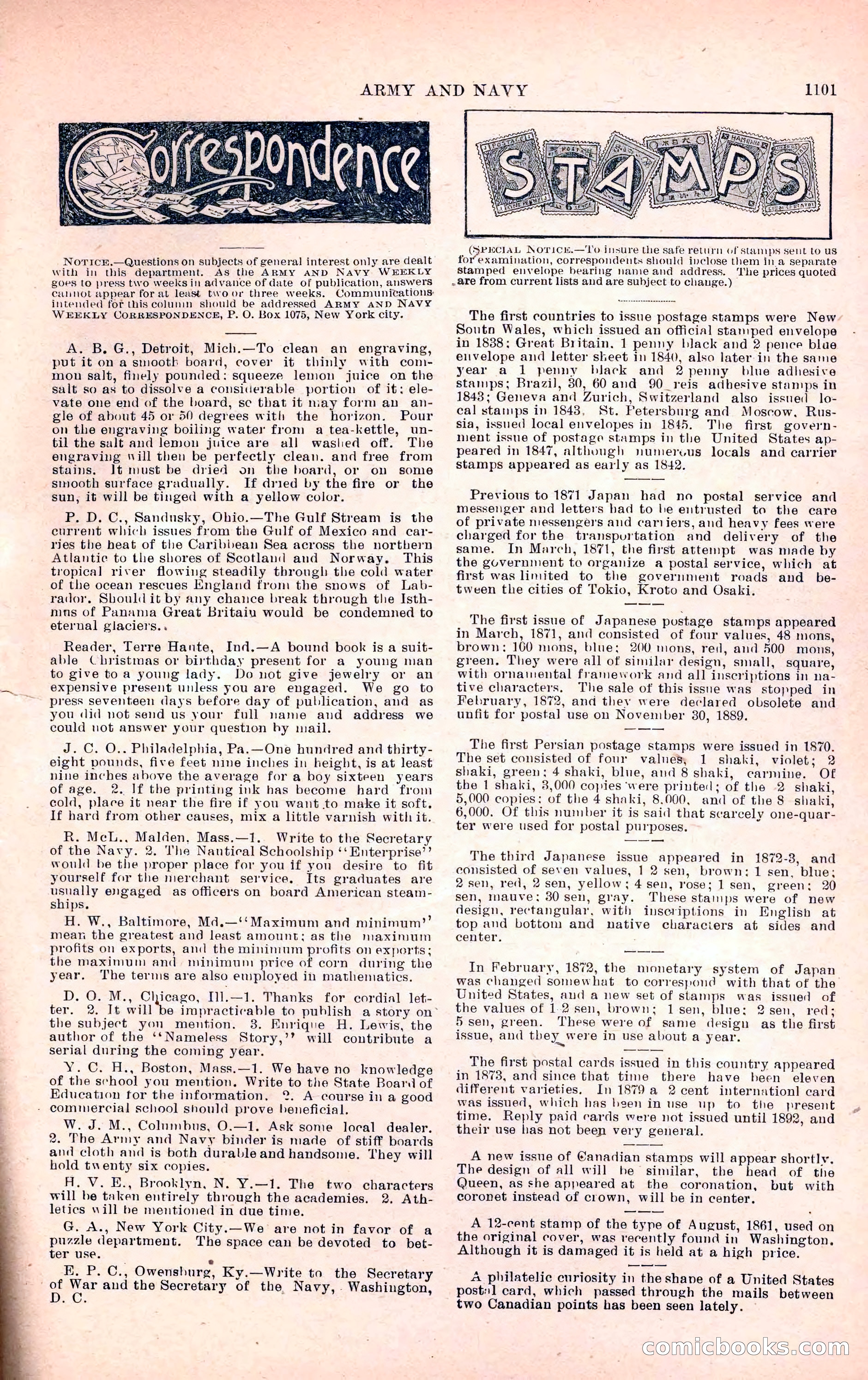
A restored page from Penny Dreadfuls, 1897. Page through the whole issue in the reader above.
📄 Transcribed text from this page (OCR, searchable)
Machine-transcribed from the original scan — historical spelling and the odd misread are preserved.
ARMY AND NAVY NorTice.—Questions on subjects of general interest only are dealt with in this department. As the ARMY AND NAvyY WEEKLY goes to press two weeks in advance of date of publication, answers cannot appear for al least twoor three weeks. Communications: intended fot this colunin should be addressed ARMY AND NAVY WEEKLY CORRESPONDENCE, P. O. Box 1075, New York city. A. B. G., Detroit, Mich.—To clean an engraving, put it on a smooth board, cover it thinly with com- mou salt, finely pounded: squeeze lemon juice on the salt so as to dissolve a considerable portion of it: ele- vate one end of the board, sc that it niay form an an- gle of about 45 or 50 degrees with the horizon. Pour on the engraving boiling water from a tea-kettle, un- til the salt and lemon juice are all waslied off. The engraving Will then be perfectly clean. and free from stains. It must be dried on the board, or on some smooth surface gradually. If dried by the fire or the sun, it will be tinged with a yellow color. P. D. C., Sandusky, Ohio.—The Gulf Stream is the eurrent which issues from the Gulf of Mexico and car- ries the heat of the Caribbean Sea across the northern Atlantie to the shores of Scotland and Norway. This tropical river flowing steadily through the cold water of the ocean rescues England from the snows of Lab- rador. Should it by any chance break through the Isth- mus of Panama Great Britaiu would be condemned to eternal glaciers. . Reader, Terre Hante, Ind.—A bound book is a suit- able Christmas or birthday present for a young man to give toa young lady. Do not give jewelry or an expensive present unless you are engaged. We go to press seventeen days before day of publication, and as you did not send us your full name and address we could not answer your question by mail. J.C. O.. Philadelphia, Pa.—One hundred and thirty- eight pounds, five feet nine inches in height, is at least nine inches above the average for a boy sixteen years of age. 2. If the printing ink has become hard from cold, place it near the fire if you want .to make it soft. If hard from other causes, mix a little varnish with it. R. MchL., Malden, Mass.—1. Write to the Secretary of the Navy. 2, I'he Nautical Schoolship ‘‘ Enterprise’’ would be the proper place for you if yon desire to fit yourself for the merchant service. Its graduates are usually engaged as officers on board American steam- ships. H. W., Baltimore, Md.—‘‘Maximum and minimum’’ mean the greatest and least amount; as the maximum profits on exports, and the minimum profits on exports; the maximum and) minimum price of corn during the year. The ternis are also employed in mathematics. D. O. M., Chicago, 1].—1. Thanks for cordial let- ter. 2. It will the subject yon mention. 3. Enrique H. Lewis, the author of the ‘‘Nameless Story,’’ will contribute a serial during the coming year. Y.C. H., Boston, Mass.—1. We have no knowledge of the school you mention. Write to the State Board of Education for the information, 2. A course in a good commercial school should prove beneficial. W. J. M., Columbus, O.—1. Ask some local dealer. 2. The Army and Navy binder is made of stiff boards and cloth and is both durable and handsome. They will hold twenty six copies. H. V. E., Brooklyn, N. Y.—1. The two characters will be taken entirely through the academies. 2, Ath- letics will be mentioned in due time. G. A., New York City.—We are not in favor of a puzzle department. The space can be devoted to bet- ter use. ew Poo. Owenshurg, Ky.—Write to the Secretary s ne aud the Secretary of the, Navy, . Washington, e impracticable to publish a story on” (QPKCIAL Norick.—To insure the safe return Of slanips sent to us for examination, correspondents should inelose them ina separate Stamped envelope bearing name and address. ‘The prices quoted .are from current lists and are subject to chauge.) Bee - 322 pt ewenescen The first countries to issue postage stamps were New Soutn Wales, which issued an official stamped envelope in 1838; Great Britain, 1 penny black and 2 pence blue elvelope and letter sheet in 1840, also later in the same year a 1 penny black and 2 penny blue adhesive stamps; Brazil, 30, 60 and 90_reis adhesive stamps in 1843; Geneva and Zurich, Switzerland also issued lo- cal stamps in 1843, St. Petersburg and Moscow, Rus- sia, issued local envelopes in 1845. The first govern- nient issue of postage stamps in the United States ap- peared in 1847, although numercus locals and carrier stamps appeared as early as 1842. i es Previous to 1871 Japan had no postal service and messenger and letters bad to he entrusted to the care of private messengers and cariiers, and heavy fees were charged for the transpurtation and delivery of the same. In March, 1871, the first attempt was made by the government to organize a postal service, which at first was limited to the government roads and be- tween the cities of Tokio, Kroto and Osaki. The first issue of Japanese pustage stamps appeared in March, 1871, and consisted of four values, 48 mons, brown: 160 mons, blue; 200 mons, red, and 500 mons, green, They were all of similar design, small, square, with ornamental framework and all inscriptions in na- tive characters. The sale of this issue was stopped in February, 1872, and they were declared obsolete and unfit for postal use on November 30, 1889. —_—_ The first Persian postage stamps were issued in 1870. The set consisted of four valnes, 1 shaki, violet; 2 shaki, green: 4 shaki, blue, and 8 shaki, carmine. Of the 1 shaki, 8,000 copies ‘were printed; of the 2 shaki, 5,000 copies: of the 4 shaki, 8.000, and of the 8 shal, 6,000. Of this number it is said that scarcely one-quar- ter were used for postal purposes. —— | The third Japanese issue appeared in 1872-3, and consisted of seven values, 1 2 sen, brown: 1 sen, blue; 2 sen, red, 2 sen, yellow; 4 sen, rose; 1 sen, green: 20 sen, mauve: 30 sen, gray. These stamps were of new design, rectangular, with inscriptions in English at top and bottom and native characters at sides and center. In February, 1872, the monetary system of Japan was changed somewhat to correspond with that of the United States, aud a new set of stamps was issued of the values of 1.2 sen, brown; 1 sen, blue: 2sen, red; 5 sen, green. These were of same design as the first issue, and they _were in use about a year. The first postal cards issued in this country appeared in 1873, and since that time there have heen eleven different varieties. In 1879 a 2 cent internation] card was issued, which has been in use up to the present time. Reply paid cards were not issued until 1892, and their use has not been very general. A new issue of Ganadian stamps will appear shortly. The design of all will be similar, the head of the Queen, as she appeared at the coronation, but with coronet instead of crown, will be in center. A 12-cent stamp of the type of August, 1861, used on the original cover, was recently found in Washington, Although it is damaged it is held at a high price. a philatelic curiosity in the shane of a United States postil card, which passed through the mails between two Canadian points has been seen lately. CoOnniclooolkks.com