
Penny Dreadfuls, 1881 · page 29 of 38
Alice Bridge of Norwich — page 29: what you’re looking at
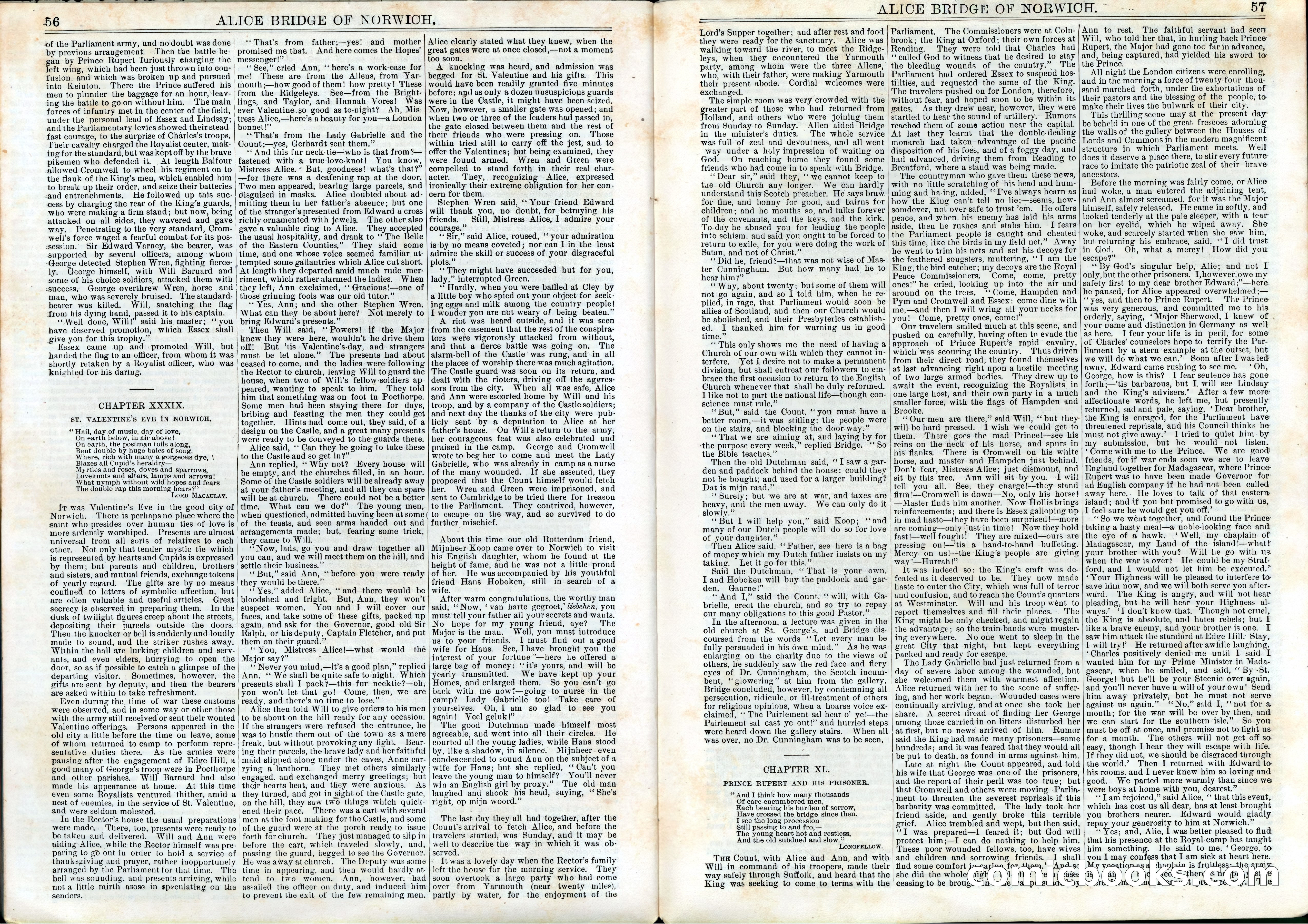
A restored page from Penny Dreadfuls, 1881. Page through the whole issue in the reader above.
📄 Transcribed text from this page (OCR, searchable)
Machine-transcribed from the original scan — historical spelling and the odd misread are preserved.
56 ALICE BRIDGE OF NORWICH, of the Parliament army, and no doubt was done by previous arrangement. _ Then the battle be- gan by Prince Rupert furiously charging the left wing, which had been just thrown into con: fusion, and which was broken up and pursued into Keinton. There the Prince suffered his men to plunder the baggage for an hour, leav- ing the battle to goon without him, The main forces of infantry met in the center of the field, under the personal lead of Essex and Lindsay; and the Parliamentary levies showed their stead- fast courage, to the surprise of Charles’s troops. Lheir cavalry charged the Royalist center, mak- ing for the standard, but was kept off by the brave pikemen who defended it. At length Balfour allowed Cromwell to wheel his regiment on to the flank of the King’s men, which enabled him to break up their order, and seize their batteries and entrenchments. He followed up this suc- cess by charging the rear of the King’s guards, who were making a firm stand; but now, being attacked on all sides, they wavered and gave way. Penetrating to the very standard, Crom- weil’s force waged a fearful combat for its pos- session. Sir Edward Varney, the bearer, was supported by several officers, among whom George detected Stephen Wren, fighting fierce- ly. George himself, with Will Barnard and some of his choice soldiers, attacked them with success, man, who was severely bruised. The standard- bearer was killed. Will, snatching the flag from his dying hand, passed it to bis captain. ‘“©Well done, Will!” said his master; ‘‘ you have deserved promotion, which Essex shall give you for this trophy.” Essex came up and promoted Will, but handed the flag to an officer, from whom it was shortly retaken by a Royalist officer, who was knighted for his daring, CHAPTER XXXIX. 8T. VALENTINE’S EVE {N NORWICH. “Hail, day of music, day of love, On earth below, in air above! On earth, the postman tvils along, Bent double by huge bales of song, Where, rich with many a gorgeous dye, \ Blazes all Cupid's heraldry-— Myrtles and roses, doves and sparrows, Loveknots and altars, lamps and arrows! What nymph without wild hopes and fears The double rap this morning hears?” Lorp Macautay, Iv was Valentine’s Eve in the good city of Norwich. There is perhaps no place where the saint who presides over human ties of love is more ardently worshiped. Presents are almost universal from all sorts of relatives to each other. Not only that tender mystic tie which is represented by hearts and Cupids is expressed by them; but parents and children, brothers and sisters, and mutual friends, exchange tokens of yearly regard. The gifts are by no means confined to letters of symbolic affection, but are often valuable and useful articles. Great secrecy is observed in preparing them. In the dusk of twilight figures creep about the streets, depositing their parcels outside the doors. Then the knocker or bell is suddenly and loudly made to sound, and the striker rushes away. Within the hall are lurking children and serv- ants, and even elders, hurrying to open the door, so as if possible to catch a glimpse of the departing visitor. Sometimes, however, the gifts are sent by deputy, and then the bearers | are asked within to take refreshment. Even during the time of war these customs were observed, and in some way or other those with the army still received or sent their wonted Valentine offerings, Persons appeared in the old city a little before the time on leave, some | of whom returned to camp to perform repre- sentative duties there. As the armies were pausing after the engagement of Edge Hill, a good many of George’s troop were in Pocthorpe and other parishes. Will Barnard had also made his appearance at home, At this time even some Royalists ventured thither, amid a nest of enemies, in the service of St. Valentine, and were seldom molested. In the Rector’s house the usunl preparations were made. There, too, presents were ready to be takeu and delivered. Will and Ann were aiding Alice, while the Rector himself was pre- paring to god out in order to hold a service of thanksgiving and prayer, rather inopportunely arranged by the Parliament for that time. The bell was sounding, and presents arriving, while not a little mirth arose in speculating on the senders, George overthrew Wren, horse and, and mother And here comes the Hopes’ “That's from father;—yes! promised me tbat. “messenger!” “See,” cried Ann, ‘‘here’s a work-case for me! These are from the Allens, from Yar- mouth ;—how good of them! how pretty! These from the Ridgeleys. See—from the Bright- lings, and Taylor, and Hannah Vores! Was ever Valentine.so good as to-night? Ah, Mis- tress Alice,—here’s a beauty for you—a London bonnet!” ‘‘That’s from the Lady Gabrielle and the Count;—yes, Gerhardt sent them.” ‘« And this fur neck-tie—who is that from?— .fastened with a true-love-knot! You know, Mistress Alice. ~ But, goodness! what’s that?” |—-for there was a deafening rap at the door. Two men appeared, bearing large parcels, and disguised in masks. Alice doubted about ad- mitling them in her father’s absence; but one of the stranger's presented from Edward a cross richly ornamented with jewels. The other also gave a valuable ring to Alice. They accepted the usual hospitality, and drank to ‘‘ The Belle of the Hastern Counties,” They staid some time, and one whose voice seemed familiar at- tempted some gallantries which Alice cut short. At length they departed amid much rude mer- riment, which rather alarmed the ladies. When they left, Ann exclaimed, ‘‘ Gracious!—one of those grinning fools was our old tutor.” “Yes, Ann; and the other Stephen Wren. What can they be about here?’ Not merely to bring Edward’s presents.” Then Will said, ‘‘ Powers! if the Major | knew they were here, wouldn’t he drive them off! But ’tis Valentine’s-day, and strangers ‘Inust be let alone.” The presents had about ‘ceased to come, and the ladies were following the Rector to church, leaving Will to guard the house, when two of Will’s fellow-soldiers ap- peared, wanting to speak to him. They told him that something was on foot in Pocthorpe. Some men had been staying there for days, bribing and feasting the men they could get together, Hints had come out, they said, of a design on the Castle, and a great many presents ‘| were ready to be conveyed to the guards there. Alice said, ‘‘ Can they be going to take these to the Castle and so get in?” Ann replied, ‘‘Why not? Every house will be empty, and the churches filled, in an hour. Some of the Castle soldiers will be already away at your father’s meeting, and all they can spare will beat church. There could not be a better time. What can we do?” The young men, when questioned, admitted having been at some of the feasts, and seen arms handed out and arrangements made; but, fearing some trick, ‘they came to Will. ‘“Now, lads, go you and draw together all you can, and we will meet them on the hill, and settle their business.” “But,” said Ann, ‘‘ before you were ready they would be there.” “Yes,” added Alice, ‘‘and there would be bloodshed and fright. But, Ann, they won't suspect women. ou and I will cover our faces, and take some of these gifts, packed up again, and ask for the Governor, good old Sir Ralph, or his deputy, Captain Fletcher, and put | them on their guard.” “You, Mistress Alicel—what would thé Major say?” : “ Never you mind,—it’s a good plan,” replied Ann. ‘“ We shall be quite safe to-night.. Which presents shall I pack?—this fur necktie?—oh, you wou't let that go! Come, then, we are ready, and there’s no time to lose.” Alice then told Will to give orders to his men | to be about on the hill ready for any occasion. If the strangers were refused the entrance, he | was to hustle them out of the town as a mere |freak, but without provoking any fight. Bear. ing their parcels, the brave lady and her faithful | maid slipped along under the eaves, Anne car- rying a lanthorn, They met others similarly / engaged. and exchanged merry greetings; but _their hearts beat, and they were anxious. As they turned, and got in sight of the Castle gate, on the hill, they saw two things which quick- ‘ened their pace. There wasa cart with several men at the foot making for the Castle, and some of the guard were at the porch ready to issue forth forchurch. They just managed to slip in before the cart, which traveled slowly, and, passing the guard, begged to see the Governor. He was away atchurch. The Deputy was some |- time in appearing, and then would hardly at- tend to two women. Ann, however, had assailed the officer on duty, and induced him to prevent the exit of the few remaining men. Alice clearly stated what they knew, when the great gates were at once closed,—not a moment too soon. A knocking was heard, and admission was begged for St. Valentine and his gifts. This would have been readily granted five minutes before; ayd as only a dozen unsuspicious guards were in the Castle, it might have been seized. Now, however, a smaller gate was opened; and when two or three of the leaders had passed in, the gate closed between them and the rest of their friends who were pressing on. Those within tried still to carry off the jest, and to offer the Valentines; but being examined, they were found armed. Wren and Green were compelled to stand forth in their real char- acter. They, recognizing Alice, expressed ironically their extreme obligation for her con- cern for them. Stephen Wren said, ‘‘ Your friend Edward will thank you, no doubt, for betraying his friends. Still, Mistress Alice, I admire your courage.” “Sir,” said Alice, roused, ‘‘ your admiration is by no means coveted; nor can I in the least admire the skill or success of your disgraceful plots.” ‘«They might have succeeded but for you, lady,” interrupted Green. ‘‘Hardly, when you were baffled at Cley by a little boy who spied out your object for seek- ing eggs and milk among the country people! I wonder you are not weary of being beaten.” A riot was heard outside, and it was seen from the casement that the rest of the conspira- tors were vigorously attacked from without, and that a fierce baitle was going on. The alarm-bell of the Castle’ was rung, and in all the places of worship there was much agitation, The Castle guard was soon on its return, and dealt with the rioters, driving off the agyres- sors from the city. When all was safe, Alice and Ann were escorted home by Will and his troop, and by a company of the Castle soldiers; and next day the thanks of the city were pub- licly sent by a deputation to Alice at her father’s house. On Will’sreturn to the army, her courageous feat was also celebrated and praised in the camp. George and Cromwell wrote to beg her to come and meet the Lady Gabrielle, who was already in camp asa nurse of the many wounded. If she assented, they proposed that the Count himself would fetch her. Wren and Green were imprisoned, and sent to Cambridge to be tried there for treason tothe Parliament. They contrived, however, to escape on the way, and so survived to do further mischief. About this time our old Rotterdam friend, Mijnheer Koop came over to Norwich to visit his English daughter, whom he found at the height of fame, and he was not a little proud of her. He wasaccompanied by his youthful friend Hans Hoboken, still in search of a wife. After warm congratulations, the worthy man said, ‘‘ Now, ‘van harte gegroet,’ Webchen, you roust tell your father all your secrets and wants. No hope for my young friend, aye? The Major is the man. Well, you must introduce us to your friends. I must find out a good wife for Hans. See, [have brought you the interest of your fortune”—here he offered a large bag of money: ‘'it’s yours, and will be yearly transmitted. We have kept up your Homes, and enlarged them. So you can’t go back with me nowf—going to nurse in the camp? Lady Gabrielle too! Take care of yourselves. Oh, I am so glad to see you again! Veel geluk!” The good Dutchman made himself most agreeable, and went into all their circles. He courted all the young ladies, while Hans stood by, like a shadow, in silence. Mijnheer even condescended to sound Ann on the subject of a wife for Hans; but she replied, ‘‘Can’t you leave the young man to himself? You'll never win an English girl by proxy.” The old man laughed and shook his head, saying, ‘‘ She’s right, op mija woord.” The last day they all had together, after the Count’s arrival to fetch Alice, and before the travelers started, was Sunday, and it may be well to describe the way in which it was ob- served. Tt was a lovely day when the Rector’s family left the house for the morning service. They soon overlook a large party who had come over from Yarmouth (near twenty miles), partly by water, for the enjoyment of the ALICE BRIDGE OF NORWICH.” -- 57 Lord’s Supper together; and after rest and food they were ready for the sanctuary. Alice was walking toward the river, to meet the Ridge- leys, when they encountered the Yarmouth party, among whom were the three Allens,’ who, with their father, were making Yarmouth their present abode. Cordial welcomes were exchanged. The simple room was very crowded with the greater part of those who had returned from Holland, and others who were joining them from Sunday to Sunday. Allen aided Bridge in the minister’s duties. The whole service was full of zeal and devoutness, and all went way under a holy impression of waiting on God. On reaching home they found some friends who had come in to speak with Bridge. “Dear sir,” said they, ‘“‘ we cannot keep to tue old Church any longer. We can hardly understand this Scotch preacher. He says braw. for fine, and bonny for good, and bairns for children; and he mouths so, and talks forever of the covenants, and the keys, and the kirk. To-day he abused you for leading the people into schism, and said you ought to be forced to return to exile, for you were doing the work of Satan, and not of Christ.” “Did he, friend?—that was not wise of Mas- ter Cunningham. But how many had he to hear him?” “Why, about er but some of them will not go again, and so I told him, when he re- plied, in rage, that Parliament would soon be allies of Scotland, and then our Church would be abolished, and their Presbyteries establish- ed. I thanked him for warning us in good time.” “«This only shows me the need of having a Church of our own with which they cannot in- terfere, Yet I desire not to make a permanent division, but shall entreat our followers to em- brace the first occasion to return to the English Church whenever that shall be duly reformed. I like not to part the national life—though con- science must rule.” But,” said the Count, ‘‘you must have a better room,—it was stifling; the people were on the stairs, and blocking the door-way.” “That we are aiming at, and laying by for -the purpose every week,” replied Bridge. ‘* So the Bible teaches.” Then the old Dutchman said, ‘‘I saw a gar- den and paddock behind the house: could they not be bought, and used for a larger building? Dat is mijn raad.” ‘«Surely; but we are at war, and taxes are heavy, and the men away. We can only do it slowly.” ‘‘But 1 will help you,” said Koop; ‘and many of our Dutch people will do so for love of your daughter.” : Then Alice said, ‘‘ Father, see here isa bag of money which my Dutch father insists on my taking. Let it go for this.” Said the Dutchman, ‘‘That is your own. I and Hoboken will buy the paddock and gar- den, Gaarne!” ‘And I,” said the Count, ‘will, with Ga- prielle, erect the church, and so try to repay our many obligations to this good Pastor.” In the afternoon, a lecture was given in the old church at St. George's, and Bridge dis- coursed from the words ‘‘Let every man be fully persuaded in his own mind.” As he was enlarging on the charity due to the views of others, he suddenly saw the red face and fiery eyes of Dr. Cunningham, the Scotch incum- bent, ‘‘glowering” at him from the gallery. Bridge concluded, however, by condemning all persecution, ridicule, or ill-treatment of others for religious opinions, when a hoarse voice ex- claimed, ‘‘ The Pairlement sal hear o’ ye!—the Pairlement sal cast ye out!’ and hurried steps were heard down the gallery stairs. When all was over, no Dr. Cunningham was to be seen. CHAPTER XL. PRINCE RUPERT AND HIS PRISONER. “ And I think how many thousands Of care-encumbered men, Each bearing his burden of sorrow, Have crossed the bridge since then. I see the long procession Still passing to and fro,— The young heart hot and restless, And the old subdued and slow.”’ LONGFELLOW. Tue Count, with Alice and Ann, and with Will in command of his troopers, made their way safely through Suffolk, and heard that the King was seeking to come to terms with the Parliament, The Commissioners were at Coln- brook; the King at Oxford; their own forces at Reading. They were told that Charles had “called God to witness that he desired to stay the bleeding wounds of the country.” The Parliament had ordered Essex to suspend hos- tilities, and requested the same of the King. The travelers pushed on for London, therefore, without fear, and hoped soon to be within its gates. As they drew near, however, they were startled to hear the sound of artillery. Rumors reached them of some action near the capital. At last they learnt that the double. dealing monarch had taken advantage of the pacific disposition of his foes, and of a foggy day, and had advanced, driving them from’ Reading to Brentford, where a stand was being made. The countryman who gave them these news, with no little scratching of his head and hum- ming and ha-ing, added, ‘‘ I’ve always hearn as how the King can’t tell no lie;—seems, how- somdever, not over-safe to trust em. He offers peace, and when. his enemy has laid his arms aside, then he rushes and stabs him. I fears the Parliament people is caught and cheated this time, jie the birds in my field net.” Away he went to trim his nets and set his decoys for the feathered songsters, muttering, ‘‘I am the King, the bird catcher; my decoys are the Royal Peace Commissioners. Come, come, pretty ones!” he cried, looking up into the air and around on the trees. ‘‘ Come, Hampden and Pym and Cromwell and Essex: come dine with me,—and then I will wring all your necks for you! Come, pretty ones, come!” Our travelers smiled much at this scene, and pushed on carefully, having often tn evade the approach of Prince Rupert’s rapid cavalry, which was scouring the country. Thus driven from their direct road, they found themselves at last advancing right upon a hostile meeting of two large armed bodies. They drew up to await the event, recognizing the Royalists in one large host, and their own party in a much smaller force, with the flags of Hampden and Brooke. “Our men are there,” said Will, ‘‘ but they will be hard pressed. I wish we could get to them. There goes the mad Prince!—see his reins on the neck of his horse, and spurs in his flanks, There is Cromwell on his white horse, and master and Hampden just behind. Don’t fear, Mistress Alice; just dismount, and sit by this tree. Ann will sit by you. I will tell you all, See, they charge!—they stand | firm!—Cromwell is down—No, only his horse! —Master finds him another. Now Hollis brings reinforcements; and there is Essex galloping up /in mad haste—they have been surprised!—more are Ccoming—only just in time! Now they hold fast!—well fought! They are mixed—ours are pressing on!—’tis a hand-to-hand buffeting. Mercy on us!—-the King’s people are giving way !—Hurrah!” It was indeed so: the King’s craft was de- feated as it deserved to be. They now made haste to enter the City, which was full of terror and confusion, and to reach the Count’s quarters at Westminster. Will and his troop wént to report themselves and fill their places. The King might be only checked, and might regain the advantage; so the train-bands were muster- ing everywhere. No one went to sleep in the great Ci