
Penny Dreadfuls, 1881 · page 30 of 38
Alice Bridge of Norwich — page 30: what you’re looking at
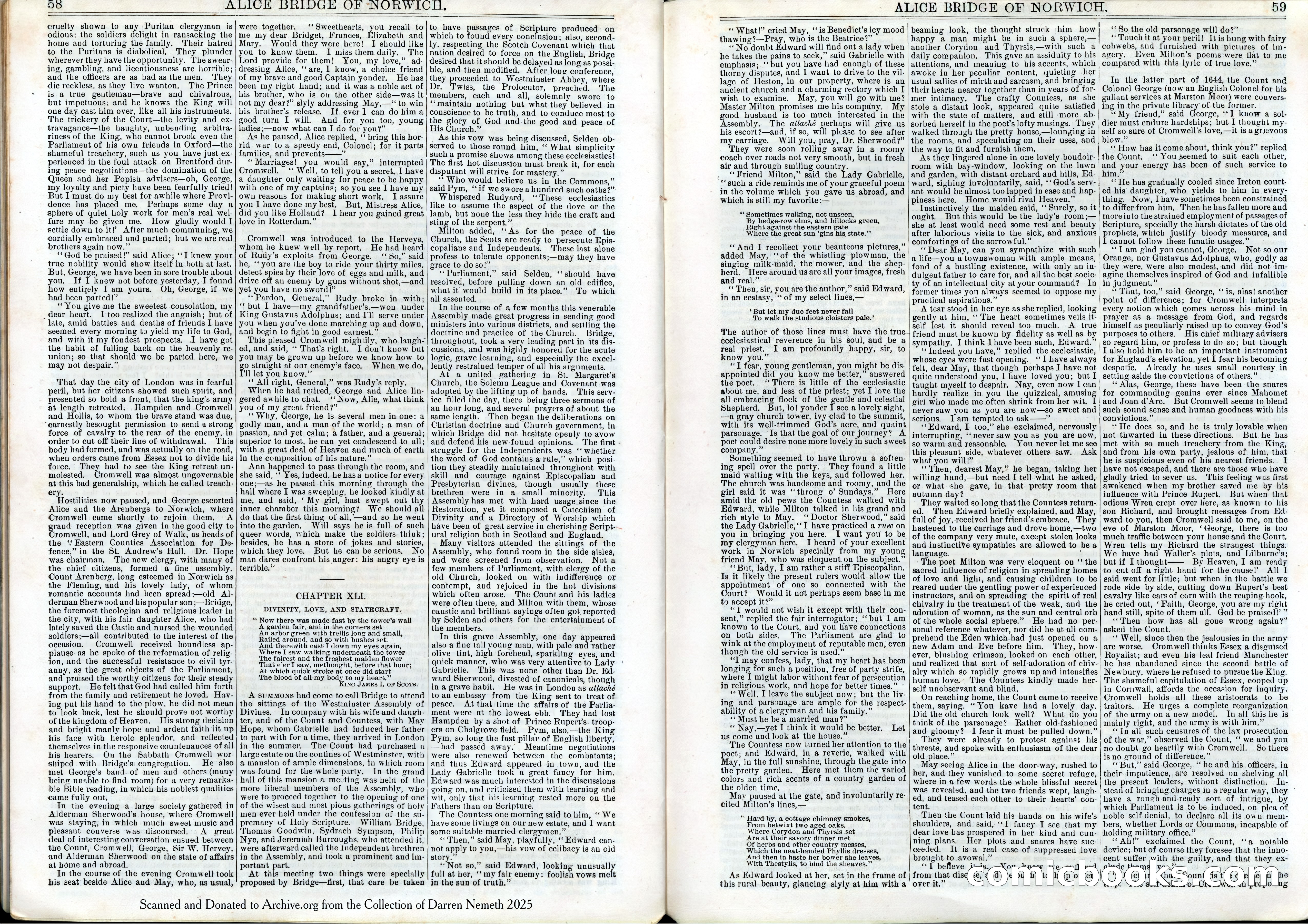
A restored page from Penny Dreadfuls, 1881. Page through the whole issue in the reader above.
📄 Transcribed text from this page (OCR, searchable)
Machine-transcribed from the original scan — historical spelling and the odd misread are preserved.
_ dear heart. cruelty shown to any Puritan clergyman is odious: the soldiers delight in ransacking the home and torturing the family. Their hatred to the Purilans is diabolical. They plunder wherever they have the opportunity. The swear- ing, gambling, and licentiousness are horrible; and the officers are as bad asthe men. They die reckless, as they live wanton. The Prince is a true gentleman—brave and chivalrous, but impetuous; and he knows the King will one day cast him over, like all his instruments. The trickery of the Court—the levity and ex- travagance—the haughty, unbending arbitra- riness of the King, who cannot brook even the Parliament of his own friends in Oxford—the shameful treachery, such as you have just ex- perienced in the foul attack on Brentford dur- ing peace negotiations—the domination of the Queen and her Popish advisers—oh, George, my loyalty and piety have been fearfully tried! But I must do my best for awhile where Provi- dence has placed me. Perhaps some day a sphere of quiet holy work for men’s real wel- fare may be given me. How gladly would I settle down to it!) After much communing, we cordially embraced and parted; but we are real brothers ayain now.” ““God be praised!” said Alice; ‘(I knew your true nobility would show itself in both at last. But, George, we have been in sore trouble about you. If I knew not before yesterday, I found how entirely I am yours. Oh, George, if we had been parted!” “You give me the sweetest consolation, my I too realized the anguish; but of late, amid battles and deaths of friends I have seemed every morning to yield my life to God, and with it my fondest prospects. .I have got the habit of falling back on the heavenly re- union; so that should’ we be parted here, we may not despair.” That day the city of London was in fearful peril, but her citizens showed such spirit, and presented so -bold a front, that the king’s army at length retreated. Hampden and Cromwell and Hollis, to whom the brave stand was due, earnestly besought permission to send a strong force of cavalry to the rear of the enemy, in order to cut off their line of withdrawal. This body had formed, and was actually on the road, when orders came from Essex not to divide his force. They had to see the King retreat un- molested. Cromwell was almost ungovernable at this bad generalship, which he called treach- ery. Hostilities now paused, and George escorted Alice and the Arenbergs to Norwich, where Cromwell came shortly to rejoin them. A grand reception was given in the good city to romwell, and Lord Grey of Walk, as heads of the ‘{ Eastern Counties Association for De- fence,” in the St. Andrew's Hall. Dr. Hope was chairman. The new clergy, with many of the chief citizens, formed a fine assembly. Count Arenberg, long esteemed in Norwich as the Fleming, and his lovely lady, of whom romantic accounts had been spread;—old Al- derman Sherwood and his popular son ;—Bridge, the foremost theologian and religious leader in the city, with his fair daughter Alice, who had lately saved the Castle and nursed the wounded soldiers;—all contributed to the interest of the occasion. Cromwell received boundless ap- plause- as he spoke of the reformation of relig- jon, and the successful resistance to civil tyr: anny, as the great objects of the Parliament, and praised the worthy citizens for their steady support. He felt that God had called him forth from the family and retirement he loved, Hay- ing put his hand to the plow, he did not mean to look back, lest he should prove not worthy of the kingdom of Heaven. His strong decision and bright manly hope and ardent faith lit up his face with heroic splendor, and reflected themselves in tlie responsive countenances of all his hearers. On the Sabbath Cromwell wor- shiped with Bridge’s congregation. He also met George’s band of men and others (many being unable to find room) for a very remarka- ble Bible reading, in which his noblest qualities came fully out. In the evening a large society gathered in Alderman Sherwood’s house, where Cromwell was staying, in which much sweet music and pleasant converse was discoursed. A great deal of interesting conversation ensued between the Count, Cromwell], George, Sir W. Hervey, and Alderman Sherwood on the state of affairs at home and abroad. In the course of the evening Cromwell took his seat beside Alice and May, who, as usual, were together. ‘‘Sweethearts, you recall to me my dear Bridget, Frances, Hlizabeth and Mary. Would they were here! I should like you to know them. I miss them daily. The Lord provide for them! You, my love,” ad- dressing Alice, ‘‘are, I know, a choice friend of my brave and good Captain yonder. He has been my right hand; and it was a noble act of his brother, who is on the other side—was it not my dear?” slyly addressing May,—‘‘ to win his brother’s release. If ever 1 can do hima good turn I will. And for you too, young ladies ;—now what can IJ do for you?” As he paused, Alice replied, ‘‘ bring this hor- rid war to a speedy end, Colonel; for it parts families, and prevents——” “Marriages! you would say,” interrupted Cromwell. ‘‘ Well, to tell you a secret, I have a daughter only waiting for peace to be happy with one of my captains; so you see I have my own reasons for making short work. I assure you I have done my best. But, Mistress Alice, did you like Holland? I hear you gained great love in Rotterdam.” Cromwell was introduced to the Herveys, whom he knew well by report. He had heard of Rudy’s exploits from George. ‘‘ So,” said he, ‘‘ you are the boy to ride your thirty miles, detect spies by their love of eggs and milk, and drive off an enemy by guns without shot,—and yet you have no sword!” ‘*Pardon, General,” Rudy broke in with; “‘ but I have—my grandfather’s,—won under King Gustavus Adolphus; and I'll serve under you when you’ve done marching up and down, and begin to fight in good earnest.” This pleased Cromwell mightily, who laugh- ed, and said, ‘‘ That’s right. I don’t know but you may be grown up before we know how to go straight at oar enemy’s face. When we do, Til let you know.” “ All right, General,” was Rudy’s reply. When he had retired, George and Alice lin- gered awhile to chat. ‘‘ Now, Alie, what think you of my great friend?” “Why, George, he is several men in one: a godly man, and a man of the world; a man of passion, and yet calm; a father, and a general; superior to most, he can yet condescend to all; with.a greaf deal of Heaven and much of earth in the composition of his nature.” Ann happened to pass through the room, and she said, ‘‘ Yes, indeed, he hasa notice for every one;—as he passed this morning through the hall where I was sweeping, he looked kindly at me, and said, ‘ My girl, hast swept out thy | inner chamber this morning? We should all do that the first thing of all,—and so he went into the garden. Will says he is full of such queer words, which make the soldiers think; besides, he has a store of jokes and stories, which they love. But he can be serious. No man dares confront his anger: his angry eye is terrible.” CHAPTER XLII. DIVINITY, LOVE, AND STATECRAFT.. “ Now there was made fast by the tower’s wall A garden fair, and in the corners set An arbor green with trellis long and small, Railed around, and so with bushes set. And therewith cast I down my eyes again, Where I saw walking underneath the tower The fairest and the freshest maiden flower That e‘erI saw, methought, before that hour; At which quick stroke at once did start The blood of all my body to “ heart,”” Kine James I, or Scors. A suMMons had come to call Bridge to attend the sittings of the Westminster Assembly of Divines. In company with his wife and daugh- ter, and of the Count and Countess, with May Hope, whom Gabrielle had induced her father to part with for a time, they arrived in London in the summer. The Count had purchased a large estate on the confines of Westminster, with a mansion of ample dimensions, in which room was found for the whole party. In the grand hall of this mansion a mevting was held of the more liberal members of the Assembly, who were to proceed together to the opening of one of the wisest and most pious gatherings of holy men ever held under the confession of the su- premacy of Holy Scripture. William Bridge, Thomas Goodwin, Sydrach Sympson, Philip Nye, and Jeremiah Burroughs, who attended it, were afterward called the Independent brethren in the Assembly, and took a prominent and im- portant part. At this meeting two things were specially proposed by Bridge—first, that care be taken to have passages of Scripture produced on which to found every conclusion; also, second- ly. respecting the Scotch Covenant which that nation desired to force on the English, Bridge desired that it should be delayed as long as possi- ble, and then modified. After long conference, they proceeded to Westminster Abbey, where Dr. Twiss, the Prolocutor, preached. The members, each and all, solemnly swore to “‘maintain nothing but what they believed in conscience to be truth, and to conduce most to the glory of God and the good and peace of His Church.” As this vow was being discussed, Selden ob- served to those round him, ‘‘ What simplicity such a promise shows among these ecclesiastics! The first hot discussion must break it, for each disputant will strive for mastery.” * Who would believe us in the Commons,” said Pym, ‘‘if we swore a hundred such oaths?” Whispered Rudyard, ‘‘These ecclesiastics like to assume the aspect of the dove or the lamb, but none the less they hide the craft and sting of the serpent.” Milton added, ‘‘As for the peace of the Church, the Scots are ready to persecute Epis- copalians and Independents. These last alone profess to tolerate opponents;—may they have grace to do so!” “Parliament,” said Selden, ‘‘should have resolved, before pulling down an old edifice, what it would build in its place.” To which all assented, In the course of a few months this venerable Assembly made great progress in sending good ministers into various districts, and settling the doctrine and practice of the Church. Bridge, throughout, took a very leading part in its dis- cussions, and was highly honored for the acute logic, grave learning, and especially the excel- lently restrained temper of all his arguments. At a uniled gathering in St. Margarct’s Church, the Solemn League and Covenant was adopted by the lifting up of hands, This serv- ice filled the day, there being Lhree sermons of an hour long, and several prayers of about the same lengtb. Then began the deliberations on Christian doctrine and Church government, in which Bridge did not hesitate openly to avow and defend his new-found opinions. The first struggle for the Independents was ‘‘ whether the word of God contains a rule,” which posi- tion they steadily maintained throughout with skill and courage against Episcopalian and Presbyterian divines, though usually these brethren were in a small minority. This Assembly has met with hard usage since the Restoration, yet it composed a Catechism of Divinity and « Directory of Worship which ural religion both in Scotland and England, Many visitors attended the sittings of the Assembly, who found room in the side aisles, and were screened from observation. Not a few members of Parliament, with clergy of the old Ohurch, looked on with indifference or contempt, and rejoiced in the hot divisions which often arose. The Count and his ladies were often there, and Milton with them, whose caustic and brilliant sayings often got reported by Selden and others for the entertainment of the members. In this grave Assembly, one day appeared also a fine tall young man, with pale and rather olive tint, high forehead, sparkling eves, and quick manner, who was very attentive to Lady Gabrielle. This was none other than Dr. Ed- ward Sherwood, divested of canonicals, though in a grave habit. He was in London as attaché to an embassy from the King sent to treat of peace. At that time the affairs of the Parlia- ment were at the lowest ebb. They had lost Hampden by a shot of Prince Rupert’s. troop- ers on Chalgrove field. Pym, also,—the King Pym, so long the fast pillar of English liberty, —had passed away. Meantime negotiations were also renewed between the combatants; and thus Edward appeared in town, and the Lady Gabrielle tock a great fancy for him. Edward was much interested in the discussions going on, and criticised them with learning and wit, only that his learning rested more on the Fathers than on Scripture. The Countess one morning said to him, ‘‘ We have some livings on our new estate, and I want some suitable matried clergymen,” . “Then,” said May, playfully, ‘‘ Edward can- not apply to you,—his vow of celibacy is an old story.” “Not so,” said Edward, looking unusuall full at her, ‘‘ my fair enemy: foolish vows melt in the sun of truth.” Scanned and Donated to Archive.org from the Collection of Darren Nemeth 2025 have been of great service in cherishing Script-— ALICE BRIDGE OF NORWICH. 59 “What!” cried May, ‘‘is Benedict’s icy mood thawing?—Pray, who is the Beatrice?” “No doubt Edward will find out a lady when he takes the pains to seek,” said Gabrielle with emphasis; ‘‘ but you have had enough of these thorny disputes, and I want to drive to the vil- lage of Heston, in our property, where is an ancient church and a charming rectory which I wish to examine. May, you will go with me? Master Milton promises me his company. My good husband is too much interested in the Assembly. The attaché perhaps will give us his escort?—and, if so, will please to see after my carriage. Will you, pray, Dr. Sherwood?” They were soon rolling away in a roomy coach over roads not very smooth, but in fresh air and through smiling country. “Friend Milton,” said the Laie Gabrielle, ‘such a ride reminds me of your graceful poem in the volume which you gave us abroad, and which is still my favorite :— “ Sometimes walking, not unseen, By hedge-row elms, and hillocks green, Right against the eastern gate Where the great sun gins his state.” ‘‘And I recollect your beauteous pictures,” added May, ‘‘of the whistling plowman, the singing milk-maid, the mower, and the shep- herd. Here around usare all your images, fresh and real.” “Then, sir, you are the author,” said Edward, in an ecstasy, ‘‘of my select lines,— ‘But let my due feet never fail To walk ihe studious cloisters pale.’ The author of those lines must have the true ecclesiastical reverence in his soul, and be a real priest. I am profoundly happy, sir, to know you.” ‘I fear, young gentleman, you might be dis. appointed did you know me better,” answered the poet. ‘‘There is little of the ecclesiastic about me, and less of the priest; yet I love the all embracing flock of the gentle and celestial Shepherd. But, lo! yonder I see a lovely sight, —a gray church tower, ivy-clad to the summit, with its well-trimmed God’s acre, and quaint parsonage. Is that the goal of our journey? A poet could desire none more lovely in such sweet company.” Something seemed to have thrown a soften- ing spell over the party. They found a little maid waiting with the keys, and followed her. The church was handsome and roomy, and the girl said it was ‘‘throng o’ Sundays.” Here amid the old pews the Countess walked with Edward, while Milton talked in his grand and rich style to May. ‘‘ Doctor Sherwood,” said the Lady Gabrielle, ‘‘I have practiced a ruse on you in bringing you here. I want you to be my clergyman here. I heard of your excellent work in Norwich specially from my young friend May, who was eloquent.on the subject.” “But, lady, I am rather a stiff Episcopalian. Is it likely the present rulers would allow the appointment of one so connected with the Court? Would it not perhaps seem base in me to accept it?” “T would not wish it except with their con- sent,” replied the fair interrogator; ‘‘but I am known to the Court, and you have connections on both sides. The Parliament are glad to wink at the employment of reputable men, even though the old service is used.” “I may confess, lady, that my heart has been longing for such a position, free of party strife, where I might labor without fear of persecution in religious work, and hope for better times.” ° “Well, I leave the subject now; but the liv- ing and parsonage are ample for the respect- ability of a clergyman and his family.” “Must he be a married man?” “ Nay,—yet I think it would be better. Let us come and look at the house.” The Countess now turned her attention to the poet; and Edward, in a reverie, walked with May, in the full sunshine, through the gate into the pretty garden. Here met them the varied colors and rich scents of a country garden of the olden time. ; May paused at the gate, and involuntarily re- cited Milton’s lines, — “ Hard by, a cottage chimney smokes, From betwixt two aged oaks, Where Corydon and Thyrsis set Are at their savory dinner met Of herbs and other country messes, Which the neat-handed Phyllis dresses, And then in haste her bower she leaves, With Thestylis, to bind the sheaves.” As Edward looked at her, set in the frame of this rural beauty, glancing slyly at him with a beaming look, the thought struck him how | happy a man might be in such a sphere,— another Corydon and Thyrsis,—with such a daily companion. This gave an assiduity to his “So the old parsonage will do?” “Touch it at your peril! It is hung with fairy cobwebs, and furnished with pictures of im- agery. ven Milton’s poems were flat to me attentions, and meaning to his accents, which ; compared with this lyric of true love.” awoke in her peculiar content, quieting her usual sallies of mirth and sarcasm, and bringing | their hearts nearer together than in years of for- mer intimacy. The crafty Countess, as she stole a distant look, appeared quite satisfied with the state of matters, and still more ab- sorbed herself in the poet’s lofty musings. They walked through the pretty house,—loungipg in In the latter part of 1644, the Count and Colonel George (now an English Colonel for his gallant services at Marston Moor) were convers- ing in the private library of the former. “My friend,” said George, ‘‘1 know a sol- dier must endure hardships; but I thought my- self so sure of Cromwell's love,—it is a grievous the rooms, and speculating on their uses, and , blow.” the way to fit and furnish them, : | As they lingered alone in one lovely boudoir- | room with bay-window, looking on the lawn and garden, with distant orchard and hills, Ed- ward, sighing involuntarily, said, ‘‘ God’s serv- ant would be almost too lapped in ease and hap- piness here. Home would rival Heaven.” Instinctively the maiden said, ‘‘Surely, so it ought. But this would be the lady’s room;— ske at least would need some rest and beauty after laborious visits to the sick, and anxious comfortings of the sorrowful.” “‘Dear May, can you sympathize with such a life—you a townswoman with ample means, fond of a bustling existence, with only an in- dulgent father to care for, and all the best socie- ty of an intellectual city at your command? In former times you always seemed to oppose my practical! aspirations.” A tear stood in her eye as she replied, looking gently at him, ‘‘ The heart sometimes veils it- self lest it should reveal too much. A true friend must be known by fidelity as well as by sympathy. I think 1 have been such, Edward.” ‘Indeed you have,” replied the ecclesiastic, whose eyes were fast opening. ‘‘I have always felt, dear May, that though perhaps I have not quite understood you, I have loved you; but I taught myself to despair. Nay, even now I can | hardly realize in you the quizzical, amusing , girl who made me often shrink from her wit. never saw you as you are now—so sweet and serious. Jam tempted to ask——” ‘«Edward, I too,” she exclaimed, nervously interrupting, ‘‘never saw you as you are now, so warm and reasonable. You never let me see this pleasant side, whatever others suw. Ask