
Penny Dreadfuls, 1881 · page 28 of 38
Alice Bridge of Norwich — page 28: what you’re looking at
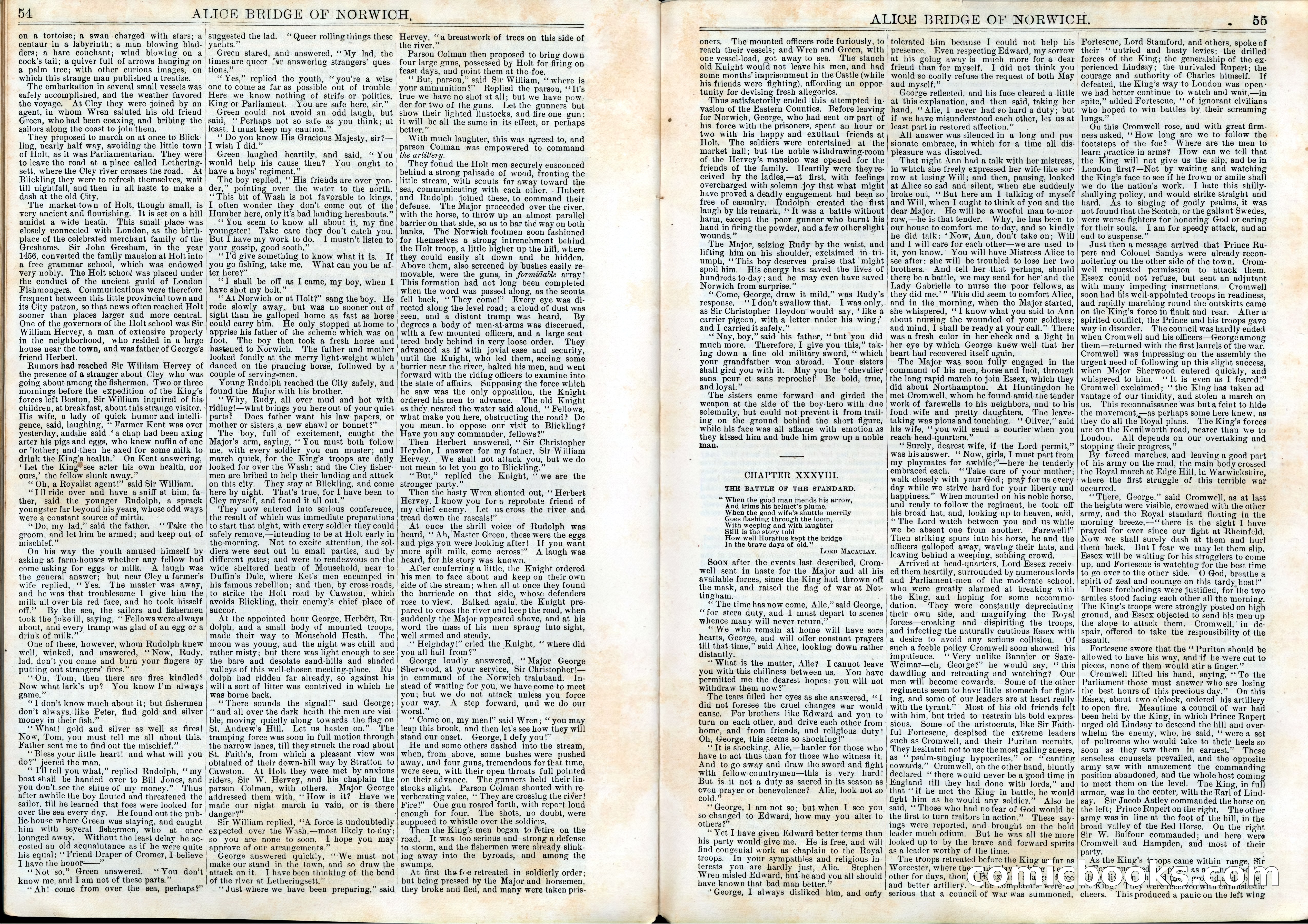
A restored page from Penny Dreadfuls, 1881. Page through the whole issue in the reader above.
📄 Transcribed text from this page (OCR, searchable)
Machine-transcribed from the original scan — historical spelling and the odd misread are preserved.
B4 ALICE BRIDGE OF NORWICH, on a tortoise; a swan charged with stars; a | suggested the lad. ‘‘ Queer rolling things these Hervey, ‘‘a breastwork of trees on this side of centaur-in a labyrinth; a man blowing blad-| ders; a hare couchant; wind blowing on a cock’s tail; a quiver full of arrows hanging on a palm tree; with other curious images, on which this strange man published a treatise. The embarkation in several small vessels was safely accomplished, and the weather favored the voyage. At Cley they were joined by an agent, in whom Wren saluted his old friend Green, who had been coaxing and bribing the sailors along the coast to join them. They proposed to march on at once to Blick- ling, nearly half way, avoiding the little town of Holt, as it was Parliamentarian. They were to leave the road at a place called Lethering- sett, where the Cley river crosses the road. At Blickling they were to refresh themselves, wait till nightfall, and then in all haste to make a dash at the old City. The market-town of Holt, though small, is very ancient and flourishing. It is set on a hill amidst a wide heath. This small place was elosely connected with London, as the birth- place of the celebrated merchant family of the Greshams. Sir John Gresham, in the year 1456, converted the family mansion at Holt into a free grammar school, which was endowed very nobly. The Holt school was placed under the conduct of the ancient gmld of London Fishmongers. Communications were therefore frequent between this little provincial town and its City patron, so that news often reached Holt sooner than places larger and more central. One of the governors of the Holt school was Sir William Hervey, a man of extensive property in the neighborhood, who resided in a large house near the town, and was father of George’s friend Herbert. Rumors had reached Sir William Hervey of the presence of a stranger about Cley who was going about among the fishermen. Two or three motnings before the expedition of the King’s forces left Boston, Sir William inquired of his children, at breakfast, about this strange visitor. His wife, a lady of quick humor and intelli- gence, said, laughing, ‘‘ Farmer Kent was over yesterday, andzhe said ‘a chap had been axing arter his pigs and eggs, who knew nuffin of one or ’tother; and-then he axed for some milk to drink the King’s health.’ On Kent answering, ‘Tiet the King’see azter his own health, nor ours,’ the fellow slunk away.” ‘‘Oh, a Royalist agent!” said Sir William. “T)l ride over and have a sniff at him, fa- ther, said the younger Rudolph, a sprack youngster far beyond his years, whose odd ways were a constant source of mirth. “Do, my lad,” said the father. ‘‘ Take the groom, and let him be armed; and keep out of mischief.” On his way the youth amused himself by asking at farm-houses whether any fellow had come asking for eggs or milk. A laugh was the general answer; but near Cley a farmer’s wife replied, ‘Yes. The master was away, and he was that troublesome J give him the milk all over bis red face, and he took hisself off.” By the sea, the sailors and fishermen tuok the joke ill, saying, ‘‘ Fellows were always about, and every tramp was glad of an egg or a drink of milk.” : One of these, however, whom Rudolph knew well, winked, and answered, ‘‘Now, Rudy, Jad, don’t you come and burn your fingers by putting out strangers’ fires.” “Oh, Tom, then there are fires kindled? Now what lark’s up? You know I’m always game.” “T don’t know much about it; but fishermen don’t always, like Peter, find gold and silver money in their fish.” : ‘“What! gold and silver as well as fires! Now, Tom, you must tell me all about this, Father sent me to find out the mischief,” * Bless your little heart! and what will you do?” jeered the man. “Tl tell you what,” replied Rudolph, ‘‘ my boat shall be handed over to Bill Jones, and you don’t see the shine of my money.” Thus after awhile the boy flouted and threatened the sailor, till he learned that foes were looked for over the sea every day. He found out the pub- lic-house where Green was staying, and caught him with several fishermen, who at once lounged away. Without the least delay he ac- costed an old acquaintance as if he were quite his equal: ‘Friend Draper of Cromer, I believe I have the honor—” “Not so,” Green answered. ‘‘ You don’t know me, and IJ am not of these parts.” ““Ah! come from over the sea, perhaps?” yachts,” | Green stared, and answered, ‘‘My lad, the times are queer ‘vr answering strangers’ ques- tions.” “Yes,” replied the youth, ‘‘you’re a wise one to come as far as possible out of trouble. Here we. know nothing of strife or politics, King or Parliament. You are safe here, sir.” Green could not avoid an odd laugh, but said, ‘‘ Perhaps not so safe as you think; at. least, I must keep my caution.” ‘Do you know His Gracious Majesty, sir?— I wish I did.” Green laughed heartily, and said, ‘‘ You would help his cause then? You ought to! have a boys’ regiment.” The boy replied, ‘‘ His friends are over yon- | der,” pointing over the water to the north. | “This bit of Wash is not favorable to kings. I often wonder they don’t come out of the Humber here, only it’s bad lunding hereabouts.” ‘You seem to know all about it, my fine, oungster! Take care they don’t catch you. ut I have my work to do. I mustn’t listen to your gossip, good-sooth.” ‘I'd give something to know what it is. If you go fishing, take me, What can you be af- ter here?” **T shall be off as I came, my boy, when I have shot my bolt,” ‘* At Norwich or at Holt?” sang the boy. He, tode slowly away, but was no sooner out of sight than he galloped home as fast as horse! could carry him. He only stopped at home to apprise his father of the scheme which was on foot. The boy then took a fresh horse and hastened to Norwich. The father and mother | looked fondly at the merry light-weight which danced on the prancing horse, followed by a couple of serving-men. Young Rudolph reached the City safely, and found the Major with his brother. “Why, Rudy, all over mud and hot with riding!—what brings you here out of your quiet parts? Does father want his law papers, or mother or sisters a new shaw] or bonnet?” The boy, full of excitement, caught the Major’s arm, saying, ‘‘ You must both follow me, with every soldier you can muster; and march quick, for the King’s troops are daily looked for over the Wash; and the Cley fisher- men are bribed to help their landing and attack on this city. They stay at Blickling, and come | here by night. That’s true, for I have been to Cley myself, and found it all out,” They now entered into serious conference, the result of which was immediate preparations to start that night, with every soldier they could safely remove,—intending to be at Holt early in | the- morning. Not to excite attention, the sol- diers were seat out in gmall parties, and by different gates; aud were to rendezvous on the wide sheltered heath of Mousehold, near to Duffin’s Dale, where Ket’s men encamped in his famous rebellion; and then, by cross-roads, to strike the Holt road by Oawston, which avoids Blickling, their enemy’s chief place of | succor. At the appointed hour George, Herbért, Ru- dolph, and a small body of mounted troops, made their way to Mousehold Heath. The moon was young, and the night was chill and| rather misty; but there was light enough to see the bare and desolate sand-hills and shaded valleys of this well-chosen meeting-place. Ru- dolph had ridden far already, so against. his will a sort of litter was contrived in which he was borne back. “There sounds the signal!” said George; ‘‘and all over the dark heath the men are visi- ble, moving quietly along towards -the flag on St. Andrew's Hill. Let us hasten on.” The, tramping force was soon in full motion through the narrow lanes, till they struck the road about St. Faith’s, from which a pleasant view was obtained of their down-hill way by Stratton to Cawston. At Holt they were met by anxious riders, Sir W. Hervey, and his chaplain the parson Colman, with .others. Major George addressed them with, ‘‘ How is it? Have we made our night march in vain, or is there danger?” 3 Sir William replied, ‘‘A force is undoubtedly expected over the Wash,—most likely to-day; so you are none to soon. I hope you may approve of our arrangements.” George answered quickiy, ‘‘We must not , make our stand in the town, and so draw the. attack on it. I have been thinking of the bend, the river.” Parson Colman then proposed to bring down ‘four large guns, possessed by Holt for firing on feast days, and point them at the foe. ‘* But, parson,” said Sir William, ‘where is your ammunition?” Replied the parson, ‘‘It’s true we have no shot at all; but we have pow- der for two of the guns. Let the gunners but show their lighted linstocks, and fire one gun: it will be all the same in its effect, or perhaps better.” With much laughter, this was agreed to, and parson Colman was empowered to command the artillery. They found the Holt men securely ensconced behind a strong palisade of wood, fronting the little stream, with scouts far away toward the sea, communicating with each other. - Hubert and Rudolph he these, to command their defense. The Major proceeded over the river, with the horse, to throw up an almost parallel barrier on that side, so as to bar the way on both banks, The Norwich footmen soon fashioned for themselves a strong intrenchment behind the Holt troop, a little higher up the hill, where they could easily sit down and be hidden. Above them, also screened by bushes easily re- movable, were the guns, in formidable array! This formation had not long been completed when the word was passed along, as the scouts fell back, ‘‘They come!” Every eye was di- rected along the level road; acloud of dust was seen, and a distant tramp was heard. By degrees a body of men-at-arms was discerned, with a few mounted officers, and a large scat- tered body behind in very loose order. ‘They advanced as if with jovial ease and security, until the Knight, who led them, seeing some barrier near the river, halted his men, and went forward with the riding officers to examine into the state of affairs. Supposing the force which he saw was the only opposition, the Knight ordered his men to advance. The old Knight as they neared the water said aloud, ‘‘ Fellows, what make you here, obstructing the road? Dc you mean. to oppose our visit to Blickling? Have you any commander, fellows?” - Then Herbert answered, ‘‘ Sir Christopher Heydon, I answer for my father, Sir William Hervey. _We shall not attack you, but we do not mean to let you go to Blickling.” “But,” replied the Knight, ‘‘ we are the stronger party.” - Then the hasty Wren shouted out, ‘‘ Herbert Hervey, I know you fora reprobate friend of my chief enemy. Let uscross the river and tread down the rascals!” At once the shrill voice of Rudolph was heard, ‘‘ Ah, Master Green, these were the eggs and pigs you were looking after! If you want more spilt milk, come across!” A laugh was heard, for his story was known. After conferring a little, the Knight ordered his men to face about and keep on their own side of the stream; when all at once they found the barricade on that side, whose defenders rose to view. Balked again, the Knight pre- pared to cross the river and keep the road, when suddenly the Major appeared above, and at his word the mass of his men sprang into sight, well armed and steady. ‘‘ Heighday!” cried the Knight, ‘‘ where did you all hail from?” George loudly answered, ‘‘Major George Sherwood, at your service, Sir Christopher!— in command of the Norwich trainband. In- stead of waiting for you, we have come to meet you; but we do not attack unless you force your way. A step forward, and we do our worst.” ‘*Come on, my men!” said Wren; ‘‘ you may leap this brook, and then let's see how they will stand our onset. George, I defy you!” He and some others dashed into the stream, when, from above, some bushes were pushed away, and four guns, tremendous for ttat time, were seen, with their open throats full pointed on their advance. The gunners held their Jin- stocks alight. Parson Colman shouted with re. verberating voice, ‘‘ They are crossing the river! Fire!” One gun roared forth, with report loud enough for four. The shots, no doubt, were supposed to whistle over the soldiers. Then the King’s men began to fetire on the road. It was too serious and strong a defense to storm, and the fishermen were already slink- ing away into the byroads, and among the swamps, At first the foe retreated in soldierly order; of the river at Letheringsett.” : “Just where we have been preparing,” said but being pressed by the Major and horsemen, they broke and fled, and many were taken pris- ALICE BRIDGE OF NORWICH. ct ii oners. The mounted officers rode furiously, to reach their vessels; and Wren and Green, with one vessel-load, got away to sea. The stanch old Knight would not leave his men, and had some months’ imprisonment in the Castle (while his friends were fighting), affording an oppor. tunity for devising fresh allegories. Thus satisfactorily ended ‘this attempted in- vasion of the Eastern Counties. Before leaving for Norwich, George, who had sent on part of his force with the prisoners, spent an hour or two with his happy and exultant friends at Holt. The soldiers were entertained at the market hall; but the noble withdrawing-room of the Hervey’s mansiop was opened for the friends of the family. Heartily were they re- ceived by the ladies,—at first, with feelings overcharged with solemn joy that what. might have proved a deadly engagement had been so. free of casualty. Rudolph created the first laugh by his remark, ‘‘ It was a battle without harm, except the poor gunner who burnt his hand in firing the powder, and a few other slight wounds.” The Major, seizing Rudy by the waist, and lifting him on his shoulder, exclaimed in-tri- umph, ‘This boy deserves praise that might spoil him. His energy has saved the lives of hundreds to-day; and he may even have saved | Norwich from surprise.” “Come, George, draw it mild,” was Rudy’s response. ‘‘I don’t swallow that. I was only, as Sir Christopher Heydon would say, ‘like a | carrier pigeon, with a letter nnder his wing; and I carried it safely.” ‘‘Nay, boy,” said his father, ‘‘ but you did much more. ing down a fine old military sword, ‘‘ which your grandfather won abroad. Your sisters shall gird you with it. sans peur et sans reproche!’ Be bold, true, and loyal.” The sisters came forward and girded the weapon at the side of the boy-hero with due solemnity, but could not prevent it from trail- ing on the ground behind the short figure, while his face was all aflame with emotion as they kissed him and bade him grow up a noble man. CHAPTER XXXVIII. THE BATTLE OF THE STANDARD. “ When the good man mends his arrow, And trims his helmet’s plume, When the good wife’s shuttle merrily Goes flashing through the loom, With weeping and with laughter Still is the story told How well Horatius kept the bridge In the brave days of old,” Lorp Macaunay. Soon after the events last described, Crom- well sent in haste for the Major and all his available forces, since the King had thrown off the mask, and raised the flag of war at Not- tingham. ‘The time has now come, Alie,” said George, ‘for stern duty, and I must depart to scenes whence many will never return.” ““We who remain at home will have sore hearts, George, and will offer constant prayers till that time,” said Alice, looking down rather distantly. “What is the matter, Alie? I cannot leave you with this chillness between us, You have permitted me the dearest hopes: you will not Withdraw them now?” The tears filled ner eyes as she answered, ‘I did not foresee the cruel changes war would cause. For brothers like Edward and you to turn on each other, and drive each other from home, and from friends, and religious duty! Oh, George, this seems so shocking!” ‘Tt is shocking, Alie,—harder for those who have to act thus than for those who witness it. And to go away and draw the sword and fight with fellow-countrymen—this is very hard! But is it not a duty as sacred in its season as a prayer or benevolence? Alie, look not so cold.” ‘George, I am not so; but when I see you so changed to Edward, how may you alter to others?” _‘Yet I have given Edward better terms than his party would give me. He is free, and will find congenial work as chaplain to the Royal troops. In your sympathies and religious in- terests you are hardly just, Alie. Stephen Wren misled Edward, but he and you all should have known that bad man better.” George, I always disliked him, and only Therefore, I give you this,” tak- | May you be ‘ chevalier | tolerated him because I could not help his presence, Even respecting Edward, my sorrow at his going away is much more for a dear friend than for myself. I did not think you would so coolly refuse the request of both May and myself.” George reflected, and his face cleared a little at this explanation, and then said, taking her hand, ‘ Alie, I never had so hard a duty; but if we have misunderstood each other, let us at least part in restored affection.” All answer was silenced in a long and pas sionate embrace, in which for a time all dis- pleasure was dissolved. That night Ann had a talk with her mistress, in which she freely expressed her wife like sor- row at losing Will; and then, pausing, looked at Alice so sad and ‘silent, when she suddenly broke out, ‘‘ But here am I talking of myself and Will, when I ought to think of you and the dear Major. He will be a woeful man to-mor- row,—he is that tender. Why, he has been to our house tocomfort me to-day, and so kindly he did talk: ‘Now, Ann, don’t take on; Will and I will care for each other—we are used to it, you know. You will have Mistress Alice to see after: she will be troubled to lose her two brothers, And tell her that perhaps, should there be a battle, we may send for her’ and the Lady Gabrielle to nurse the poor fellows, as they did me.’” This did seem to comfort Alice, and in the morning, when the Major started, she whispered, ‘‘I know what you said to Ann about nursing the wounded of your soldiers; and mind, I shall be ready at your call.” There was a fresh color in her cheek and a light in her eye by which George knew well that her heart had recovered itself again. The Major was soon fully engaged in the command of his men, horse and foot, through the long rapid march to join Essex, which they did about Northampton. At Huntingdon he met Cromwell, whom he found amid the tender work of farewells to his neighbors, and to his fond wife and pretty daughters, The leave- taking was pious and touching. ‘‘ Oliver,” said his wife, ‘‘ you will send a courier when you reach head-quarters,” “Surely, dearest wife, if the Lord permit,” was hisanswer. ‘‘ Now, girls, I must part from my playmates for awhile;’—here he tenderly embraced each. ‘Take care of your mother; walk closely with your God; pray for us every day while we strive hard for your liberty and happiness.” When mounted on his noble horse, and ready to follow the regiment, he took off his broad hat, and, looking up to heaven, said, ‘‘The Lord watch between you and _ us while we be absent one from another, Farewell!” Then striking spurs into his horse, he and the officers galloped away, waving their hats, and leaving behind a weeping, sobbing crowd. Arrived at head-quarters, Lord Essex receiv- ed them heartily, surrounded by numerous lords and Parliament-men of the moderate school, who were greatly alarmed at breaking with the King, and hoping for some accommo- dation. They were constantly depreciating their own side, and magnifying the Royal forees—croaking and dispiriting the troops, and infecting the naturally cautious Essex with a desire to avoid any serious collision. Of such a feeble policy Cromwell soon showed his Impatience. ‘Very unlike Bannier or Saxe- Weimar—eh, George?