
Penny Dreadfuls, 1881 · page 27 of 38
Alice Bridge of Norwich — page 27: what you’re looking at
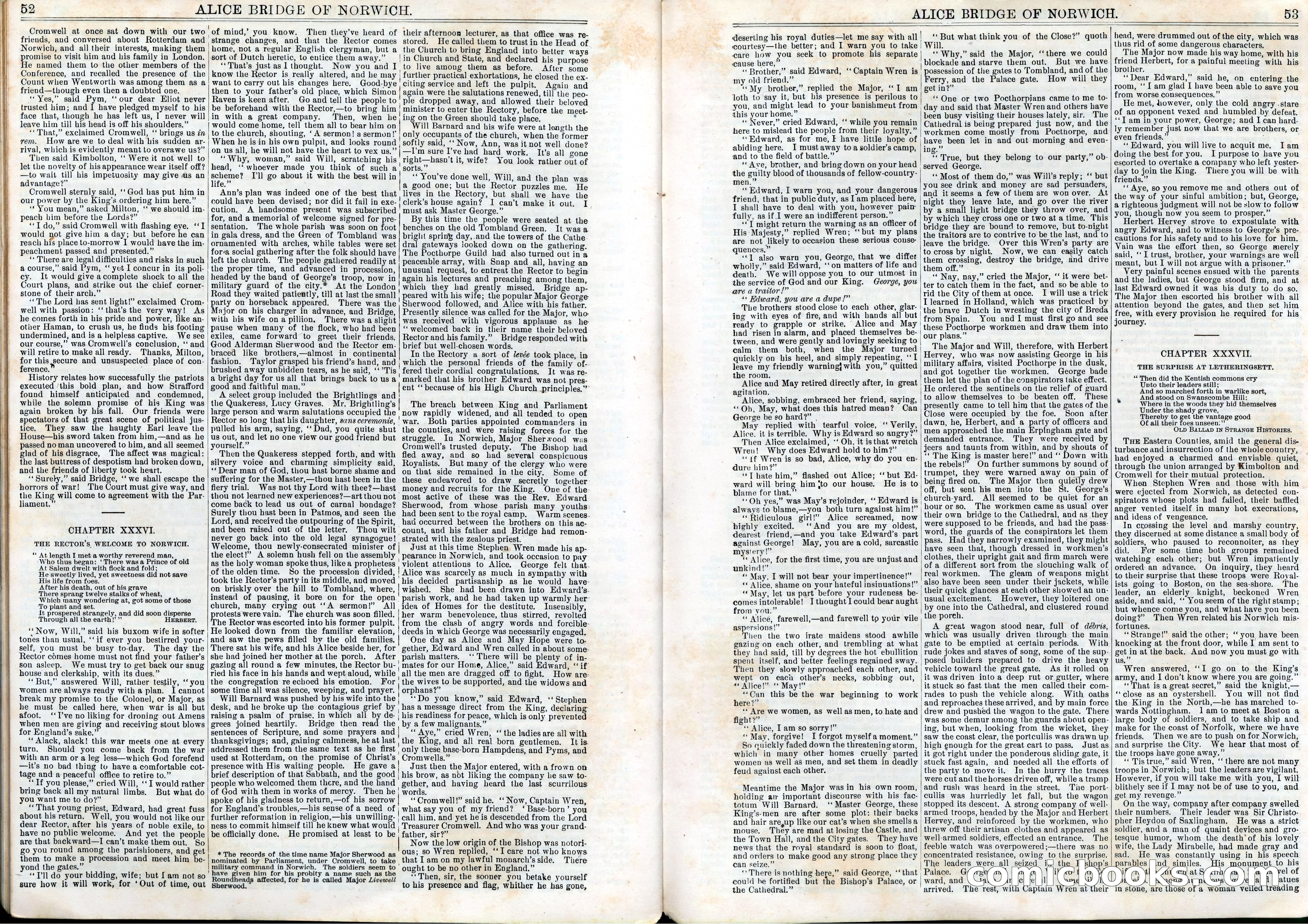
A restored page from Penny Dreadfuls, 1881. Page through the whole issue in the reader above.
📄 Transcribed text from this page (OCR, searchable)
Machine-transcribed from the original scan — historical spelling and the odd misread are preserved.
52 ALICE BRIDGE OF NORWICH. Cromwell at once sat down with our two! of mind,’ you know. Then they’ve heard of friends, and conversed about Rotterdam and Norwich, and all their interests, making them promise to visit him and his family in London. He named them to the other members of the Conference, and recalled the presence of the Count when Wentworth was among them as a friend—though even then a doubted one. “Yes,” said Pym, ‘‘our dear Eliot never trusted him; aud | have pledged myself to his face that, though he has left us, I never will leave him till his head is off his shoulders.” “That,” exclaimed Cromwell, ‘‘ brings us in rem. How are we to deal with his sudden ar- rival, which is evidently meant to overawe us?” Then said Kimbolton, ‘‘ Were it not well to let the novelty of his appearance wear itself off? —to wait till his impetuosity may give ais an | advantage?” Cromwell sternly said, ‘‘God has put him in our power by the King’s ordering him here.” ‘«You mean,” asked Milton, ‘‘ we should im- peach him before the Lords?” “T do,” said Cromwell with flashing eye, ‘‘I would not give him a day; but before he can reach his place to-morrow I would have the im- peachment passed and presented.” “ There are legal difficulties and risks in such a course,” said Pym, ‘‘ yet I concur in its poli- cy. It would give acomplete shock to all the Court plans, and strike out the chief corner- stone of their arch.” “The Lord has sent light!” exclaimed Crom- well with passion: ‘‘ that’s the very way! As he comes forth in his pride and power, like an- otner Haman, to crush us, he finds his footing undermined, and is a helpless captive. We see our course,” was Cromwell's conclusion, ‘‘ and will retire to make all ready. Thanks, Milton, for this,secure and unsuspected place of con- ference. : History relates how successfully the patriots executed /this bold plan, and how Strafford found himself anticipated and condemned, while the solemn promise of his King was again broken by his fall. Our friends were spectators of that great scene of political jus- tice. They. saw the haughty Earl leave the House—his sword taken from him,—and as he passed no man uncovered to him, and all seemed glad of his disgrace, The affect was magical: the last buttress of despotism had broken down, and the friends of liberty took heart. ‘‘Sureky,” said Bridge, ‘‘ we shall escape the horrors of war! The Court must give way, and the King will come to agreement with the Par- liament,” CHAPTER XXXVI. THE RECTOR’S, WELCOME TO NORWICH. * At length I met a worthy reverend man, ‘Who thus began: ‘ There was a Prince of old At Salem dwelt with flock and fold; He sweetly lived, yet sweetness did not save His life from foes. After his death, out of his grave There sprang twelve stalks of wheat, Which many wondering at, got some of those To plant and set. It prospered strangely, and did soon disperse Through all the earth)’ ” HERBERT. ‘Now, Will,” said his buxom wife in softer tones than usual, ‘‘if ever you bestirred your- self, you must be busy to-day. The day the Rector comes home must not find your father’s son asleep. We must try to get back our snug house and clerkship, with its dues.” *But,”” answered Will, rather testily, ‘‘ you women are always ready with a plan. I cannot break my promise to the Colonel, or Major, as he must be called here, when war is all but afoot. “T’ve no liking for droning out Amens when men are giving and receiving stout blows for England’s sake.” “ Alack, alack! this war meets one at every turn. Should you come back from the war With an arm or a leg less—which God forefend —it’s no bad thing to have a comfortable cot- tage and a peaceful office to retire to.” “If you please,” cried Will, ‘‘I would rather bring back all my natural limbs. But what do you want me to do?” ‘That young priest, Edward, had great fuss about his return. Well, you would not like our dear Rector, after his years of noble exile, to have no public welcome. And yet the people are that backward—I can’t make them out. So go you round among the parishioners, and get them to make a procession and meet him be- yond the gates.” “T’ll do your bidding, wife; but [ am not so sure how it will work, for ‘Out of time, out of the olden time. So the procession divided, strange changes, and that the Rector comes home, not a regular English clergyman, but a ‘sort of Dutch heretic, to entice them away.” ‘‘That’s just as ] thought. Now you and I know the Rector is really altered, and he may want to carry out his changes here. Good-bye then to your father’s old place, which Simon Raven is keen after. Go and tell the people to be beforehand with the Rector,—to bring him | in with a great company. Then, when he would come home, tell them all to bear him on to the church, shouting, ‘ A sermon! a sermon!’ When he isin his own pulpit, and looks round on us all, he will not have the heart to vex us,” “Why, woman,” said Will, scratching his head, ‘‘whoever made you think of such a wat I'll go about it with the best will in ife.”’ Ann’s plan was indeed one of the best that could have been devised; nor did it fail in exe- cution. A handsome present was subscribed for, and a memorial of welcome signed for pre- sentation, The whole parish was soon on foot in gala dress, and the Green of Tombland was ornamented with arches, while tables were set fora social gathering after the folk should have left the church. The people gathered readily at the proper time, and advanced in procession, headed by the band of George’s troop, now in military guard of the city.* .At the London Road they waited patieutly, till at last the small party on horseback appeared. There was the Major on his charger in advance, and Bridge, with his wife ona pillion, There was a slight pause when many of the flock, who had been exiles, came forward to greet their friends. Good Alderman Sherwood and the Rector em- braced like brothers,—almost in continental fashion. Taylor grasped his friend’s hand, and | brushed away unbidden tears, as he said, ‘‘’Tis a bright day for us all that brings back to us a! good and faithful man.” A select group included the Brightlings and the Quakeress, Lucy Graves. Mr, Brightling’s large person and warm salutations occupied the Rector so long that his daughter, sans ceremonie, pulled his arm, saying, ‘‘Dad, you quite shut us out, and let no one view our good friend but yourself,” Then the Quakeress stepped forth, and with silvery voice and charming simplicity said, ‘Dear man of God, thou hast borne shame and suffering for the Master,—thou hast been in the fiery trial. Was not thy Lord with thee?—hast thou not learned new experiences?—art thou not come back to lead us out of carnal bondage? Surely thou hast been in Patmos, and seen the Lord, and received the outpouring of the Spirit, and been raised out of the letter. Thou wilt never go back into the old legal synagogue! Welcome, thou newly-consecrated minister of the elect!” A solemn hush fell on the assembly as the holy woman spoke thus, like a prophetess took the Rector’s partyin its middle, and moved on briskly over the hill to Tombland, where, instead of pausing, it bore on for the open church, many crying out ‘‘A sermon!” All protests were vain. The church was soon filled. The Rector was escorted into his former pulpit. He looked down from the familiar elevation, and saw the pews filled by the old families, There sat his wife, and his Alice beside her, for she had joined her mother at the porch, After gazing all round a few minutes, the Rector bu-! ried his face in his hands and wept aloud, while the congregation re echoed his emotion. For some time all was silence, weeping, and prayer. Will Barnard was pushed by his wife into the ; desk, and he broke up. the contagious grief by raising a psalm of praise, in which all by de- grees joined heartily. Bridge then read the sentences of Scripture, and some prayers and thanksgivings; and, gaining calmness, he at last addressed them from the same text as he first used at Rotterdam, on the promise of Christ’s presence with His waiting people. He gave a brief description of that Sabbath, and the good people who welcomed them there, and the hand of God with them in works of mercy. Then he| spoke of his gladness to return,—of his sorrow for England’s troubles,—his sense of a need of | further reformation in religion,—his unwilling- | ness to commit himself till he knew what would be officially done. He promised at least to be * The records of the time name Major Sherwood as nominated by Parliament, under Cromwell, to take | military command in Norwich. The soldiers seem to ‘have fies him for his probity a name such as the Roundheads affected, for he is called Major Livewell Sherwood. their afternoon lecturer, as that office was re- stored. He called them to trust in the Head of the Church to bring England into better ways in Church and State, and declared kis purpose to live among them as before. After some further practical exhortations, he closed the ex- citing service and left the pulpit. Again and again were the salutations renewed, till the peo- ple dropped away, and allowed their beloved minister to enter the Rectory, before the meet- ing on the Green should take place. Will Barnard and his wife were at length the only occupants of the church, when the former softly said, ‘‘ Now, Ann, was it not well done? —l’m sure I’ve had hard work. It’s all gone i ii it, wife? You look rather out of sorts, ‘You've done well, Will, and the plan was a good one; but the Rector puzzles me. He lives in the Rectory, but shall we have the clerk’s house again? I can’t make it out. I must ask Master George.” By this time the people were seated at the benches on the old Tombland Green. It was a bright spring day, and the towers of the Cathe. dral gateways iooked down on the gathering. The Pocthorpe Guild had also turned out ina peaceable array, with Snap and all, having an unusual request, to entreat the Rector to begin again his lectures and preaching among them, which they had greatly missed. Bridge ap- peared with his wife; the popular Major George Sherwood followed, and Alice with his father. Presently silence was called for the Major, who: was received with vigorous applause as he ‘‘welcomed back in their name their beloved Rector and his family.” Bridge responded with brief but well-chosen words, In the Rectory a sort of levée took place, in which the personal friends of the family of- fered their cordial congratulations. It was re- marked that his brother Edward was not pres- ent “because of his High Church principles.” The breach between King and Parliament now rapidly widened, and all tended to open | war. Both parties appointed commanders in the counties, and were raising forces for the struggle. In Norwich, Major Sherwood was Cromwell’s trusted deputy. The Bishop had fled away, and so had several conspicuous Royalists. But many of the clergy who were on that side remained in the city. Some of these endeavored to draw secretly together _money and recruits for the King. One of the most active of these was the Rev. Edward Sherwood, from whose parish many youths: had been sent to the royal camp. Warm scenes. had occurred between the brothers on this ae- count, and his father and Bridge had remon- strated with the zealous priest. Just at this time Stephen Wren made his ap- pearance in Norwich, and took occasion to pay violent attentions to Alice. George felt that. Alice was scarcely as much in sympathy with his decided partisanship as he would have- wished. She had been drawn into Edward’s- . Parish work, and he had taken up warmly her- idea of Homes for the destitute. Insensibly, her warm benevolence, thus stirred, revolted from the clash of angry words and forcible- deeds in which George was necessarily engaged. One day as Alice and May Hope were to- gether, Edward and Wren called in about some- parish matters, ‘' There will be plenty of in- mates for our Home, Alice,” said Edward, ‘if’ all the men are dragged off to fight. How are- the wives to be supported, and the widows and orphans?” ‘Do you know,” said Edward, ‘‘ Stephen has a message direct from the King, declaring his readiness for peace, which is only prevented by a few malignants,” “ Aye,” cried Wren, ‘‘ the ladies are all with the King, and all real born gentlemen, It is. only these base-born Hampdens, and Pyms, and Cromwells.” Just then the Major entered, with a frown on his brow, as not liking the company he saw to- gether, and having heard the last scurrilous words. : “Cromwell!” said he. ‘‘ Now, Captain Wren, what say you of my friend? ‘ Base-born’ you call him, and yet he is descended from the Lord Treasurer Cromwell. And who was your grand- father, sir?” Now the low origin of the Bishop was notori- ous; so Wren replied, ‘‘I care not who knows that I am on my lawful monarch’s side. There ought to be no other in England.” “Then, sir, the sooner you betake yourself to his presence and flag, whither he has gone, ALICE BRIDGE OF NORWICH. _ 53 deserting his royal duties—let me say with all ccourtesy—the better; and I warn you to take care how you seek to promote his separate cause bere,” “ Brother,” said Edward, ‘‘ Captain Wren is my old friend.” ; ‘My brother,” replied the Major, “I am loth to say it, but his presence is perilous to you, and might lead to your banishment from this your home.” “ Never,” cried Edward, ‘‘ while you remain | Cathedral is being prepared just now, and the here to mislead the people from their loyalty.” ‘‘Edward, as for me, E have little hope of abiding here. I must away toa soldier’s camp, and to the field of battle.” “ Ave, brother, and bring down on your head | the guilty blood of thousands of fellow-country- men.” ‘* Edward, I warn you, and your dangerous friend, that in public duty, as I am placed here, I shall have to deal with you, however pain fully, as if I were an indifferent person.” ‘“T might return the warning as an officer of His Majesty,” replied Wren; “‘but my plans are not likely to occasion these serious conse quences,” ; ‘(I also warn you, George, that we differ wholly,” said Edward, ‘‘on matters of life and death. We will oppose you to our utmost in the service of God and our King. George, you are a traitor!” “« Hdward, you are a dupe!” The brothers stood close to each other, glar- ing with eyes of fire, and with hands all but ready to grapple or strike. Alice and May had risen in alarm, and placed themselves be- tween, and were gently and lovingly seeking to calm them both, when the Major turned quickly on his heel, and simply repeating, ‘1 leave my friendly warning}with you,” quitted the room. Alice and May retired directly after, in great | agitation. : Alice, sobbing, embraced her friend, saying, ‘“<Oh, May, what does this hatred mean? Can | George be so hard?” , May replied with tearful voice, ‘‘ Verily, Alice, it is terrible. Why is Edward so angry?” Then Alice exclaimed, *‘ Oh, it isthat wretch Wren! Why does Edward hold to him?” “tf Wren is so bad, Alice, why do you en- dure him?” ‘‘T hate him,” flashed out Alice; ‘‘ but Ed- ward will bring him {to our house. He is to blame for that.” “‘Oh yes,” was May’s rejoinder, ‘‘ Edward is always to blame,—you both turn against him!” “Ridiculous girl!’ Alice screamed, now highly excited. ‘And you are my oldest, dearest friend,—and you take Edward’s part against George! May, you are a cold, sarcastic mystery!” ‘« Alice, for the first time, you are unjust and unkind!” “ May, I will not bear your impertinence!” “ Alice, shame on your hateful insinuations!” “May, let us part before your rudeness be- comes intolerable! I thought I could bear aught from you.” “ Alice, farewell,—and farewell to your vile aspersions!” Then the two irate maidens stood awhile gazing on each other, and trembling at what they had said, till by degrees the hot ebullition spent itself, and better feelings regained sway. Then they slowly approached each other, and wept on eacn other’s necks, sobbing out, «« Alice!” ‘* May!” “Can this be the war beginning to work here?” ‘« Are we women, as well as men, to hate and fight?” ‘Alice, Iam so sorry!” “May, forgive! I forgot myselfa moment.” So quickly faded down the threatening storm, which in many other homes cruelly parted women as well as men, and set them in deadly feud against each other. Meantime the Major was in his own room, holding ar important discourse with his fac- totum Will Barnard. ‘‘ Master George, these King’s-men are after some plot: their backs and hair are,up like our cat’s when she smells a mouse. They are mad at losing the Castle, and the Town Hall, and the City gates. They have news that the royal standard is soon to float, and orders to make good any strong place they can seize,” “There is nothing here,” said George, ‘‘that | could he fortified but the Bishop's Palace, or | the Cathedral.” ‘But what think you of the Close?” quoth Will. ‘“ Why,” said the Major, ‘‘there we could blockade and starve them out. But we have possession of the gates to Tombland, and of the Ferry, and the Palace gate. How will they get in?” ‘*One or two Pocthorpjans came to me to- day and said that Master Wren and others have been busy visiting their houses lately, sir. The workmen come mostly from Pocthorpe, and have been let in and out morning and even- ing.” cs True, but they belong to our party,” ob- served George. “* Most of them do,” was Will’s reply; ‘‘ but you see drink and money are sad persuaders, and it seems a few of them are won over, At night they leave late, and go over the river by a small light bridge they throw over, and by which they cross one or two at a time. This bridge they are bound to remove, but to-night the traitors are to contrive to’be the last, and to leave the bridge. Over this Wren’s party are |to cross by night. Now, we can easily catch them crossing, destroy the bridge, and drive them off.” ‘“Nay, nay,” cried the Major, ‘‘ it were bet- ter to catch them in the fact, and so be able to rid the City of them at once. I will use a trick I learned in Holland, which was practiced by the brave Dutch in wresting the city of Breda from Spain. You and I must first go and see these Pocthorpe workmen and draw them into our plans.” The Major and Will, therefore, with Herbert Hervey, who was now assisting George in his military affairs, visited Pocthorpe in the dusk, and got together the workmen. George bade them let the plan of the conspirators take effect. He ordered the sentinels on the relief of guard to allow themselves to -be beaten off. These presently came to tell him that the gates of the Close were occupied by the foe. Soon after dawn, he, Herbert, and a party of officers and |men approached the main Erptngham gate and demanded entrance. They were received by jeers and taunts from within, and by shouts of ‘The King is master here!” and “ Down with the rebels!” On further summons by sound of trumpet, they were warned away on pain of being fired on. The Major then que drew off, but sent his men into the St. George’s church-yard. All seemed to be quiet for an hour or so, The workmen came as usual over their own bridge to the Cathedral, and as they were supposed to be friends, and had the pass- word, the guards of the conspirators let them pass, Had they narrowly examined, they might have seen that, though dressed in workmen’s clothes, their upright gait and firm march were of a different sort from the slouching walk of real workmen. The gleam of weapons might also have been seen under their jackets, while their quick glances at each other showed an un- usual excitement. However, they loitered one by one into the Cathedral, and clustered round the poreh. A great wagon stood near, full of dédrvs, which was usually driven through the main gate to be emptied at certain periods. With rude jokes and staves of song, some of the sup- | posed builders prepared to drive the heavy vehicle toward the great gate. As it rolled on it was dr