
Penny Dreadfuls, 1881 · page 26 of 38
Alice Bridge of Norwich — page 26: what you’re looking at
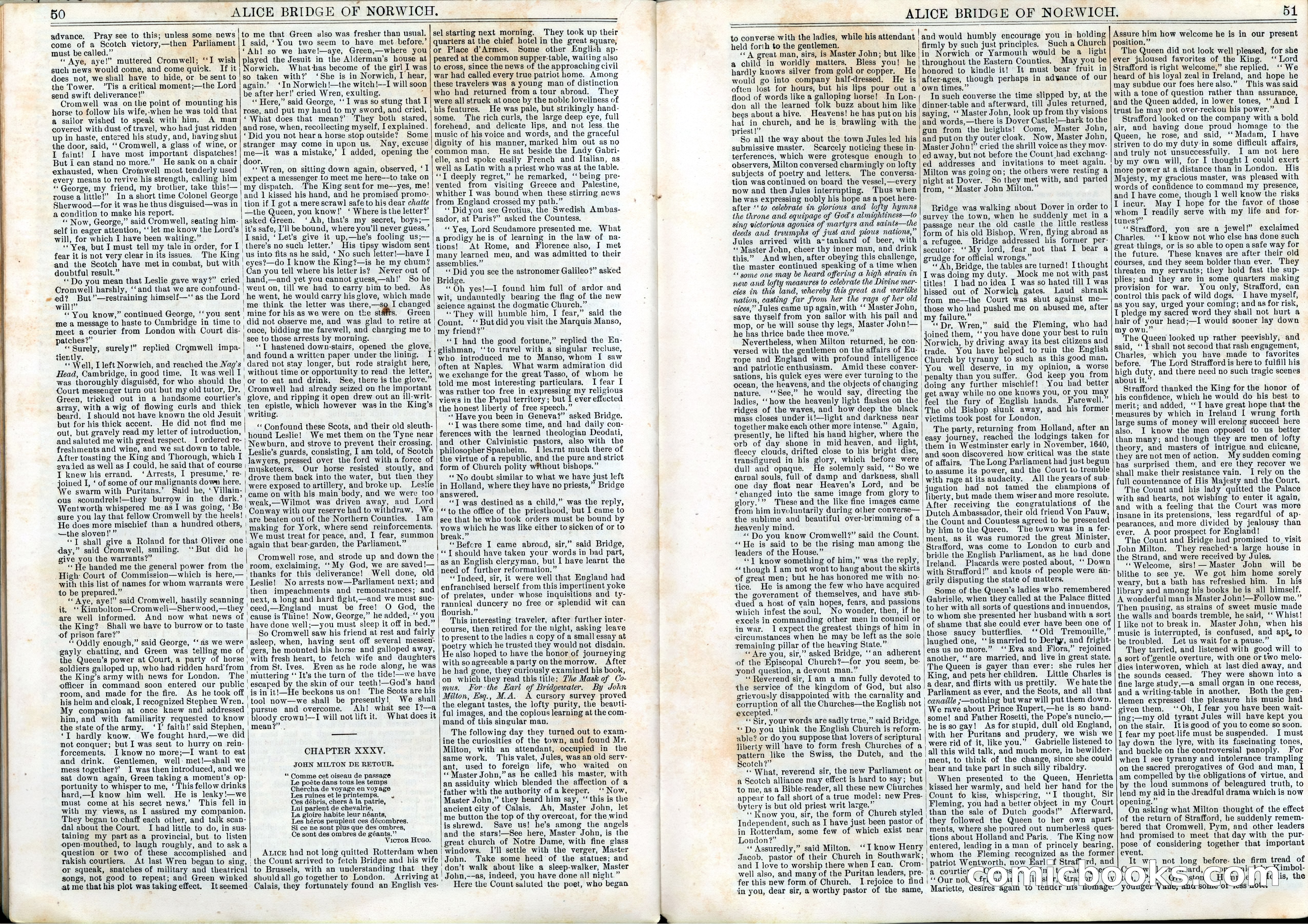
A restored page from Penny Dreadfuls, 1881. Page through the whole issue in the reader above.
📄 Transcribed text from this page (OCR, searchable)
Machine-transcribed from the original scan — historical spelling and the odd misread are preserved.
% ee eee 50 ALICE BRIDGE OF NORWICH. advance. Pray see to this; unless some news|to me that Green also was fresher than usual, come of a Scotch victory,—then Parliament |1 said, ‘You two seem to have met before.’ must be called.” ‘Ah! so we have!—aye, Green,—where you “ Aye, aye!” muttered Cromwell; ‘‘I wish | played the Jesuit in the Alderman’s house at such news would come, and come quick. If it; Norwich. What-has become of the girl I was does not, we shall have to hide, or besent to}so taken with? ‘She is in Norwich, I hear, the Tower. Tis a critical moment;—the Lord | again.’ ‘In Norwich!—the witch |—-I will soon send swift deliverance!” be after her!’ cried Wren, exulting. é Cromwell was onthe point of mounting his| ‘‘ Here,” said George, ‘‘I was so stung that I horse to follow his wife,-when he was told that | rose, and put my hand to my sword, and cried, a sailor wished to speak with him. A mam‘ What does that mean ? They both stared, covered with dust of travel, who had just ridden | and rose, when, recollecting myself, I explained. up in haste, entered his study, and, having shut | ‘ Did you not hear a horse stop outside? Some the door, said, ‘‘ Cromwell, a glass of wine, or| stranger may come in upon us, Nay, excuse I faint! I have most important dispatches! |me—it was a mistake,’ I added, opening the But 1 can stand no more.” He sank on a chair | door. exhausted, when Cromwell most tenderly used “ Wren, on sitting down again, observed, ‘1 every means to revive his strength, calling him | expect a messenger to meet me here—-to take on “George, my friend, my brother, take this!—; my dispatch. ‘The King sent for me—yes, me! rouse a little!” In a short time Colonel George | and 1 kissed his hand, and he promised promo- Sherwood—for it was he thus disguised—was in | tion if I got a mere scrawl safe to his dear chatte a condition to make his report. —the Queen, you know!’ ‘ Where is the letter?’ “ Now, George,” said Cromwell, seating him-jasked Green. ‘Ah, that’s my secret, boys;— self in eager attention, ‘‘let me know the Lord’s | it’s safe, I’ll be bound, where you'll never guess.’ will, for which I have been waiting.” I said, ‘Let’s give it up,—he’s fooling us;— ‘Yes, but I must tell my tale in order, for I there’s no such letter.’ His tipsy wisdom sent fear it is not very clear in its issues. The King us into fits as he said, ‘ No such letter!—have I and the Scotch have met in combat, but with eyes?—do I know the King?—is he my chum? doubtful result.” Can you tell where his letter is? Never out of “Do you mean that Leslie gave way?” cried hand,—and yet you cannot guess,—ah!’ So he | Cromwell harshly, ‘‘and that we are confound- | went on, till we had to carry him to bed. As ed? But’—restraining himself—‘‘as the Lord he went, he would carry his glove, which made will!” me think the letter was there,—so I changed “You know,” continued George, ‘‘you sent mine for his as we were on the stéfts. Green me a message to haste to Cambridge in time to did not observe me, and was glad to retire at meet a courier from London with Court dis- | once, bidding me farewell, and charging me to patches?” | see to those arrests by morning. “Surely, surely!” reptied Cromwell impa-| ‘‘L hastened down-stairs, opened the glove, tient] and found a written paper under the lining, es Vell, Lleft Norwich, and reached the Nag’s ‘dared not stay longer, but rode straight here, Head, Cambridge, in good time, It was well I without time or opportunity to read the letter, was thoroughly disguiséd, for who should the or to eat and drink. See, there is the glove.” Court messenger turn out but my old tutor, Dr. Cromwell had already seized on the important Green, tricked out in a handsome courtier’s glove, and ripping it open drew out an ill-writ- array, with a wig of flowing curls and thick ten epistle, which however was in the King’s beard, I should not have known the old Jesuit | writing. but for his thick accent. He did not find me “ Confound these Scots, and their old sleuth- out, but gravely read my letter of introduction, zi and saluted me with great respect. . I ordered re- | hound Leslie! We met them on the Tyne near freshments and wine, and we sat down to table. | Newburn, and strove to prevent their crossing. After toasting the King and Thorough, which I evaied as well as I could, he said that of course | I knew his errand. ‘Arrests, I presume,’ re- | joined I, ‘ of some of our malignants down here. e swarm with Puritans.’ Said he, ‘ Villain- ous scoundrels!—they burrow in the dark.’ | Wentworth whispered meas I was going, ‘Be! sure you lay that fellow Cromwell by the heels! | He does more mischief than a hundred others, | Leslie’s guards, consisting, I am told, of Scotch lawyers, pressed over the ford with a force of musketeers. Our horse resisted stoutly, and drove them back into the water, but then they were exposed to artillery, and broke up. Lestie came on with his main body, and we were too weak,—Wilmot was driven away, and Lord Conway with our reserve had to withdraw. We are beaten out of the Northern Counties. Iam making for York, where send reinforcements. High: Court of Commission—which is here,— thanks for this deliverance! Well done, old par >»? ri Beer aire a Roland for that Oliver one | We must treat for peace, and, I fear, summon i ‘ 5 i ” day,” said Cromwell, smiling. “But did he again that bear-garden, the Parliament. give you the warrants?” Cromwell rose, and strode up and down the “He handed me the general power from the room, exclaiming, ‘‘My God, we are saved |— with this list of names for whom warrants were | Leslie! No arrests now—Parliament next; and to be prepared.” ithen impeachments and remonstrances; and “Aye, aye!” said Cromwell, hastily scanning next, a long and hard figlt,—and we must suc- it. ‘‘ Kimbolton—Cromwell—Sherwood,—they 'ceed,—England must be free! O God, the are well informed. And now what news of | cause is Thine! Now, George,” he added;‘‘ you the King? Shall we have to burrow or to taste have done well;—you must sleep it off in bed.” of prison fare?” So Cromwell saw his friend at rest and fairly “ Oddly enough,” said George, ‘‘as we were asleep, when, having sent off several messen- gayly chatting, and Green was telling me of gers, he mounted his horse and galloped away, the Queen’s power at Court, a party of horse | with fresh heart, to fetch wife and daughters soldiers galloped up, who had -ridden hard'from from St. Ives. Even as he rode along, he was the King’s army with news for London. The' muttering ‘‘It’s the turn of the tide!—we have officer in command soon entered our public | escaped by the skin of our teeth!—God’s hand room, and made for the fire. As he took off is in it!—He beckons us on! The Scots are his his helm and cloak, I recognized Stephen Wren. | tool now—we shall be presently! We shall My companion at once knew and addressed ; pursue and overcome. Ah! what see I?—a him, and with familiarity requested to know | bloody crown!—I will not lift it. What does it the state of the army. ‘I’ faith!’ said Stephen, mean?” . ‘I hardly know. We fought hard,—we did not conquer; but I was sent to hurry on rein- forcements. I know no more;—I want to eat and drink. Gentlemen, well: met!—shall we mess together?’ I was then introduced, and we sat down again, Green taking a moment’s op- portunity to whisper to me, ‘ This fellow drinks hard,—I know him well. He is leaky!—we must come at his secret news.’ This fell in with my views, as I assured my companion. They began to chaff each other, and talk scan- dal about the Court. I had little to do, in sus- taining my part as a provincial, but to listen open-mouthed, to laugh roughly, and to ask a Yiotor Hugo. question or two of these accomplished and] Aticx had not long quitted Rotterdam when | rakish courtiers. At last Wren began to sing, | the Count arrived to fetch Bridge and his wife or squeak, snatches of military and theatrical to Brussels, with an understanding that they CHAPTER XXXYV. JOHN MILTON DE RETOUR. “ Comme cet oiseau de passage Le poéte dans tous les temps Chercha de voyage en voyage Les ruines etleprintemps. Ces débris, chers 4 la patrie, Lui parlent de chevalrie, La gloire habite leur néanta, Les héros peuplent ces dévombres. Si ce ne sont plus que des ombres, Ce sont des ombres de géants.”’ | mus. sel starting next morning. They took up their quarters at the chief hotel in the great square, or Place d’Armes. Some other English ap- peared at the common supper-table, waiting also to cross, since the news of the approaching civil war had called every true patriot home. Among these travelers was a young man of distinction who had returned from a tour abroad. They were all struck at once by the noble loveliness of his features. He was pale, but strikingly hand- some. The rich curls, the large deep eye, full forehead, and delicate lips, and not less the music of his voice and words, and the graceful dignity of his manner, marked him out as no common man. He sat beside the Lady Gabri- elle, and spoke easily French and Italian, as well as Latin with a priest who was at the table. “‘T deeply regret,” he remarked, ‘‘ being pre- vented from visiting Greece and Palestine, whither I was bound when these stirring news from England crossed my path.” ‘Did you see Grotius, the Swedish Ambas- sador, at Paris?” asked the Countess. “Yes, Lord Scudamore presented me. What a prodigy he is of learning in the law of na- tions! At Rome, and Florenee also, IJ met many learned men, and was admitted to their assemblies.” ‘« Did you see the astronomer Galileo?” asked Bridge. “Oh yes!—I found him full of ardor and wit, undauntedly bearing the flag of the new science against the dogmatic Church.” “They will humble him, I fear,” said the Count. ‘‘ But did you visit the Marquis Manso, ‘my friend?” “I had the good fortune,” replied the En- glishman, ‘‘to travel with a singular recluse, who introduced me to Manso, whom I saw often at Naples. What warm admiration did we exchange for the great Tasso, of whom he told me most interesting particulars, I fear I was rather too free in expressing my religious views in the Papal territory; but I ever effected the honest liberty of free speech.” ‘Have you been in Geneva?” asked Bridge. “TI was there some time, and had daily con- ferences with the learned theologian Deodati, and other Calvinistic pastors, also with the philosopher Spanheim, I learnt much there of the virtue of a republic, and the pure and strict form of Church polity without bishops.” ‘No doubt similar to what we have just left in Holland, where they have no priests,” Bridge answered. “‘T was destined as a child,” was the reply, “« to the office of the priesthood, but I came to see that he who took orders must be bound by vows which he was like either to sicken of or to break.” “ Befcre I came abroad, sir,” said Bridge, ‘T should have taken your words in had part, as an English clergyman, but I have learnt the need of further reformation.” ‘Indeed, sir, it were well that England had enfranchised herself from this impertinent yoke of prelates, under whose inquisitions and ty- rannical duncery no free or splendid wit can flourish.” This interesting traveler, after further inter- course, then retired for the night, asking leave to present to the ladies a copy of a small essay at poetry which he trusted they would not disdain. He also hoped to have the honor of journeying with so agreeable a party onthe morrow. After he had gone, they curiously examined bis book, on which they read this title: The Mask of Oo- For-the Earl of Bridgewater. By John Milton, Heq., M.A. A cursory survey proved the elegant tastes, the lofty purity, the beavti- ful images, and the copious learning at the com- mand of this singular man. The following day they turned out to exam- ine the curiosities of the town, and found Mr. Milton, with an attendant, occupied in the ant, used to foreign life, who waited on “Master John,” as he called his master, with an assiduity which blended the affection of a father with the authority of a keeper. ‘‘ Now, Master John,” they heard him say, ‘this is the ancient city of Calais. Ah, Master John, let me button the top of thy overcoat, for the wind isshrewd. Save us! he’s among the angels and the stars!—See here, Master John, is the great church of Notre Dame, with fine glass windows. I'll settle with the verger, Master John. Take some heed’ of the statues; and don’t walk about like a sleep-walker, Master songs, not good to repeat; and Green winked shvuldall go together to London. Arriving at | at me that his plot was taking effect. Itseemed Calais, they fortunately found an English ves- John,-—as, indeed, you have done all night.” Here the Count saluted the poet, who began same work. This valet, Jules, was an old serv- , > ALICE BRIDGE OF NORWICH. Bi to converse with the ladies, while his attendant. held forth to the gentlemen. ‘<A great man, sirs, is Master John; but like a child in worldly matters. Bless you! he hardly knows silver from gold or copper. He would go into company half-dressed. He is often Jost for hours, but his lips pour out a flood of words like a galloping horse! In Lon- dou all the learned folk buzz about him like bees about a hive. Heavens! he has put on his hat in church, and he is brawling with the priest!” . : So all the way about the town Jules led his submissive master. Scarcely noticing these in- terferences, which were grotesque enough to observers, Milton conversed charmingly on lofty subjects of poetry and letters. The conversa- tion was continued on board the vessel,—every now and then Jules interrupting. Thus when he was expressing nobly his hope as a poet here- after ‘‘to celebrate in glorious and lofiy hymns the throne and equipage of God's almightiness—to sing victorious agonies of martyrs and sainis—the deeds and truumphs of just and pious nations,” Jules arrived with a-tankard of beer, with “Master John, cheer thy inner man, and drink this.” And when, after obeying this challenge, the master continued speaking of a time when «« some one may be heard offering a high strain in new and lofty measures to celebrate the Divine mer- cies in this land, whereby this great and warlike nation, casting far from her the rags of her old vices,” Jules came up again, with ‘‘ Master John, save thyself from yon sailor with his pail and mop, or he will souse thy legs, Master John!— he has thrice bade thee move.” Nevertheless, when Milton returned, he con- versed with the gentlemen on the affairs of Eu- rope and England with profound intelligence and patriotic enthusiasm, Amid these conver- sations, his quick eyes were ever turning to the ocean, the heavens, and the objects of changing nature. ‘‘See,” he would say, directing the ladies, ‘‘how the heavenly light flashes on the ridges of the waves, and how deep the black mass closes under il!—light and darkness near together make each other more intense.” Again, presently, he lifted his hand higher, where the orb of day shone in mid heaven, and light, fleecy clouds, drifted close to his bright disc, transfigured in his glory, which before were dull and opaque. He solemnly said, ‘‘So we carpal souls, full of damp and darkness, shall one day float near Heaven’s Lord, and be ‘changed into the same image from glory to glory.’” These and the like fine images came from him involuntarily during other converse— the sublime and beautiful over-brimming of a heavenly mind. “To you know Cromwell?” said the Count. «He is said to be the rising man among the leaders of the House.” “1 know something of him,” was the reply, “(though I am not wont to hang about the skirts of great men; but he has honored me with no- tice. He is among the few who have acquired the goverament of themselves, and have stb- dued a host of vain hopes, fears, and passions which infest the soul, No wonder, then, if he excels in commanding other men in council or in war. 1 expect the greatest things of him in ‘circumstances when he may be left as the sole remaining pillar of the heaving State.” « Are you, sir,” asked Bridge, ‘‘an adherent of the Episcopal Church?—for you seem, be- yond question, a devout man.” ‘Reverend sir, Iam a man fully devoted to the service of the kingdom of God, but also rievously disappointed with th lit d 5 y Wee orice Oe tek | canaille ;—nothing but war will put them down. corruption of all the Churches—the English not excepted.” ‘“ Sir, your words are sadly true,” said Bridge. *Do you think the English Church is reform- able? or do you suppose that lovers of scriptural liberty will have to form fresh Churches of a pattern like the Swiss, the Dutch, and the | Scotch?” “ What, reverend sir, the new Parliament or a Scotch alliance may effect is hard to say; but to me, as a Bible-reader, all these new Churches appear to fall short of a true model: new Pres- bytery is but old priest writ large.” ‘Know you, sir, the form of Church styled Independent, such as I have just been pastor of | in Rotterdam, some few of which exist near London?” “ Assuredly,” said Milton. ‘(I know Henry Jacob, pastor of their Church in Southwark; and I love to worship there when I can. Crom- well also, and many of the Puritan leaders, pre- fer this new form of Church. LI-rejoice to find in you, dear sir, a worthy pastor of the same, ‘and would humbly encourage you in holding firmly by such just principles. Such a Church in Norwich or Yarmouth would be a light throughout the Eastern Counties, May you be honored to kindle it! It must bear fruit in after-ages, though perhaps in adyance of our own times.” Tn such converse the time slipped by, at the dinner-table and afterward, till Jules returned, saying, ‘‘ Master John, look up from thy visions and words,—there is Dover Castle!—hark to the gun from the heights! Come, Master John, and put on thy outer cloak. Now, Master John, Master John!” cried the shrill voice as they mov- ed away, but not before the Count_had exchang- ed addresses and invitations to meet again. Milton was going on; the others were resting a night at Dover. So they met with, and parted from, ‘‘ Master John Milton.” Bridge was walking about Dover in order to survey the town, when he suddenly met in a passage near the old castle the little restless form of his old Bishop, Wren, flying abroad as a refugee. Bridge addressed his former per- secutor: ‘‘My lord, fear not that I bear a grudge for official wrongs.” «« Ah, Bridge, the tables are turned! I thought I was doing my duty. Mock me not with past titles! I bad no idea I was so hated till I was hissed out of Norwich gates. Laud shrank from me—-the Court was shut against me— those who had pushed me on abused me, after my failure.” ‘Dr, Wren,” said the Fleming, who had joined them, ‘‘ you have done your best to ruin Norwich, by driving away its best citizens and trade. You have heiped to ruin the English Church by tyranny to such as this good man. | You well deserve, in my opinion, a worse ‘penalty than you suffer.. God keep you from doing any further mischief! You had better get away while no one knows you, or you may feel the fury of English hands. Farewell.” The old Bishop slunk away, and his former victims took post for London. The party, returning from Holland, after an easy journey, reached the lodgings taken for them in Westminster early in November, 1640, and soon discovered how critical was the state of affairs, The Long Parliament had just begun to assume its power, and the Court to tremble with rage at its audacity. All the yearsof sub- jugation had not tamed the champions of liberty, but made them wiser and more resolute. After receiving the congratulations of the Dutch Ambassador, their old friend Von Pauw, the Count and Countess agreed to be presented by him to the Queen, The town was in a fer- ment, as it was rumored the great Minister, | Strafford, was come to London to curb and bridle the English Parliament, as he had done Ireland. Placards were posted