
Penny Dreadfuls, 1857 · page 61 of 394
Agnes, or, Beauty and Pleasure — page 61: what you’re looking at
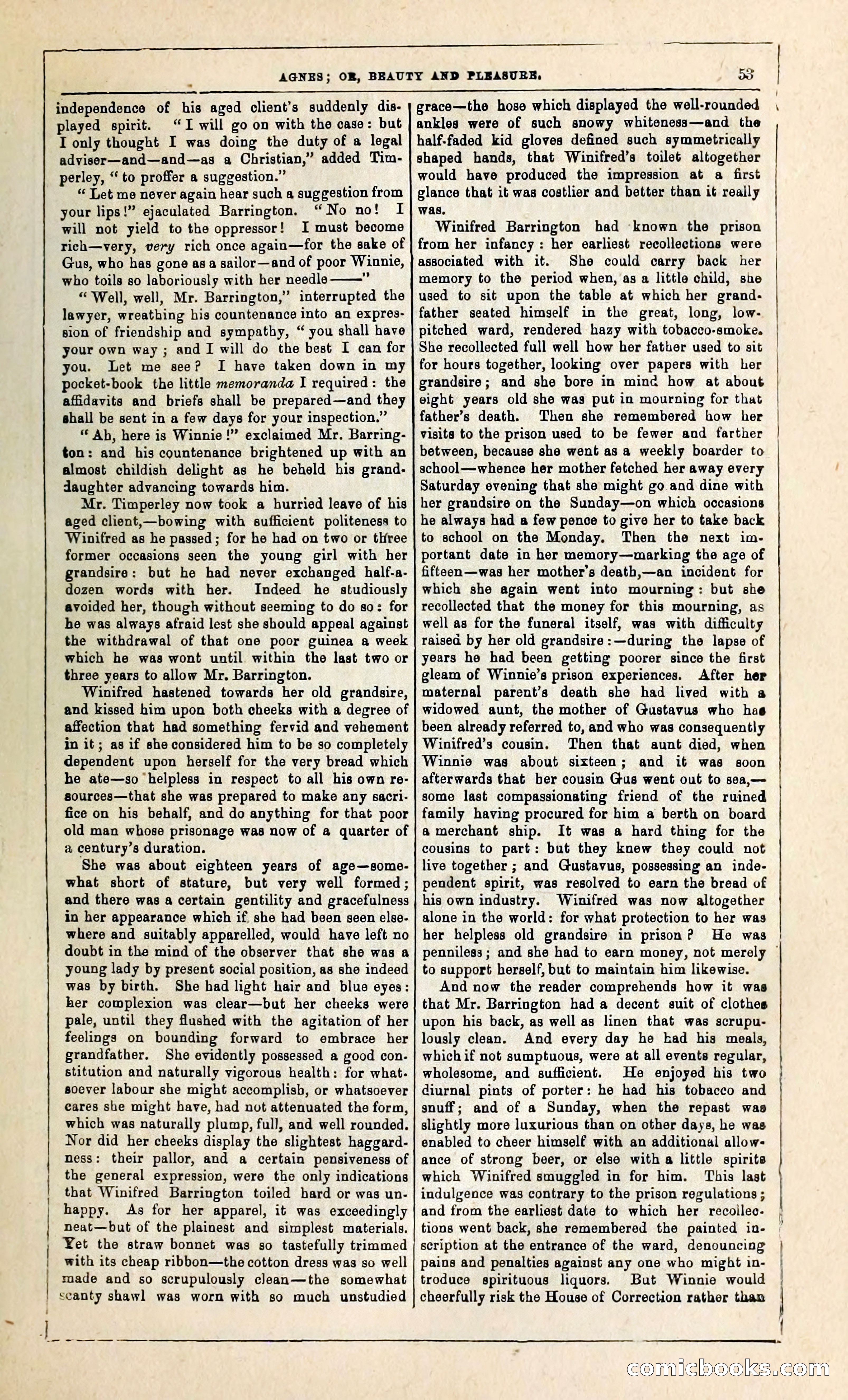
A restored page from Penny Dreadfuls, 1857. Page through the whole issue in the reader above.
📄 Transcribed text from this page (OCR, searchable)
Machine-transcribed from the original scan — historical spelling and the odd misread are preserved.
| | q AGNES; OB, BEAUTY AND PLEASUEE, independence of his aged client’s suddenly dis- played spirit. “TI will go on with the case: but I only thought I was doing the duty of a legal adviser—and—and—as a Christian,’ added Tim- perley, “ to proffer a suggestion.” «‘ Let me never again hear such a suggestion from your lips!” ejaculated Barrington. “No no! I will not yield to the oppressor! I must become rich—very, very rich once again—for the sake of Gus, who has gone asa sailor—and of poor Winnie, who toils so laboriously with her needle oe “Well, well, Mr. Barrington,” interrupted the lawyer, wreathing his countenance into an expres- sion of friendship and sympathy, “ you shall have your own way; and I will do the best I can for you. Let me see? I have taken down in my pocket-book the little memoranda I required: the affidavits and briefs shall be prepared—and they shall be sent in a few days for your inspection.” “ Ah, here is Winnie!” exclaimed Mr. Barring- ton: and his countenance brightened up with an almost childish delight as he beheld his grand- daughter advancing towards him. Mr. Timperley now took a hurried leave of his aged client,—bowing with sufficient politeness to Winifred as he passed; for he had on two or three former occasions seen the young girl with her grandsire: but he had never exchanged half-a- dozen words with her. Indeed he studiously avoided her, though without seeming to do so: for he was always afraid lest she should appeal against the withdrawal of that one poor guinea a week which he was wont until within the last two or three years to allow Mr. Barrington. Winifred hastened towards her old grandsire, and kissed him upon both cheeks with a degree of affection that had something fervid and vehement in it; as if she considered him to be so completely dependent upon herself for the very bread which he ate—so helpless in respect to all his own re- sources—that she was prepared to make any sacri- fice on his behalf, and do anything for that poor old man whose prisonage was now of a quarter of a century’s duration. She was about eighteen years of age—some- what short of stature, but very well formed; and there was a certain gentility and gracefulness in her appearance which if. she had been seen else- where and suitably apparelled, would have left no doubt in the mind of the observer that she was a young lady by present social position, as she indeed was by birth. She had light hair and blue eyes: her complexion was clear—but her cheeks were pale, until they flushed with the agitation of her feelings on bounding forward to embrace her grandfather. She evidently possessed a good con- stitution and naturally vigorous health: for what- soever labour she might accomplish, or whatsoever cares she might have, had not attenuated the form, which was naturally plump, full, and well rounded. Nor did her cheeks display the slightest haggard- ness: their pallor, and a certain pensiveness of the general expression, were the only indications that Winifred Barrington toiled bard or was un- happy. As for her apparel, it was exceedingly neat—but of the plainest and simplest materials. Yet the straw bonnet was so tastefully trimmed with its cheap ribbon—the cotton dress was so well made and so scrupulously clean—the somewhat | scanty shawl was worn with so much unstudied —_=-— ——_— DU a) grace—the hose which displayed the well-rounded ankles were of such snowy whiteness—and the half-faded kid gloves defined such symmetrically shaped hands, that Winifred’s toilet altogether would have produced the impression at a first glance that it was costlier and better than it really was. Winifred Barrington had known the prison from her infancy : her earliest recollections were associated with it. She could carry back her memory to the period when, as a little child, she used to sit upon the table at which her grand- father seated himself in the great, long, low- pitched ward, rendered hazy with tobacco-smoke. She recollected full well how her father used to sit for hours together, looking over papers with her grandsire; and she bore in minc how at about eight years old she was put in mourning for that father’s death. Then she remembered how her visits to the prison used to be fewer and farther between, because she went as a weekly boarder to school—whence her mother fetched her away every Saturday evening that she might go and dine with her grandsire on the Sunday—on which occasions he always had a few pence to give her to take back to school on the Monday. Then the next im- portant date in her memory—marking the age of fifteen—was her mother’s death,—an incident for which she again went into mourning: but she recollected that the money for this mourning, as well as for the funeral itself, was with difficulty raised by her old grandsire:—during the lapse of years he had been getting poorer since the first gleam of Winnie’s prison experiences. After her maternal parent’s death she had lived with a widowed aunt, the mother of Gustavus who has been already referred to, and who was consequently Winifred’s cousin. Then that aunt died, when Winnie was about sixteen; and it was soon afterwards that ber cousin Gus went out to sea,— some last compassionating friend of the ruined family having procured for him a berth on board a merchant ship. It was a hard thing for the cousins to part: but they knew they could not live together ; and Gustavus, possessing an inde- pendent spirit, was resolved to earn the bread of his own industry. Winifred was now altogether alone in the world: for what protection to her was her helpless old grandsire in prison? He was penniless ; and she had to earn money, not merely © to support herself, but to maintain him likewise. And now the reader comprehends how it was that Mr. Barrington had a decent suit of clothes upon his back, as well as linen that was scrupu- lously clean. And every day he had his meals, whichif not sumptuous, were at all events regular, wholesome, and sufficient. He enjoyed his two diurnal pints of porter: he had his tobacco and snuff; and of a Sunday, when the repast was slightly more luxurious than on other days, he was enabled to cheer himself with an additional allow- ance of strong beer, or else witha little spirits which Winifred smuggled in for him. This last indulgence was contrary to the prison regulations ; and from the earliest date to which her recollec- tions went back, she remembered the painted in- scription at the entrance of the ward, denouncing pains and penalties against any one who might in- troduce spirituous liquors. But Winnie would cheerfully risk the House of Correction rather than CoOMmicoool —_-_-—————__———_—_—_—_—_—_—- — — CO©