
Penny Dreadfuls, 1857 · page 62 of 394
Agnes, or, Beauty and Pleasure — page 62: what you’re looking at
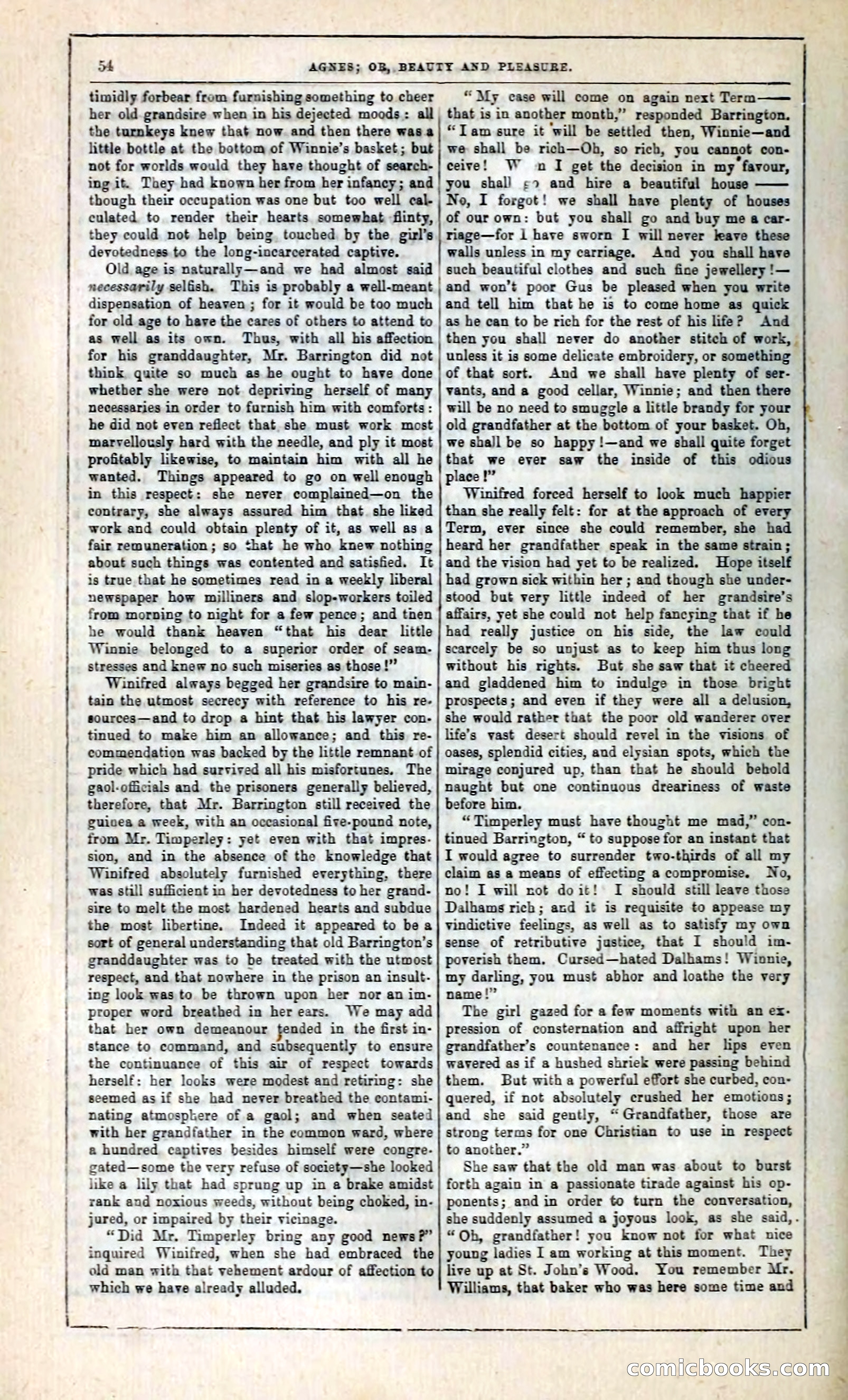
A restored page from Penny Dreadfuls, 1857. Page through the whole issue in the reader above.
📄 Transcribed text from this page (OCR, searchable)
Machine-transcribed from the original scan — historical spelling and the odd misread are preserved.
A TT SE o ee Be AGNES; OB, BEAUTY AND PLEASURE. timidly forbear from furnishing something to cheer her old grandsire when in his dejected moods: all the turnkeys knew that now and then there was a little bottle at the bottom of Winnie’s basket; but not for worlds would they have thought of search- ing it. They had known her from her infancy; and though their occupation was one but too well cal- culated to render their hearts somewhat flinty, they could not help being. touched. by the. girl’s devotedness to the long-incarcerated captive. Old age is naturally—and we had almost said necessarily selfish. This is probably a well-meant | dispensation of heaven ; for it would be too much for old age to have the cares of others to attend to as well as its own. Thus, with all his affection for his granddaughter, Mr. Barrington did not think. quite so much as he ought to have done whether she were not depriving herself of many necessaries in order to furnish him with comforts: he did not even reflect that she must work most marvellously hard with the needle, and ply it most profitably likewise, to maintain him with all he wanted. Things appeared to go on well enough in this respect: she never complained—on the contrary, she always assured him that. she liked work and could obtain plenty of it, as well as a fair remuneration; so that he who knew nothing about such things was contented and satisfied. It is true that he sometimes read in a weekly liberal newspaper how milliners and slop-workers toiled from morning to night for a few pence; and then he would thank heaven “that his dear little Winnie belonged to a superior order of seam- stresses and knew no such miseries as those!” Winifred always begged her grandsire to main- tain the utmost secrecy with reference to his re- sources—and to drop a hint that his lawyer con- tinued to make him an allowance; and this re- commendation was backed by the little remnant of pride which had survived all his misfortunes. The gaol-officials and the prisoners generally believed, therefore, that Mr. Barrington still received the guicea a week, with an occasional five-pound note, from Mr. Timperley: yet even with that impres- sion, and in the absence of the Enowledge that Winifred absolutely furnished everything, there was still sufficient in her devotedness to her grand- sire to melt the most hardened hearts and subdue the most libertine. Indeed it appeared to be a sort of general understanding that old Barrington’s granddaughter was to be treated with the utmost respect, and that nowhere in the prison an insult- ing look was.to. be thrown upon her nor an im- proper word breathed in herears. We may add that her own demeanour fended in the first in- stance to command, and subsequently to ensure the continuance of this air of respect towards herself: her looks were modest and retiring: she seemed as if she had never breathed the eontami- nating atmosphere of a gaol; and when seated with her grandfather in the common ward, where a hundred. captives besides himself were congre- gated—some the very refuse of society—she looked like a lily that had sprung up in a brake amidst rank and noxious weeds, without being choked, in- jured, or impaired by their vicinage. “Did Mr. Timperley bring any good news?” inquired Winifred, when she had embraced the old man with that vehement ardour of affection to which we have already alluded. ee “My case will come on again next Term—— that is in another month,” responded Barrington. “Tam sure it will be settled then, Winnie—and we shall be rich—Ob, so rich, you cannot con- ceive! W an I get the decision in my favour, you shall ¢> and hire a beautiful house No, I forgot! we shall have plenty of houses of our own: but you shall go and buy me a car- riage—for 1 have sworn I will never leave these walls unless in my carriage. And you shall have such beautiful clothes and such fine jewellery !— and won’t poor Gus be pleased when you write and tell him that he is to come home as quick as he can to be rich for the rest of his life? And then you shall never do another stitch of work, unless it is some delicate embroidery, or something of that sort. And we shall have plenty of ser- vants, and a good cellar, Winnie; and then there will be no need to smuggle a little brandy for your old grandfather at the bottom of your basket. Oh, we shaJl be so happy !—and we shall quite forget that we ever saw the inside of this odious place !” Winifred forced herself to look much happier than she really felt: for at the approach of every Term, ever since she could remember, she had heard her grandfather speak in the same strain; and the vision had yet to be realized. Hope itself had grown sick within her ; and though she under- stood but very little indeed of her grandsire’s affairs, yet she could not help fancying that if he had really justice on his side, the law could scarcely be so unjust as to keep him thus long without his rights. But she saw that it cheered and gladdened him to indulge in those bright prospects; and even if they were all a delusion, she would rather that the poor old wanderer over life’s vast desert should revel in the visions of oases, splendid cities, and elysian spots, which the mirage conjured up, than that he should behold naught but one continuous dreariness of waste before him. “Timperley must have thought me mad,” con- tinued Barrington, “ to suppose for an instant that I would agree to surrender two-thirds of all my claim as a means of effecting a compromise. No, no! I will not doit! I should still leave those Dalhams rich; and it is requisite to appease my vindictive feelings, as well as to satisfy my own sense of retributive justice, that I should im- poverish them. Cursed—hated Dalhams! Winnie, my darling, you must abhor and loathe the very name!” The girl gazed for a few moments with an ex- pression of consternation and affright upon her grandfather's countenance: and her hips even wavered as if a hushed shriek were passing behind them. But with a powerful effort she curbed, con- quered, if not absolutely crushed her emotions; and she said gently, “Grandfather, those are strong terms for one Christian to use in respect to another.” She saw that the old man was about to burst forth again in a passionate tirade against his op- ponents; and in order to turn the conversation, she suddenly assumed a joyous look, as she said,. “Oh, grandfather! you know not for what nice young ladies I am working at this moment. They live up at St. John’s Wood. You remember Mr. Williams, that baker who was here some time and comleloolks (a) (E(0)