
Penny Dreadfuls, 1857 · page 60 of 394
Agnes, or, Beauty and Pleasure — page 60: what you’re looking at
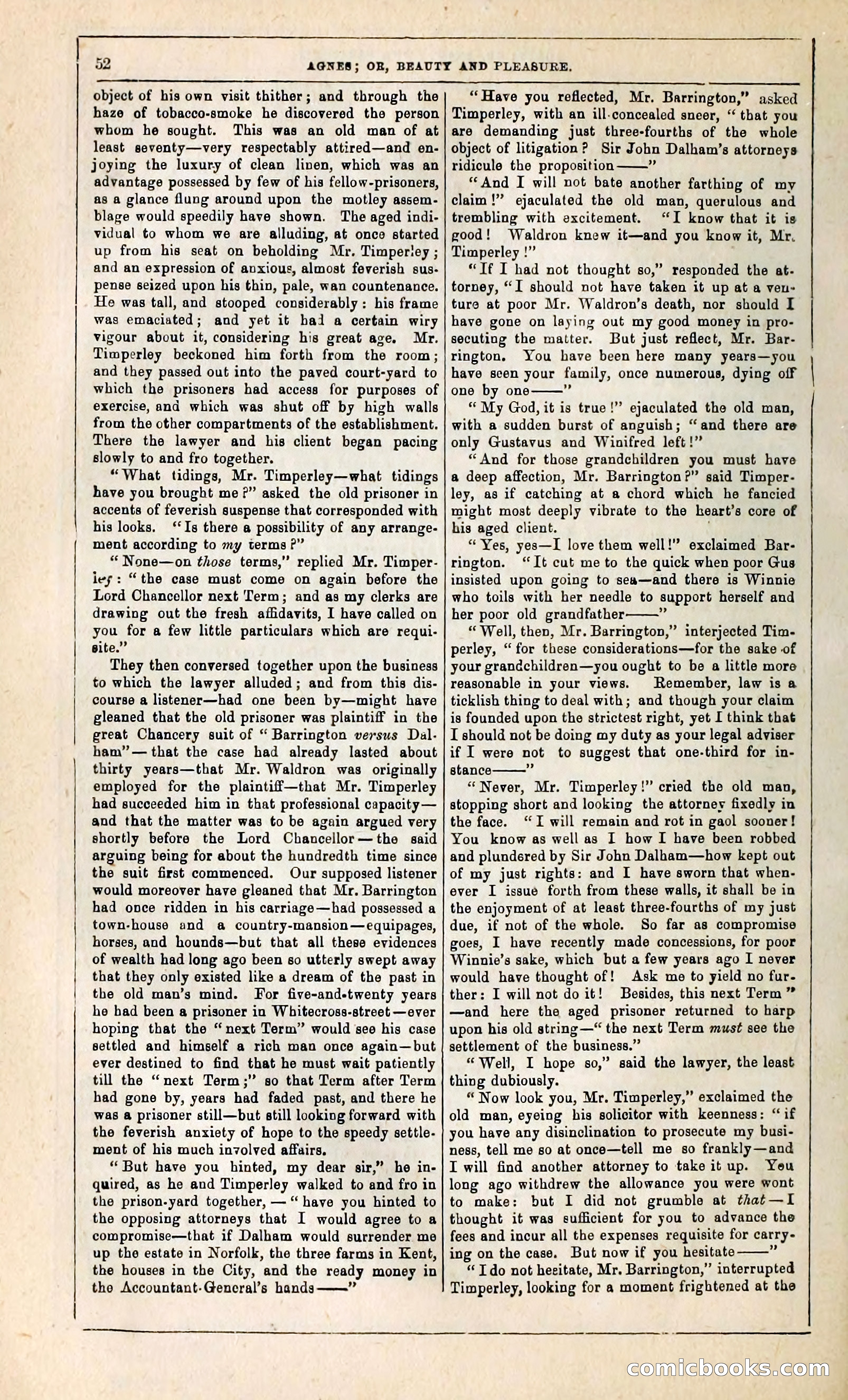
A restored page from Penny Dreadfuls, 1857. Page through the whole issue in the reader above.
📄 Transcribed text from this page (OCR, searchable)
Machine-transcribed from the original scan — historical spelling and the odd misread are preserved.
St a ee nF cr object of his own visit thither; and through the haze of tobacco-smoke he discovered the person whom he sought. This was an old man of at least seventy—very respectably attired—and en- joying the luxury of clean linen, which was an advantage possessed by few of his fellow-prisoners, as a glance flung around upon the motley assem- blage would speedily have shown. The aged indi- vidual to whom we are alluding, at once started up from his seat on beholding Mr. Timperiey ; and an expression of anxious, almost feverish sus- pense seized upon his thin, pale, wan countenance. He was tall, and stooped considerably: his frame was emaciated; and yet it bad a certain wiry vigour about it, considering his great age. Mr. Timperley beckoned him forth from the room; and they passed out into the paved court-yard to which the prisoners had access for purposes of exercise, and which was shut off by high walls from the other compartments of the establishment. There the lawyer and his client began pacing slowly to and fro together. “What tidings, Mr. Timperley—what tidings have you brought me?” asked the old prisoner in accents of feverish suspense that corresponded with his looks. ‘‘Is there a possibility of any arrange- ment according to my terms?” ** None—on those terms,” replied Mr. Timper- ies: “the case must come on again before the Lord Chancellor next Term; and as my clerks are drawing out the fresh affidavits, I have called on you for a few little particulars which are requi- site.” They then conversed together upon the business to which the lawyer alluded; and from this dis- course a listener—had one been by—might have gleaned that the old prisoner was plaintiff in the great Chancery suit of “ Barrington versus Dal- ham’’— that the case had already lasted about thirty years—that Mr. Waldron was originally employed for the plaintiff—that Mr. Timperley had succeeded him in that professional capacity — and that the matter was to be again argued very shortly before the Lord Chancellor—the said arguing being for about the hundredth time since the suit first commenced. Our supposed listener would moreover have gleaned that Mr. Barrington had once ridden in his carriage—had possessed a town-house and a country-mansion—equipages, horses, and hounds—but that all these evidences of wealth had long ago been so utterly swept away that they only existed like a dream of the past in the old man’s mind. For five-andetwenty years he had been a prisoner in Whitecross-street —ever hoping that the “next Term” would see his case settled and himself a rich man once again—but ever destined to find that he must wait patiently till the “next Term;” so that Term after Term had gone by, years had faded past, and there he was a@ prisoner still—but still looking forward with the feverish anxiety of hope to the speedy settle- ment of his much involved affairs, “But have you hinted, my dear sir,” he in- quired, as he and Timperley walked to and fro in the prison-yard together, — “ have you hinted to the opposing attorneys that I would agree to a compromise—that if Dalham would surrender me up the estate in Norfolk, the three farms in Kent, the houses in the City, and the ready money in the Accountant-General’s hands —~” _——_— | 2 AGNES; OR, BEAUTY AND PLEASURE, I a ne “Have you reflected, Mr. Barrington,” asked Timperley, with an ill-concealed sneer, “ that you are demanding just three-fourths of the whole object of litigation? Sir John Dalham’s attorneys ridicule the proposition M4 ‘And I will not bate another farthing of my claim!” ejaculated the old man, querulous and trembling with axcitement. “I know that it is good! Waldron knew it—and you know it, Mr. Timperley !” “Tf I had not thought so,” responded the at- torney, “I should not have taken it up at a ven- ture at poor Mr. Waldron’s death, nor should I have gone on laying out my good money in pro- secuting the matter. But just reflect, Mr. Bar- rington, You have been here many years—you have seen your family, once numerous, dying off one by one as “My God, it is true!” ejaculated the old man, with a sudden burst of anguish; “and there are only Gustavus and Winifred left!” ‘And for those grandchildren you must have a deep affection, Mr. Barrington?” said Timper- ley, as if catching at a chord which he fancied might most deeply vibrate to the heart’s core of his aged client. “ Yes, yes—I love them well!” exclaimed Bar- rington. “It cut me to the quick when poor Gus insisted upon going to sea—and there is Winnie who toils with her needle to support herself and her poor old grandfather “ “Well, then, Mr. Barrington,” interjected Tim- perley, “for these considerations—for the sake of your grancchildren—you ought to be a little more reasonable in your views. Remember, law is a ticklish thing to deal with; and though your claim is founded upon the strictest right, yet I think that I should not be doing my duty as your legal adviser if I were not to suggest that one-third for in- stance “ “ Never, Mr. Timperley!” cried the old man, stopping short and looking the attorney fixedly in the face. ‘I will remain and rot in gaol sooner! You know as well as I how I have been robbed and plundered by Sir John Dalham—how kept out of my just rights: and I have sworn that when- ever I issue forth from these walls, it shall be in the enjoyment of at least three-fourths of my just due, if not of the whole. So far as compromise goes, I have recently made concessions, for poor Winnie’s sake, which but a few years ago I never would have thought of! Ask me to yield no fur- ther: I will not doit! Besides, this next Term ” —and here the aged prisoner returned to harp upon his old string —“ the next Term must see the settlement of the business.”’ “Well, I hope so,” said the lawyer, the least thing dubiously. “ Now look you, Mr. Timperley,” exclaimed the old man, eyeing his solicitor with keenness: “ if you have any disinclination to prosecute my busi- ness, tell me so at once—tell me so frankly—and I will find another attorney to take it up. You long ago withdrew the allowance you were wont to make: but I did not grumble at that—I thought it was sufficient for you to advance the fees and incur all the expenses requisite for carry- ing on the case. But now if you hesitate e “T do not heeitate, Mr. Barrington,” interrupted Timperley, looking for a moment frightened at the LNOOKES () : (9) (Eo) eee