
Penny Dreadfuls, 1857 · page 44 of 394
Agnes, or, Beauty and Pleasure — page 44: what you’re looking at
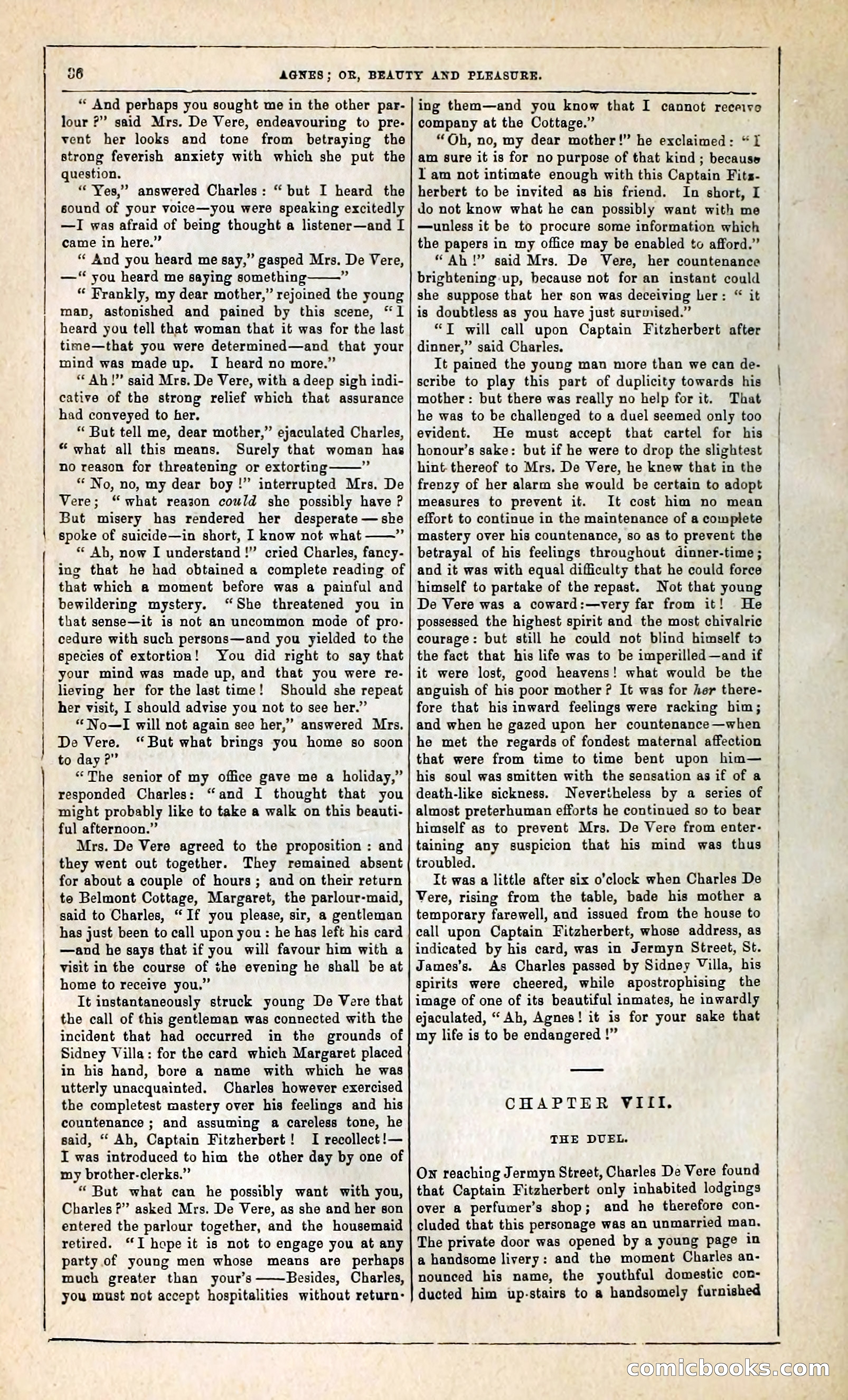
A restored page from Penny Dreadfuls, 1857. Page through the whole issue in the reader above.
📄 Transcribed text from this page (OCR, searchable)
Machine-transcribed from the original scan — historical spelling and the odd misread are preserved.
HH} AGNES; OR, BEAUTY AND PLEASURE. ** And perhaps you sought me in the other par- | ing them—and you know that I cannot receive lour ?” said Mrs. De Vere, endeavouring to pre- vent her looks and tone from betraying the strong feverish anxiety with which she put the question. “« Yes,” answered Charles: “ but I heard the sound of your voice—you were speaking excitedly —I was afraid of being thought a listener—and I came in here.” “* And you heard me say,” gasped Mrs. De Vere, —‘ you heard me saying something éd “ Frankly, my dear mother,” rejoined the young map, astonished and pained by this scene, “1 heard you tell that woman that it was for the last time—that you were determined—and that your mind was made up. I heard no more.” “Ah!” said Mrs. De Vere, with a deep sigh indi- cative of the strong relief which that assurance had conveyed to her. “But tell me, dear mother,” ejaculated Charles, “what all this means. Surely that woman has no reason for threatening or extorting a ** No, no, my dear boy !” interrupted Mrs. De Vere; “what reason could she possibly have ? But misery has rendered her desperate — she spoke of suicide—in short, I know not what ——”’ ** Ah, now I understand !” cried Charles, fancy- ing that he had obtained a complete reading of that which a moment before was a painful and bewildering mystery. “She threatened you in that sense—it is not an uncommon mode of pro- cedure with such persons—and you yielded to the species of extortion! You did right to say that your mind was made up, and that you were re- lieving her for the last time! Should she repeat her visit, I should advise you not to see her.” * No—I will not again see her,” answered Mrs. De Vere. “But what brings you home so soon to day P” “The senior of my office gave me a holiday,” responded Charles: “and I thought that you might probably like to take a walk on this beauti- ful afternoon.” Mrs. De Vere agreed to the proposition : and they went out together. They remained absent for about a couple of hours; and on their return to Belmont Cottage, Margaret, the parlour-maid, said to Charles, “If you please, sir, a gentleman has just been to call upon you: he has left his card —and he says that if you will favour him with a visit in the course of the evening he shall be at home to receive you.” It instantaneously struck young De Vere that the call of this gentleman was connected with the incident that had occurred in the grounds of Sidney Villa: for the card which Margaret placed in his hand, bore a name with which he was utterly unacquainted. Charles however exercised the completest mastery over his feelings and his countenance ; and assuming a careless tone, he said, “‘ Ah, Captain Fitzherbert! I recollect!— I was introduced to him the other day by one of my brother-clerks.” * But what can he possibly want with you, Charles ?”’ asked Mrs. De Vere, as she and her son entered the parlour together, and the housemaid retired. “I hope it is not to engage you at any party of young men whose means are perhaps much greater than your’s ——Besides, Charles, you must not accept hospitalities without return- company at the Cottage.” “Oh, no, my dear mother!” he exclaimed: “I am sure it is for no purpose of that kind ; because I am not intimate enough with this Captain Fits- herbert to be invited as his friend. In short, I do not know what he can possibly want with me —unless it be to procure some information which the papers in my office may be enabled to afford.” * Ah!” said Mrs. De Vere, her countenance brightening up, because not for an instant could she suppose that her son was deceiving her: “ it is doubtless as you have just surmised.” *“T will call upon Captain Fitzherbert after dinner,” said Charles. It pained the young man more than we can de- scribe to play this part of duplicity towards his mother: but there was really no help for it. That he was to be challenged to a duel seemed only too evident. He must accept that cartel for his honour’s sake: but if he were to drop the slightest hint- thereof to Mrs. De Vere, he knew that in the frenzy of her alarm she would be certain to adopt measures to prevent it. It cost him no mean effort to continue in the maintenance of a complete mastery over his countenance, so as to prevent the betrayal of his feelings throughout dinner-time; and it was with equal difficulty that he could force himself to partake of the repast. Not that young De Vere was a coward:—very far from it! He possessed the highest spirit and the most chivalric courage: but still he could not blind himself to the fact that his life was to be imperilled—and if it were lost, good heavens! what would be the anguish of his poor mother? It was for her there- fore that his inward feelings were racking him; and when he gazed upon her countenance —when he met the regards of fondest maternal affection that were from time to time bent upon him— his soul was smitten with the sensation as if of a death-like sickness. Nevertheless by a series of almost preterhuman efforts he continued so to bear himself as to prevent Mrs. De Vere from enter- taining any suspicion that his mind was thus troubled. It was a little after six o’clock when Charles De Vere, rising from the table, bade his mother a temporary farewell, and issued from the house to call upon Captain Fitzherbert, whose address, as indicated by his card, was in Jermyn Street, St. James’s. As Charles passed by Sidney Villa, his spirits were cheered, while apostrophising the image of one of its beautiful inmates, he inwardly ejaculated, “Ah, Agnes! it is for your sake that my life is to be endangered !” CHAPTER VIII. THE DUEL. On reaching Jermyn Street, Charles De Vere found that Captain Fitzherbert only inhabited lodgings over a perfumer’s shop; and he therefore con- cluded that this personage was an unmarried man. The private door was opened by a young page in a handsome livery: and the moment Charles an- nounced his name, the youthful domestic con- ducted him up-stairs to a handsomely furnished com <——— = we ee SS SSS OOOO ——_—EEEEOOOOOOEOEOEOEOEOOEOEEEeeeeeeeeeeee Ghbooks (EC)