
Penny Dreadfuls, 1857 · page 43 of 394
Agnes, or, Beauty and Pleasure — page 43: what you’re looking at
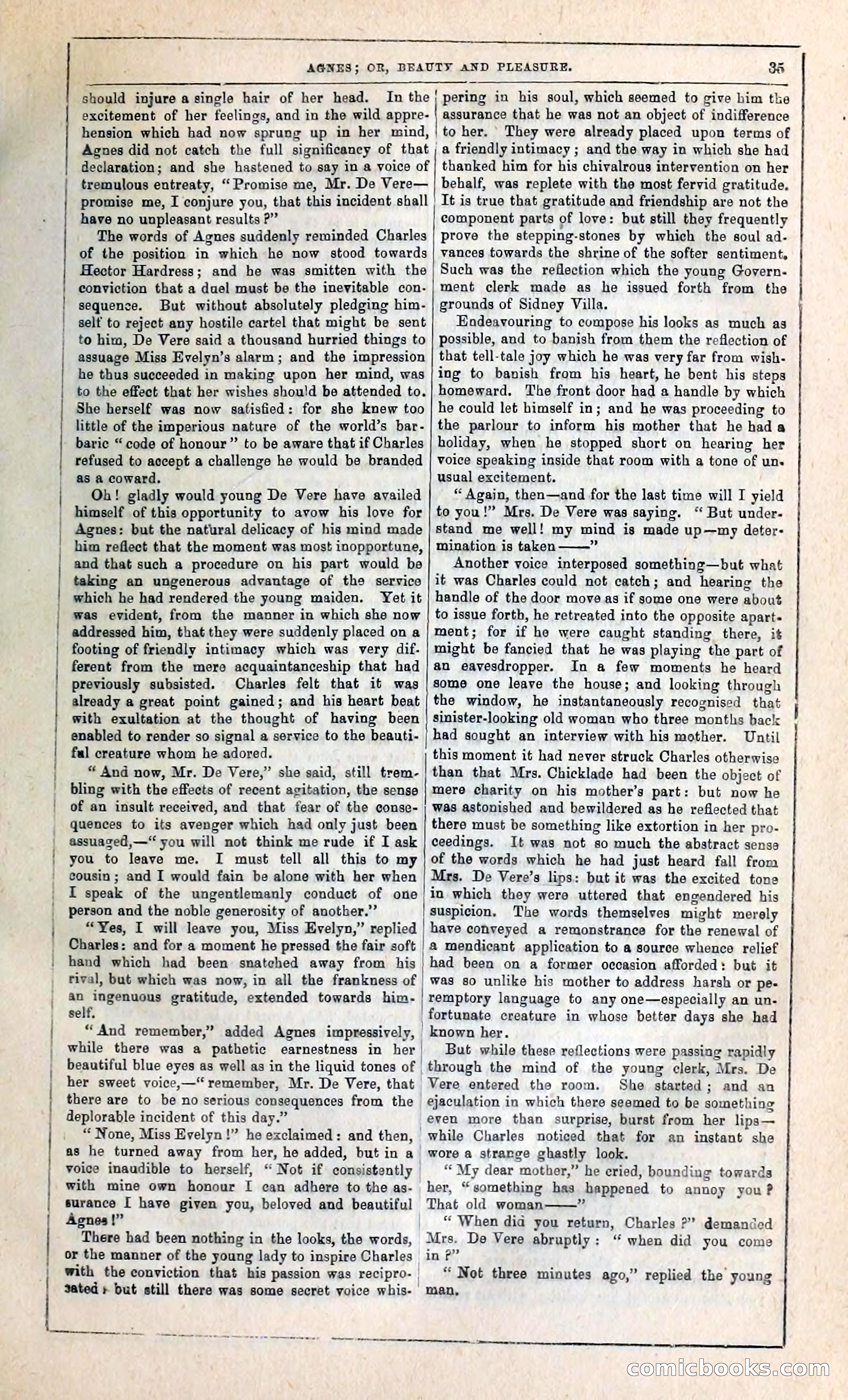
A restored page from Penny Dreadfuls, 1857. Page through the whole issue in the reader above.
📄 Transcribed text from this page (OCR, searchable)
Machine-transcribed from the original scan — historical spelling and the odd misread are preserved.
ee AGNES; OR, BEAUTY AND PLEASURE. should injure a single hair of her head. In the excitement of her feelings, and in the wild appre- hension which had now sprung up in her mind, Agnes did not catch the full significancy of that declaration; and she hastened to say in a voice of tremulous entreaty, “ Promise me, Mr. De Vere— promise me, I conjure you, that this incident shall have no unpleasant results P” The words of Agnes suddenly reminded Charles of the position in which he now stood towards Hector Hardress; and he was smitten with the conviction that a duel must be the inevitable con- sequence. But without absolutely pledging him- self to reject any hostile cartel that might be sent to him, De Vere said a thousand hurried things to assuage Miss Evelyn’s alarm; and the impression he thus succeeded in making upon her mind, was to the effect that her wishes should be attended to. She herself was now safisfied: for she knew too little of the imperious nature of the world’s bar- baric “code of honour” to be aware that if Charles refused to accept a challenge he would be branded as a coward. Ob! gladly would young De Vere have availed himself of this opportunity to avow his love for Agnes: but the natural delicacy of his mind made him reflect that the moment was most inopportune, and that such a procedure on his part would be taking an ungenerous advantage of the service which he had rendered the young maiden. Yet it was evident, from the manner in which she now addressed him, that they were suddenly placed on a footing of friendly intimacy which was very dif. ferent from the mere acquaintanceship that had previously subsisted. Charles felt that it was already a great point gained; and his heart beat with exultation at the thought of having been enabled to render so signal a service to the beauti- fal creature whom he adored. * And now, Mr. De Vere,” she said, still trem- bling with the effects of recent agitation, the sense of an insult received, and that fear of the conse- quences to its avenger which had only just been assuaged,—“ you will not think me rude if I ask you to leave me. I must tell all this to my cousin; and I would fain be alone with her when I speak of the ungentlemanly conduct of one person and the noble generosity of another.” “Yes, I will leave you, Miss Evelyn,” replied Charles: and for a moment he pressed the fair soft hand which had been snatched away from his rival, but which was now, in all the frankness of an ingenuous gratitude, extended towards him- self. “And remember,” added Agnes impressively, while there was a pathetic earnestness in her ( | oes eeiini beautiful blue eyes as well as in the liquid tones of her sweet voice,—“ remember, Mr. De Vere, that there are to be no serious consequences from the deplorable incident of this day.” “None, Miss Evelyn!” he exclaimed: and then, as he turned away from her, he added, but in a voice inaudible to herself, “Not if consistently with mine own honour [ can adhere to the as- surance [ have given you, beloved and beautiful Agnes!” There had been nothing in the looks, the words, or the manner of the young lady to inspire Charles oe pering in his soul, which seemed to give him tke assurance that he was not an object of indifference to her. They were already placed upon terms of a friendly intimacy ; and the way in which she had thanked him for his chivalrous intervention on her behalf, was replete with the most fervid gratitude. It is true that gratitude and friendship are not the component parts of love: but still they frequently prove the stepping-stones by which the soul ad- vances towards the shrine of the softer sentiment, Such was the reflection which the young Goyern- ment clerk made as he issued forth from the grounds of Sidney Villa. Endeavouring to compose his looks as much as possible, and to banish from them the reflection of that tell-tale joy which he was very far from wish- ing to banish from his heart, he bent his steps homeward. The front door had a handle by which he could let himself in; and he was proceeding to the parlour to inform his mother that he had a holiday, when he stopped short on hearing her voice speaking inside that room with a tone of un. usual excitement. “Again, then—and for the last time will I yield to you!” Mrs. De Vere was saying. “ But under. stand me well! my mind is made up—my deter- mination is taken if Another voice interposed something—but what it was Charles could not catch; and hearing the handle of the door move as if some one were about to issue forth, he retreated into the opposite apart- ment; for if he were caught standing there, it might be fancied that he was playing the part of an eavesdropper. In a few moments he heard some one leave the house; and looking through the window, he instantaneously recognised that sinister-looking old woman who three months baclx had sought an interview with his mother. Until this moment if had never struck Charles otherwise than that Mrs. Chicklade had been the object of mere charity on his mother’s part: but now he was astonished and bewildered as he reflected that there must be something like extortion in her pro- ceedings. It was not so much the abstract sense of the words which he had just heard fall from Mrs. De Vere’s lips: but it was the excited tone in which they were uttered that engendered his suspicion. The words themselves might merely have conveyed a remonstrance for the renewal of & mendicant application to a source whence relief had been on a former occasion afforded: but it was so unlike his mother to address harsh or pe- remptory language to any one—especially an un- fortunate creature in whose better days she had known her. But while these reflections were passing rapidly through the mind of the young clerk, Mrs. De Vere entered the room. She started; and an ejaculation in which there seamed to be something even more than surprise, burst from her lips— while Charles noticed that for an instant she with the conviction that his passion was recipro-— man, dated + but still there was some secret voice whis- ee - wore a strange ghastly look. “My dear mother,” he cried, bounding towards her, “something has happened to annoy you? That old woman Ms “ When dia you return, Charles ?” demanded Mrs. De Vere abruptly: “ when did you come in P” “ Not three minutes ago,” replied the young — Corn iclo@oks (Co)