
Penny Dreadfuls, 1857 · page 45 of 394
Agnes, or, Beauty and Pleasure — page 45: what you’re looking at
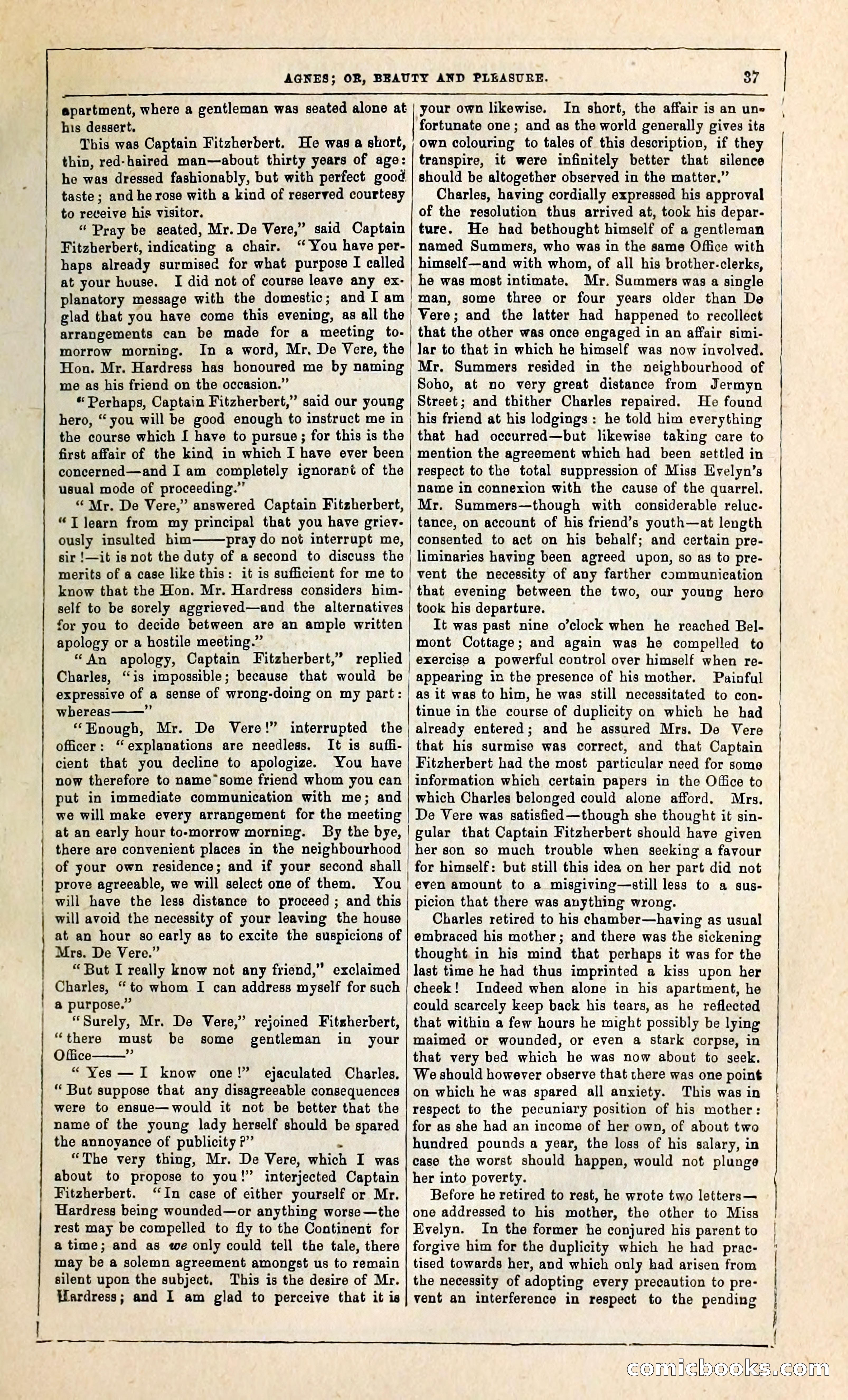
A restored page from Penny Dreadfuls, 1857. Page through the whole issue in the reader above.
📄 Transcribed text from this page (OCR, searchable)
Machine-transcribed from the original scan — historical spelling and the odd misread are preserved.
AGNES; OR, BEAUTY AND PLEASURE. 37 apartment, where a gentleman was seated alone at | your own likewise. his dessert. This was Captain Fitzherbert. He was a short, thin, red-haired man—about thirty years of age: he was dressed fashionably, but with perfect good taste; and he rose with a kind of reserved courtesy to receive his visitor. “ Pray be seated, Mr. De Vere,” said Captain Fitzherbert, indicating a chair. ‘ You have per- haps already surmisec for what purpose I called at your house. I did not of course leave any ex- planatory message with the domestic; and I am glad that you have come this evening, as all the arrangements can be made for a meeting to- morrow morning. In a word, Mr, De Vere, the Hon. Mr. Hardress has honoured me by naming me as his friend on the occasion.” * Perhaps, Captain Fitzherbert,” said our young hero, “you will be good enough to instruct me in the course which [ have to pursue; for this is the first affair of the kind in which I have ever been concerned—and I am completely ignorant of the usual mode of proceeding.” “‘ Mr. De Vere,” answered Captain Fitzherbert, “TJ learn from my principal that you have griev- ously insulted him pray do not interrupt me, sir !—it is not the duty of a second to discuss the merits of a case like this: it is sufficient for me to know that the Hon. Mr. Hardress considers him- self to be sorely aggrieved—and the alternatives for you to decide between are an ample written apology or a hostile meeting.” * An apology, Captain Fitsherbert, ” replied Charles, ‘“‘is impossible; because that would be expressive of a sense of wrong-doing on my part: whereas ‘ Enough, Mr. De Vere!” interrupted the officer: ‘explanations are needless. It is sufli- cient that you decline to apologize. You have now therefore to name some friend whom you can put in immediate communication with me; and we will make every arrangement for the meeting at an early hour to-morrow morning. Jy the bye, there are convenient places in the neighbourhood of your own residence; and if your second shall | prove agreeable, we will select one of them. You | will have the less distance to proceed ; and this will avoid the necessity of your leaving the house at an hour so early as to excite the suspicions of Mrs. De Vere.” “ But I really know not any friend,” exclaimed Charles, “to whom I can address myself for such @ purpose.” “Surely, Mr. De Vere,” “there must be some Office “Yes —I1 know one!” ejaculated Charles, “But suppose that any disagreeable consequences were to ensue—would it not be better that the name of the young lady herself should be spared the annoyance of publicity P” “The very thing, Mr. De Vere, which I was about to propose to you!” interjected Captain Fitzherbert. “In case of either yourself or Mr. Hardress being wounded—or anything worse—the rest may be compelled to fly to the Continent for a time; and as we only could tell the tale, there may be a solemn agreement amongst us to remain silent upon the subject, This is the desire of Mr. Hardress; and I am glad to perceive that it is rejoined Fitsherbert, gentleman in your In short, the affair is an un fortunate one; and as the world generally gives its own colouring to tales of this description, if they transpire, it were infinitely better that silence should be altogether observed in the matter.” Charles, having cordially expressed his approval of the resolution thus arrived at, took his depar- ture. He had bethought himself of a gentleman named Summers, who was in the same Office with himself—and with whom, of all his brother-clerks, he was most intimate. Mr. Summers was a single man, some three or four years older than De Vere; and the latter had happened to recollect that the other was once engaged in an affair simi- lar to that in which he himself was now involved. Mr. Summers resided in the neighbourhood of Soho, at no very great distance from Jermyn Street; and thither Charles repaired. He found his friend at his lodgings: he told him everything that had occurred—but likewise taking care to mention the agreement which had been settled in respect to the total suppression of Miss Evelyn’s name in connexion with the cause of the quarrel. Mr. Summers—though with considerable reluc- tance, on account of his friend’s youth—at length consented to act on his behalf; and certain pre- liminaries having been agreed upon, so as to pre- vent the necessity of any farther communication that evening between the two, our young hero took his departure. It was past nine o’clock when he reached Bel- mont Cottage; and again was he compelled to exercise a powerful control over himself when re- appearing in the presence of his mother. Painful as it was to him, he was still necessitated to con- tinue in the course of duplicity on which he had already entered; and he assured Mrs. De Vere that his surmise was correct, and that Captain Fitzherbert had the most particular need for some information which certain papers in the Office to which Charles belonged could alone afford. Mrs. De Vere was satisfied—though she thought it sin- gular that Captain Fitzherbert should have given her son so much trouble when seeking a favour for himself: but still this idea on her part did not even amount to a misgiving—still less to a sus- picion that there was anything wrong. Charles retired to his chamber—having as usual embraced his mother; and there was the sickening thought in his mind that perhaps it was for the last time he had thus imprinted a kiss upon her cheek! Indeed when alone in his apartment, he could scarcely keep back his tears, as he reflected that within a few hours he might possibly be lying maimed or wounded, or even a stark corpse, in that very bed which he was now about to seek. We should however observe that there was one point on which he was spared all anxiety. This was in respect to the pecuniary position of his mother: for as she had an income of her own, of about two hundred pounds a year, the loss of his salary, in case the worst should happen, would not plunge her into poverty. Before he retired to rest, he wrote two letters— one addressed to his mother, the other to Miss Evelyn. In the former he conjured his parent to forgive him for the duplicity which he had prac- tised towards her, and which only had arisen from the necessity of adopting every precaution to pre- vent an interference in respect to the pending Gbooks CO