
Life, 1927-02-17 · page 21 of 34
Life — February 17, 1927 — page 21: what you’re looking at
What you’re looking at
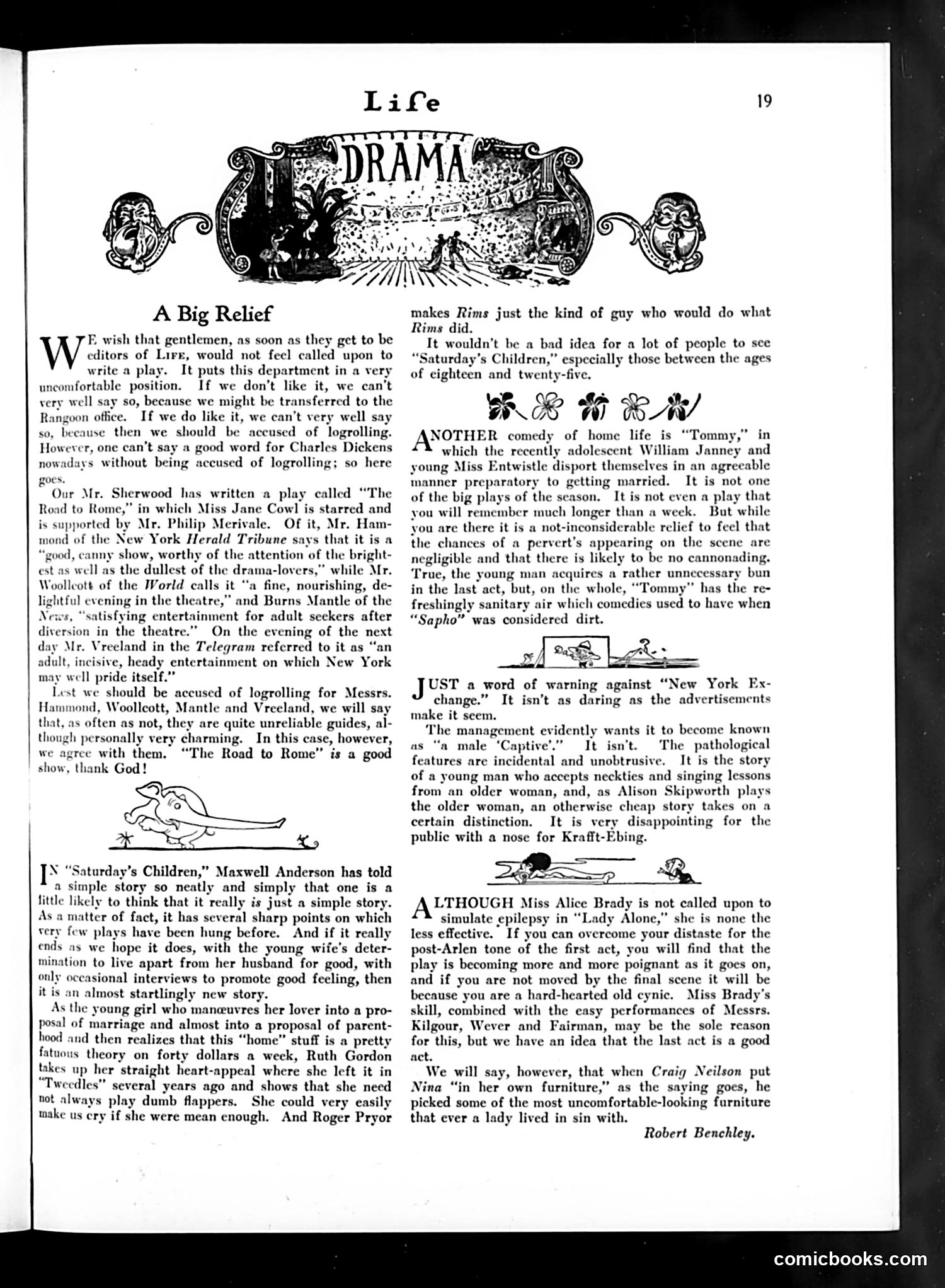
This page contains theatrical reviews by Robert Benchley, Life's drama critic. The piece humorously opens with Benchley noting the awkward position of reviewing plays written by Life's own editors—he risks either appearing to do "logrolling" (mutual promotion) if he praises it, or facing transfer to the "Rangoon office" if he criticizes it. Benchley reviews several Broadway plays: "The Road to Rome" (starring Jane Cowl), which he endorses despite claiming neutrality; "Saturday's Children" by Maxwell Anderson, featuring Ruth Gordon, which he praises for its modern take on marriage and domesticity; "Tommy," a lightweight comedy he deems acceptably wholesome; and "New York Exchange," which he critiques for overselling itself as daring when it's merely mediocre. The satire targets contemporary theater's sensationalism and the pretensions of theatrical management. References to "Sapho" being "considered dirt" reflect changing moral standards in early 20th-century drama.
📄 Transcribed text from this page (OCR, searchable)
Machine-transcribed from the original scan — historical spelling and the odd misread are preserved.
A Big Relief F. wish that gentlemen, as soon as they get to be Waiter of Lire, would not feel called upon to write a pl. It puts this department in a very uncomfortable position. If we don’t like it, we can’t very well say so, because we might be transferred to the Rangoon office. If we do like it, we can’t very well say so, because then we should be accused of logrolling. However, one can’t say a good word for Charles Dickens nowadays without being accused of logrolling; so here goes. "Our Mr. Sherwood has written a play called “The Road to Rome,” in which Miss Jane Cowl is starred and is supported by Mr. Philip Merivale. Of it, Mr. Ham- mond of the New York Herald Tribune says that it is a “good, canny show, worthy of the attention of the bright- est as well as the dullest of the drama-lovers,” while Mr. Woollcott of the World calls it “a fine, nourishing, de- lightful evening in the theatre,” and Burns Mantle of the N sfying entertainment for adult seckers after diversion in the theatre.” On the evening of the next day Mr. Vreeland in the Telegram referred to it as “an adult, incisive, heady entertainment on which New York may well pride itself.” lest we should be accused of logrolling for Messrs. Hammond, Woollcott, Mantle and Vreeland, we will say that, as often as not, they are quite unreliable guides, al- thoi personally very charming. In this case, however, we agree with them. “The Road to Rome” is a good show, thank God! N “Saturday’s Children,” Maxwell Anderson has told a simple story so neatly and simply that one is a little likely to think that it really is just a simple story. As a matter of fact, it has several sharp points on which very few plays have been hung before. And if it really ends as we hope it does, with the young wife's deter- mination to live apart from her husband for good, with only occasional interviews to promote good feeling, then it is an almost startlingly new story. As the young girl who maneeuvres her lover into a pro- posal of marriage and almost into a proposal of parent- hood and then realizes that this “home” stuff is a pretty fatuous theory on forty dollars a week, Ruth Gordon takes up her straight heart-appeal where she left it in Tweedles” several years ago and shows that she need play dumb flappers. She could very easily 'y if she were mean enough. And Roger Pryor makes Rims just the kind of guy who would do what Rims did. It wouldn't be a bad idea for a lot of people to see “Saturday’s Children,” especially those between the ages of eighteen and twenty-five. A WO Go NOTHER comedy of home life is “Tommy,” in which the recently adolescent William Janney and young Miss Entwistle disport themselves in an agreeable manner preparatory to getting married. It is not one of the big plays of the season. It is not even a play that you will remember much longer than a week. But while you are there it is a not-inconsiderable relief to feel that the chances of a pervert’s appearing on the scene are negligible and that there is likely to be no cannonading. True, the young man acquires a rather unnecessary bun in the last act, but, on the whole, “Tommy” has the re- freshingly sanitary air which comedies used to have when “Sapho” was considered dirt. 24 Just a word of warning against “New York Ex- change.” It isn’t as daring as the advertisements make it seem. The management evidently wants it to become known as “a male ‘Captive’.” It isn't. The pathological features are incidental and unobtrusive. It is the story of a young man who accepts neckties and singing lessons from an older woman, and, as Alison Skipworth pl the older woman, an otherwise cheap story takes on a certain distinction. It is very disappointing for the public with a nose for Krafft-Ebing. ALTHOUGH Miss Alice Brady is not called upon to simulate epilepsy in “Lady Alone,” she is none the less effective. If you can overcome your distaste for the post-Arlen tone of the first act, you will find that the play is becoming more and more poignant as it goes on, and if you are not moved by the final scene it will be because you are a hard-hearted old cynic. Miss Brady's skill, combined with the easy performances of Messrs. Kilgour, Wever and Fairman, may be the sole reason for this, but we have an idea that the last act is a good act. We will say, however, that when Craig Neilson put Nina “in her own furniture,” as the saying goes, he picked some of the most uncomfortable-looking furniture that ever a lady lived in sin with. Robert Benchley. comicbooks.com