
Life, 1926-07-15 · page 21 of 37
Life — July 15, 1926 — page 21: what you’re looking at
What you’re looking at
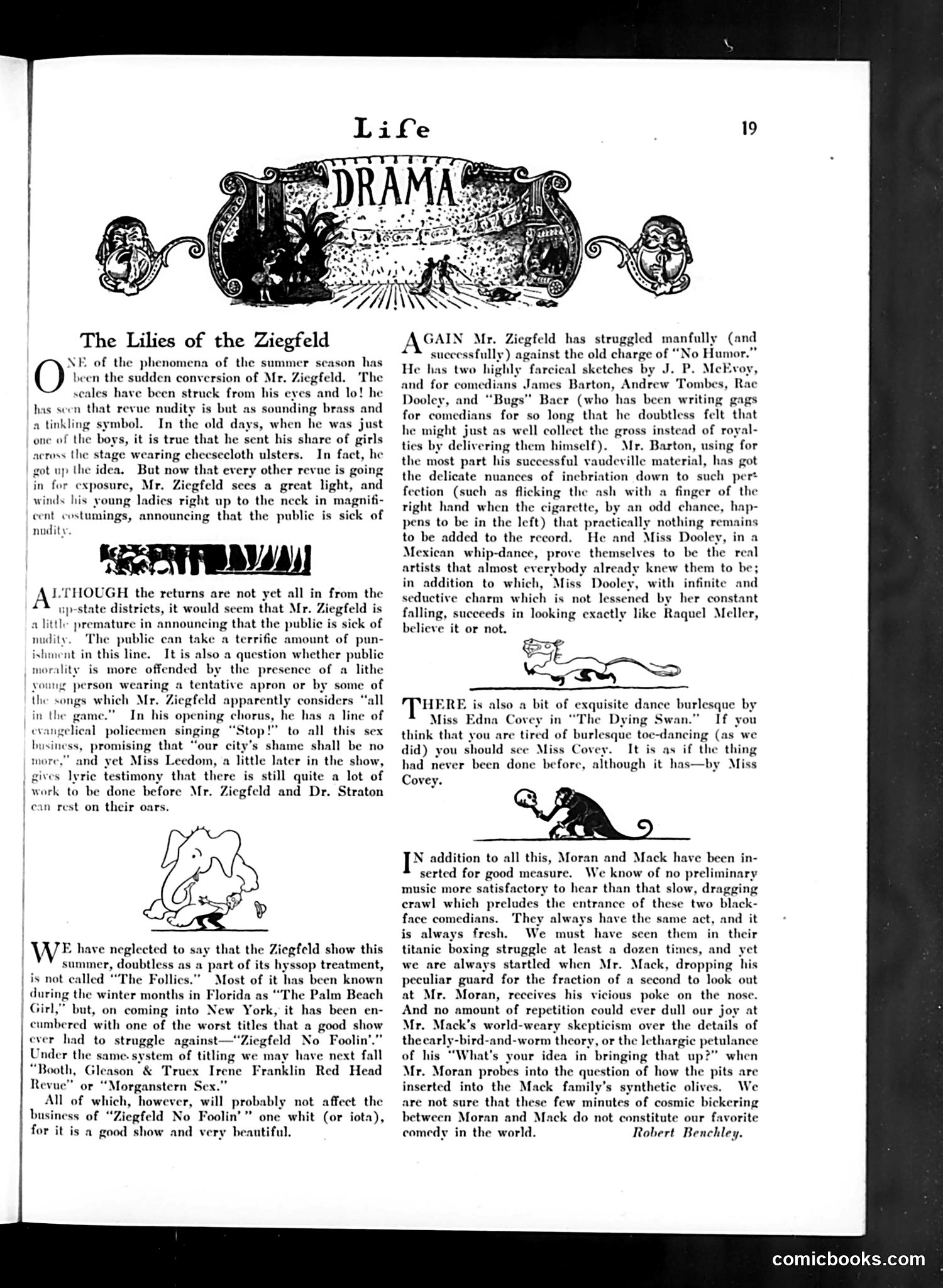
This is a theater review of Florenz Ziegfeld's revue "Ziegfeld No Foolin'" from *Life* magazine. The satire centers on Ziegfeld's sudden *claimed* shift away from nudity—historically his signature appeal—toward full costuming, claiming the public is "sick of" exposure. The reviewer is skeptical: Ziegfeld announces this moral conversion just as every competitor has adopted his former nude-heavy formula, suggesting opportunistic repositioning rather than principle. The critic doubts the public genuinely objects to nudity in revues. The piece praises specific performers (James Barton's drunk act, Miss Dooley's Mexican dance mimicking Raquel Meller, Moran and Mack's blackface comedy routine) while mocking the show's terrible title. The joke is that Ziegfeld's "purification" appears calculated—changing tactics only after nudity became industry-standard—rather than reflecting actual audience fatigue or moral awakening.
📄 Transcribed text from this page (OCR, searchable)
Machine-transcribed from the original scan — historical spelling and the odd misread are preserved.
The Lilies of the Ziegfeld O™ of the phenomena of the summer season has been the sudden conversion of Mr. Ziegfeld. The seales have been struck from his eyes and lo! he has seen that revue nudity is but as sounding brass and a tinkling symbol. In the old days, when he was just one of the boys, it is true that he sent his share of girls across the stage wearing cheesecloth ulsters. In fact, he got up the idea, But now that every other revue is going in for exposure, Mr. Ziegfeld sees a great light, and winds his young ladies right up to the neck in magnifi- cent costumings, announcing that the public is sick of AltTHouGH the returns are not yet all in from the up-state districts, it would seem that Mr. Ziegfeld is a little premature in announcing that the public kK of nudity. The public can take a terrific amount of pun- ent in this line. It is also a question whether public is more off inded. by the presence of a lithe ive apron or by some of the apparently considers “all in the opening chorus, he has a line evang singing op!” to all this sex business, promising that “our cil shame shall be no and yet Miss Leedom, a little later in the show, gives lyric testimony that there is still quite a lot of | work to be done before Mr. Ziegfeld and Dr. Straton can rest on their oars. more v y that the Ziegfeld show this part of its hyssop treatment, Most of it has been known | during the winter months in Florida as “The Palm Beach Girl,” but, on coming into New York, it has been en- cumbered with one of the worst titles that a good show ever had to struggle against—‘‘Ziegfeld No Foolin’.’ u nder the same. system of titling we may have next fall “Booth, Gleason & Truex Irene Franklin Red Head Revue” or “Morganstern Sex.” All of which, however, will probably not affect the business of “Ziegfeld No Foolin’” one whit (or iota), for it is a good show and very beautiful. Wwe have neglected to s summer, doubtles: | is not called “The Follic ASAIN Mr. Ziegfeld has struggled manfully (and against the old charge of ‘Ne Humor. He has two highly farcical sketches by McEv and for comedians J s Barton, Andrew “Temben Dooley, and “Bugs” Bacr (who has been writing gags for comedians for so long that he doubtless felt that he might just as well collect the gross instead of royal- ties by delivering them himself). Mr. Barton, using for the most part his successful vaudeville material, has got the delicate nuances of inebriation down to such per* fection (such as flicking the ash with a finger of the right hand when the cigarette, by an odd chance, hap- pens to be in the left) that practically nothing remains to be added to the record. He and s Dooley, in a Mexican whip-dance, prove themselves to be the real artists that almost everybody already knew them to be; in addition to which, Miss Dooley, with infinite and seductive charm which is not lessened by her constant falling, suceceds in looking exactly like Raquel Meller, believe it or not. dance burlesque by 1 “The Dying $ If you ou are tired of burlesque toe-d did) you should see Miss Covey. It had never been done before, although ii Covey. Miss as—by IX addition to all this, Moran and Mack have been in- erted for good measure. We know of no preliminary music more satisfactory to hear than that slow, dragging crawl which preludes the entrance of these two black- face comedians. They always have the same act, and it is always fresh. We must have seen them in their titanic boxing struggle at least a dozen times, and yet we are always startled when Mr. Mack, dropping his peculiar guard for the fraction of a second to look out at Mr. Moran, rece his vicious poke on the nose. And no amount of repetition could ever dull our joy at Mr. Mack’s world-weary skepticism over the details of thecarly-bird-and-worm theory, or the lethargic petulance of his “What's your idea in bringing that up?” when Mr. Moran probes into the question of how the pits are inserted into the Mack family’s synthetic olives. We are not sure that these few minutes of cosmic bickering between Moran and Mack do not constitute our favorite comedy in the world. Robert Benchley. comicbooks.com