
Life, 1925-02-05 · page 31 of 36
Life — February 5, 1925 — page 31: what you’re looking at
What you’re looking at
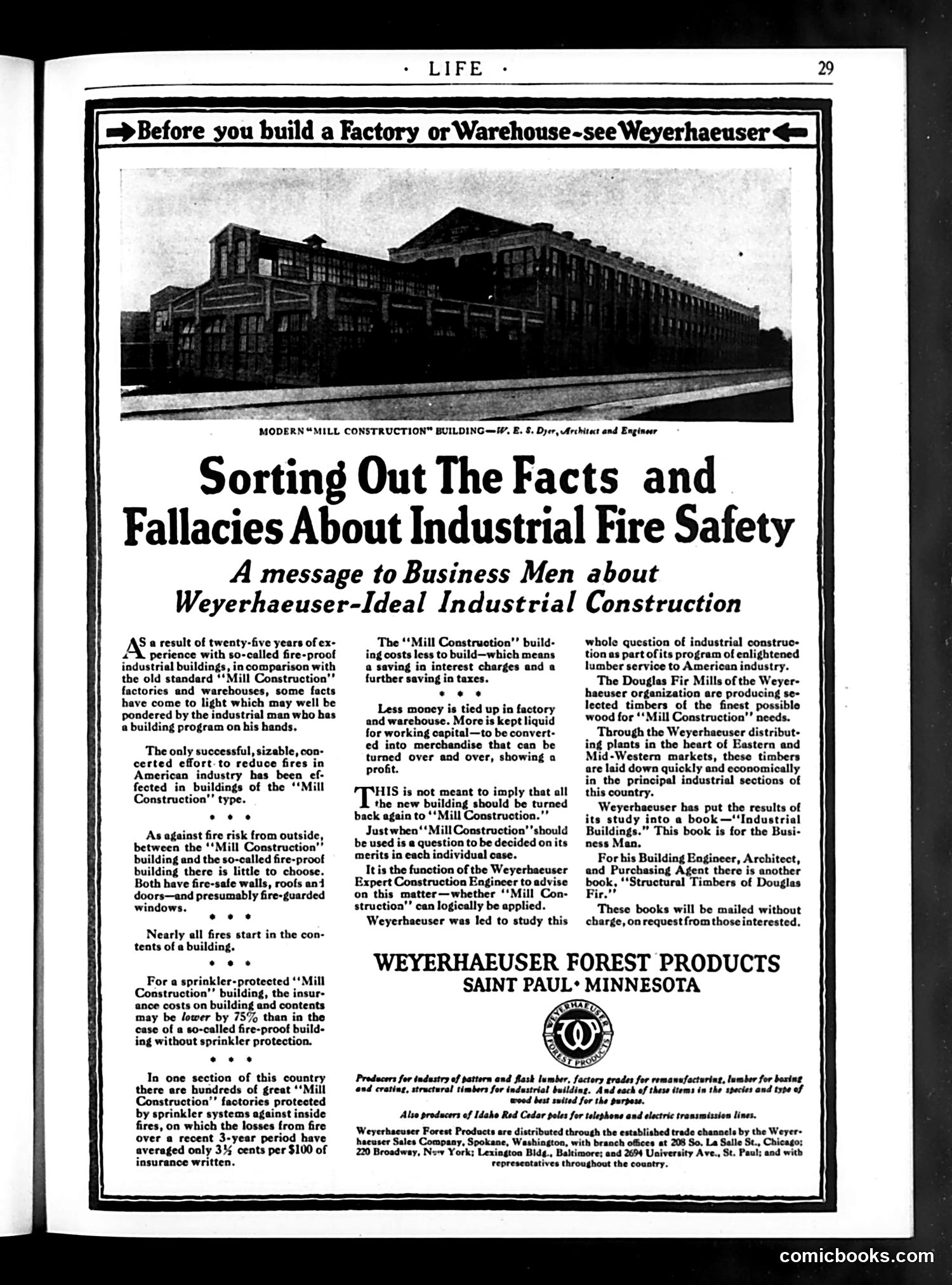
This is primarily **advertising disguised as editorial content**—a sponsored message to business owners about industrial construction, not satire or political commentary. The Weyerhaeuser Forest Products company presents itself as a neutral advisor on fire safety, claiming their "Mill Construction" method (wooden-frame factories with sprinkler systems) is cheaper and safer than conventional "fireproof" (steel/masonry) buildings. They argue fires start in *contents*, not buildings, so sprinkler protection matters more than fireproof materials. The hidden sales pitch: wooden construction uses more lumber, which Weyerhaeuser supplies profitably through their distribution network. There's no cartoon or caricature—just a photograph of a modern industrial building. The "sorting out facts and fallacies" framing suggests objectivity while actually promoting one construction method's economic advantages (lower building costs, less tied-up capital) over competitors. This represents early-20th-century corporate marketing: providing ostensibly helpful information while advancing commercial interests.
📄 Transcribed text from this page (OCR, searchable)
Machine-transcribed from the original scan — historical spelling and the odd misread are preserved.
MODERN “MILL CONSTRUCTION” BUILDING =™, B. 8. Dyer, Architect and Engineer Sorting Out The Facts and Fallacies About Industrial Fire Safety A message to Business Men about Weyerhaeuser-Ideal Industrial Construction Sa result of twenty-five years of ex- perience with so-called fire-proof industrial buildings, in comparison with the old standard ill Construction’’ factories and warehouses, some facts have come to light which may well be pondered by the industrial man who has a building program on his hands. The only successful, sizable, con- certed effort-to r American industry has been ef- fected in buildings of the ‘‘Mill Construction’’ type. As against fire risk from outs’ le, between the ‘Mill Constructi building and the so-called fire-proof building there is little to choose. Both have fire-safe walls, roofs and doors—and presumably fire-guarded windows. ee Nearly all fires start in the con- tents of a building. eee For a sprinkler-protected ‘‘Mill Construction’ building, the insur- ance costs on building and contents may be lower by 75% than in the case of a so-called fire-proof build- ing without sprinkler protection. eee In one section of this country there are hundreds of great ‘‘Mill Construction’ factories protected by sprinkler systems against inside fires, on which the losses from fire over a recent 3-year period have averaged only 34 cents per $100 of insurance written. The ‘‘Mill Construction’’ build- ing costs less to build—which means a saving i: interest charges and a further saving in taxes. cee Less money is tied up in factory and warehouse. More is kept liquid for working capital—to be convert- ed into merchandise that can be turned over and over, showing a profit. HIS is not meant to imply that all the new building should be turned back again to ‘‘Mill Construction.’’ Just when ‘‘ Mill Construction’ ’should be used is a question to be decided on its merits in each individual case. It is the function of the Weyerhaeuser Expert Construction Engineer to advise on this matter—whether ‘‘Mill Con- struction”’ can logically be applied. Weyerhaeuser was led to study this whole question of industrial construc: tion as part ofits program of enlightened lumber service to American industry. The Douglas Fir Mills of the Weyer- hacuser organization are producing se- lected timbers of the finest possible wood for ‘‘Mill Construction’’ needs. Through the Weyerhacuser distribut- ing plants in the heart of Eastern and Mid-Western markets, these timbers are laid down quickly and economically in the principal industrial sections of this country. Weyerhaeuser has put the results of its study into a book —‘‘Industrial Buildings.” This book is for the Busi- ness Man. For his Building Engineer, Architect, and Purchasing Agent there is another book, “Structural Timbers of Douglas ir.” These books will be mailed without charge, on request from those interested. WEYERHAEUSER FOREST PRODUCTS SAINT PAUL* MINNESOTA Producers for industry of pattern and flask lumber, factory grades for remanufacturing, lember for boxing and crating, structural timbers for industrial building. And each of these items in the species and type of wood best suited for the purpose. Also producers of Idaho Red Cedar poles for telephone and electric transmission lines, Weyerhaeuser Forest Products are distributed through the established trade channels by the Weyer- Popad Sales Company, Spokane, Washington, with branch offices at 208 So. La Salle Chicago; Broadway, New York; Lexington Bidg., Baltimore; and 2694 University Ave., St. P: representatives throughout the country. comicbooks.com